Shredded Parmesan (Emilian cheese)
5 Cheese Frusta
Ancient Grain Pizza
Family Style Meat Lasagna
Organic Tomato Basil Marinara
Organic Whole Wheat Spaghetti
Porcini Mushroom & Truffle Triangoli (produced in Italy)
Italian Breadsticks with Olive Oil (produced in Italy)
Lattemiele Cookies (from Piemonte)
Grifone Sangiovese (from Tuscany)
.
Sunday, February 9, 2014
Friday, January 31, 2014
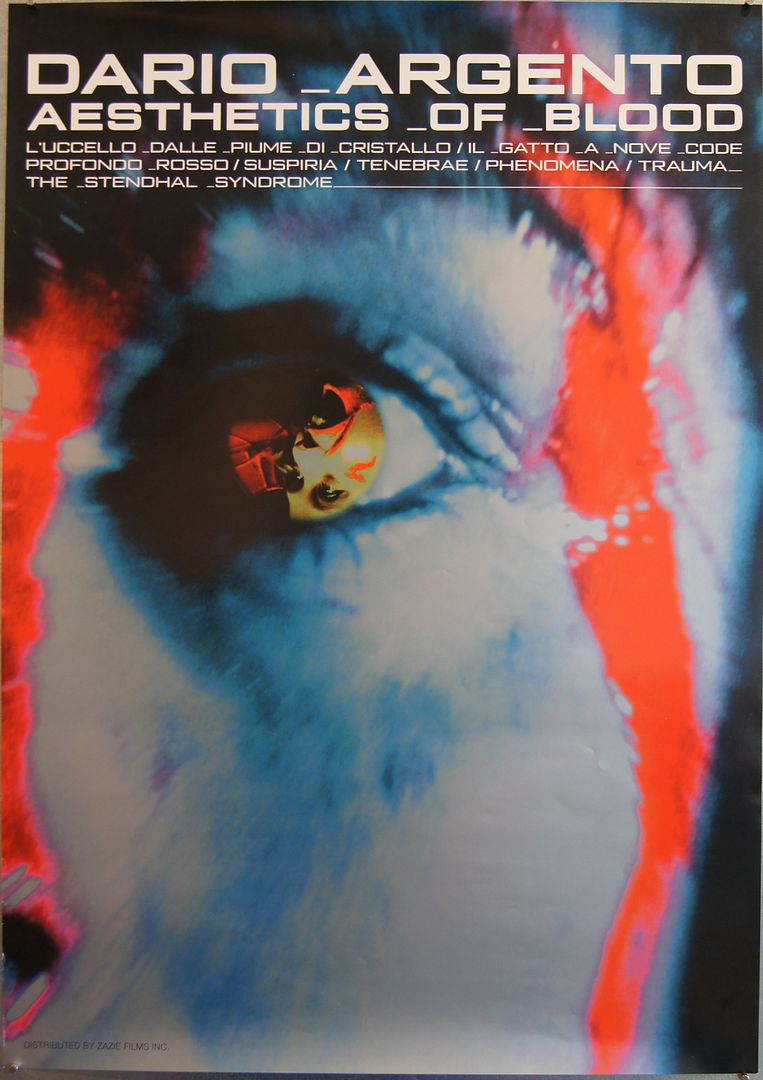
"Italian horror movies": Part 2
I have to laugh because I actually had the book to the left when I was very young. I got it for my birthday or Christmas, and it was a very good book. It covered the history up to 1974, including a lot about the Hammer films, with lots and lots of photos. Getting more back on topic, I do know that many people absolutely love Italian horror movies, going back decades. They're like Spaghetti westerns in that they have a certain style all to themselves. I found one piece of text that makes this point well.
*************************
From '12 Classic Italian Horror Movies You Need To See Before You Die' by Clare Simpson:
Hardly anything in the world gives me as much pleasure as Italian horror movies. They just make me really happy. Even the really crappy ones like Manhattan Baby (directed by Lucio Fulci) or – heaven forbid – anything directed by Bruno Mattei. Yes, I will sit down to that man’s films. I love cannibals, I love zombies, i positively adore all sorts of Italian horror based mayhem. I am also a huge fan of Giallo movies, and as some of you may have read, I wrote an article rating the best Giallo movies a while back.
The line dividing Giallo and straight out horror often becomes blurred in Italian cinema. Take a film like Torso (The Bodies Bear Traces of Carnal Violence). On one level it is a typical Giallo concerning a murder-mystery – a who dunnit with a masked killer running around – one of the most obvious motifs in the Giallo genre. On another level, it can be read as a typical straight slasher horror film – which is how it was marketed to overseas audiences.
In this list, I have mainly tried to focus on pure Italian horror, however some Giallo elements inevitably sneak in. There is a lot of pilfering and copying in Italian horror cinema, so I have attempted to pick the most original movies possible as well as the classics we all know and love. So please enjoy 12 Classic Italian Horror Movies – and if you have your own favourites please list them below.
**************************************************
If you can remember watching television before the cable-age, then you probably saw some of these movies and maybe didn't even realize that they were Italian or European. Someone compiled a list of the 50 top Italian horror directors, which gives a good quick overview of this sub-genre.
.
*************************
From '12 Classic Italian Horror Movies You Need To See Before You Die' by Clare Simpson:
Hardly anything in the world gives me as much pleasure as Italian horror movies. They just make me really happy. Even the really crappy ones like Manhattan Baby (directed by Lucio Fulci) or – heaven forbid – anything directed by Bruno Mattei. Yes, I will sit down to that man’s films. I love cannibals, I love zombies, i positively adore all sorts of Italian horror based mayhem. I am also a huge fan of Giallo movies, and as some of you may have read, I wrote an article rating the best Giallo movies a while back.
The line dividing Giallo and straight out horror often becomes blurred in Italian cinema. Take a film like Torso (The Bodies Bear Traces of Carnal Violence). On one level it is a typical Giallo concerning a murder-mystery – a who dunnit with a masked killer running around – one of the most obvious motifs in the Giallo genre. On another level, it can be read as a typical straight slasher horror film – which is how it was marketed to overseas audiences.
In this list, I have mainly tried to focus on pure Italian horror, however some Giallo elements inevitably sneak in. There is a lot of pilfering and copying in Italian horror cinema, so I have attempted to pick the most original movies possible as well as the classics we all know and love. So please enjoy 12 Classic Italian Horror Movies – and if you have your own favourites please list them below.
**************************************************
If you can remember watching television before the cable-age, then you probably saw some of these movies and maybe didn't even realize that they were Italian or European. Someone compiled a list of the 50 top Italian horror directors, which gives a good quick overview of this sub-genre.
.
Hardly
anything in the world gives me as much pleasure as Italian horror
movies. They just make me really happy. Even the really crappy ones like
Manhattan Baby (directed by Lucio Fulci) or – heaven forbid – anything
directed by Bruno Mattei. Yes, I will sit down to that man’s films. I
love cannibals, I love zombies, i positively adore all sorts of Italian
horror based mayhem. I am also a huge fan of Giallo movies, and as some
of you may have read, I wrote an article rating the best Giallo movies a
while back.
The line dividing Giallo and straight out horror often becomes blurred in Italian cinema. Take a film like Torso (The Bodies Bear Traces of Carnal Violence). On one level it is a typical Giallo concerning a murder-mystery – a who dunnit with a masked killer running around – one of the most obvious motifs in the Giallo genre. On another level, it can be read as a typical straight slasher horror film – which is how it was marketed to overseas audiences.
In this list, I have mainly tried to focus on pure Italian horror, however some Giallo elements inevitably sneak in. There is a lot of pilfering and copying in Italian horror cinema, so I have attempted to pick the most original movies possible as well as the classics we all know and love. So please enjoy 12 Classic Italian Horror Movies – and if you have your own favourites please list them below.
Read more at http://whatculture.com/film/12-classic-italian-horror-movies-you-need-to-see-before-you-die.php#t7ZFKkbzaIOWlBm3.99
The line dividing Giallo and straight out horror often becomes blurred in Italian cinema. Take a film like Torso (The Bodies Bear Traces of Carnal Violence). On one level it is a typical Giallo concerning a murder-mystery – a who dunnit with a masked killer running around – one of the most obvious motifs in the Giallo genre. On another level, it can be read as a typical straight slasher horror film – which is how it was marketed to overseas audiences.
In this list, I have mainly tried to focus on pure Italian horror, however some Giallo elements inevitably sneak in. There is a lot of pilfering and copying in Italian horror cinema, so I have attempted to pick the most original movies possible as well as the classics we all know and love. So please enjoy 12 Classic Italian Horror Movies – and if you have your own favourites please list them below.
Read more at http://whatculture.com/film/12-classic-italian-horror-movies-you-need-to-see-before-you-die.php#t7ZFKkbzaIOWlBm3.99

Labels:
art,
culture,
film,
horror film genre,
Italian horror genre,
italy,
movies
Thursday, January 30, 2014
"Italian horror movies": Part 1
I have a lot of loose-end ideas about this subject, so I think I will just bounce around here a little bit. So, this may not follow any consistent pattern. The horror film genre has long been a sub-industry in of itself, as it has been something basically "apart" from mainstream Hollywood. Every year, going back to the 70s, this genre has produced many low-budget films; as evidenced by all of those late-night movies on second-tier cable networks like Cinemax since the 80s, or the seemingly endless stream of direct-to-video movies that you probably saw in the now disappearing video rental stores.
It has become much more mainstream in recent years, but the independent element is as strong as ever. I have always enjoyed horror movies. I'm not as much for zombie or slasher films. I prefer paranormal or mystery-based thrillers. Horror films seem to be a refreshing creative license for the producers to take chances, be overzealous, be silly, be shocking--without the worry of too much artistic criticism. Of course, there is the more finely artistic element to it. The rest mostly fall into the category of exploitation films.
The Europeans have been at least as much the early pioneers of this genre. The 1922 silent German horror film 'Nosferatu' is regarded as "an influential masterpiece of cinema," and clearly a forerunner of the early classic American horror films. The "Hammer films" from the UK were very popular in the United States going back many decades, especially in the 60s and 70s. Recently I watched again the Hammer film 'Tales from the Crypt (1972), and it was very eery. I think that someone who is not a particular fan of this genre would probably enjoy being creeped out by it. It was eerily though-provoking.
The "cabin in the woods" concept has long been a favorite backdrop; as it forms a little world unto itself... in which the story unfolds. Just last week, the Independent Film Channel had a double-feature of just this theme: 'Cabin Fever' (2002), an American film; and 'The Last House in the Woods' (2006), an Italian film. This popular horror flick was something like an Italian version of 'The Texas Chainsaw Massacre'. I don't know much about Italian horror in particular, but I know that Dario Argento has long been a big name in this genre. I recall watching some of these films as a kid, often late at night, and wasn't even aware that they were from Italy... or Germany, Spain, etc. I specifically remember one called 'Bay of Blood' (1971), directed by Mario Brava.
I recall one time a friend who really knows a lot about the Italian horror genre mentioning that Anna Falchi had appeared in many of these films and is well-known in Europe as a "scream queen." In the United States, to me, Linnea Quigley is one that comes to mind in this category. Elizabeth Kaitan is another one that I really remember. American Theaters which played the exploitation films within this genre were called "Grindhouse" theaters. I don't know of any theater that specifically fits that description anymore, but it's a curious concept. One exploitation horror film which I thought was eerily artistic was Rob Zombie's 'House of 1000 Corpses' (2003).
When I was a child in the Bay Area, there was a program on KTVU called 'Creature Features' (1971-1984). Actually this apparently was a syndicated program, and this was our locally-hosted broadcast. This was a much bigger cultural element since there weren't the cable channels, internet, video games, IPad's, etc. as there is now. This was even before VCR's! Locally it was hosted by the late Bob Wilkins, who was a unique type of host who always kept everyone up-to-date on the horror or similar conventions that would come around. One movie that was frequently broadcast was George Romero's 'Night of the Living Dead' due to its popularity. That movie, and Romero's films since, have directly led to this "zombie craze" that we see today.
I had mentioned earlier the 1922 move 'Nosferatu'. In 2000, there was a British "remake" of a sort called 'Shadow of the Vampire', staring John Malkovich and Willem Dafoe. I thought it was worth a mention because it was somehow an acknowledgement of the whole of this element of our culture since 1922... and it was a good movie. Interestingly, it was a fictional horror movie about the "making" of the original film in Slovakia.
.
It has become much more mainstream in recent years, but the independent element is as strong as ever. I have always enjoyed horror movies. I'm not as much for zombie or slasher films. I prefer paranormal or mystery-based thrillers. Horror films seem to be a refreshing creative license for the producers to take chances, be overzealous, be silly, be shocking--without the worry of too much artistic criticism. Of course, there is the more finely artistic element to it. The rest mostly fall into the category of exploitation films.
The Europeans have been at least as much the early pioneers of this genre. The 1922 silent German horror film 'Nosferatu' is regarded as "an influential masterpiece of cinema," and clearly a forerunner of the early classic American horror films. The "Hammer films" from the UK were very popular in the United States going back many decades, especially in the 60s and 70s. Recently I watched again the Hammer film 'Tales from the Crypt (1972), and it was very eery. I think that someone who is not a particular fan of this genre would probably enjoy being creeped out by it. It was eerily though-provoking.
The "cabin in the woods" concept has long been a favorite backdrop; as it forms a little world unto itself... in which the story unfolds. Just last week, the Independent Film Channel had a double-feature of just this theme: 'Cabin Fever' (2002), an American film; and 'The Last House in the Woods' (2006), an Italian film. This popular horror flick was something like an Italian version of 'The Texas Chainsaw Massacre'. I don't know much about Italian horror in particular, but I know that Dario Argento has long been a big name in this genre. I recall watching some of these films as a kid, often late at night, and wasn't even aware that they were from Italy... or Germany, Spain, etc. I specifically remember one called 'Bay of Blood' (1971), directed by Mario Brava.
I recall one time a friend who really knows a lot about the Italian horror genre mentioning that Anna Falchi had appeared in many of these films and is well-known in Europe as a "scream queen." In the United States, to me, Linnea Quigley is one that comes to mind in this category. Elizabeth Kaitan is another one that I really remember. American Theaters which played the exploitation films within this genre were called "Grindhouse" theaters. I don't know of any theater that specifically fits that description anymore, but it's a curious concept. One exploitation horror film which I thought was eerily artistic was Rob Zombie's 'House of 1000 Corpses' (2003).
When I was a child in the Bay Area, there was a program on KTVU called 'Creature Features' (1971-1984). Actually this apparently was a syndicated program, and this was our locally-hosted broadcast. This was a much bigger cultural element since there weren't the cable channels, internet, video games, IPad's, etc. as there is now. This was even before VCR's! Locally it was hosted by the late Bob Wilkins, who was a unique type of host who always kept everyone up-to-date on the horror or similar conventions that would come around. One movie that was frequently broadcast was George Romero's 'Night of the Living Dead' due to its popularity. That movie, and Romero's films since, have directly led to this "zombie craze" that we see today.
I had mentioned earlier the 1922 move 'Nosferatu'. In 2000, there was a British "remake" of a sort called 'Shadow of the Vampire', staring John Malkovich and Willem Dafoe. I thought it was worth a mention because it was somehow an acknowledgement of the whole of this element of our culture since 1922... and it was a good movie. Interestingly, it was a fictional horror movie about the "making" of the original film in Slovakia.
.
Labels:
art,
Europe,
film,
horror film genre,
Italian horror genre,
italy,
movies,
United States
Friday, January 17, 2014
Giorgio de Santillana
Giorgio de Santillana [Wikipedia]
Giorgio Diaz de Santillana (Rome, 30 May 1902 – Beverly, Massachusetts, 1974) was an Italian-American philosopher of science and historian of science, and professor at MIT. He moved to the United States in 1936 and became a naturalized US citizen in 1945. In 1948, he married. In 1941 he commenced his academic career at the Massachusetts Institute of Technology (MIT), becoming an Assistant Professor the following year. From 1943 to 1945 he served in the United States Army as a war correspondent. Following the war, in 1945 he returned to MIT and was made an Associate Professor in 1948 and a full Professor of the History of Science in the School of Humanities in 1954. In 1969, he published a book entitled: Hamlet's Mill, An Essay on Myth and the Frame of Time with Dr. Hertha von Dechend. This book focussed upon the understanding of the connection between the mythological stories of Pharaonic Egypt, Babylon, Greece, Christianity, etc. and the ancient observations pertaining to the stars, planets and, most notably, the 26,000 year precession of the equinoxes.[1]
Isis, a professional journal of the history of science, included an obituary by friend, Professor Nathan Sivin in Volume 67 (1976), pages 439-443. An excerpt can be found online.
http://platonism347.tripod.com/de_santillana.htm
Bibliography
Development of rationalism and empiricism. With Edgar Zilsel. Chicago: University of Chicago Press, 1941. (International encyclopedia of unified science Foundations of the unity of science ; v2 no.8).
Leonardo Da Vinci (1956)
Crime of Galileo. London: Heinemann, 1958.
The Origins of Scientific Thought: from Anaximander to Proclus, 600 BC to 300 AD. London: Weidenfeld & Nicolson, 1961.
Reflections on Men and Ideas (1968)
Hamlet's Mill. With Hertha von Dechend (1915–2001). Boston: Gambit Inc., 1969.
The Mentor Philosophers: The Age of Adventure: Renaissance Philosophers
Further reading
Payne-Gaposchkin, Cecilia (1972). "Review of Hamlet's Mill, by Giorgio de Santillana and Hertha von Dechend". Journal for the History of Astronomy 3: 206–211. Bibcode:1972JHA.....3..206P.
**************************************************
From the video (YouTube user cfapps7865)
Joe and John Anthony West discuss the theory behind one of my all time favorite books, 'Hamlet's Mill' written by Giorgio de Santillana and Hertha von Dechen. This fascinating,.. but of course highly criticized book brings into question the self-congratulatory assumptions of Western science about the unfolding development and transmission of knowledge. This is a truly seminal and original thesis, a book that should be read by anyone interested in myth and science, and the interactions between the two.
From book: "Mistaking cultural history for a process of gradual evolution, we have deprived ourselves of every reasonable insight into the nature of culture. It goes without saying that the still more modern habit of replacing "culture" by "society" has blocked the last narrow path to understanding history. Our ignorance not only remained vast, but became pretentious as well." (page 71)
From The Joe Rogan Experience, Podcast 226
Full interview:
http://www.youtube.com/watch?v=swEmL2a-h5o
http://en.wikipedia.org/wiki/Hamlet%27s_Mill
http://www.bibliotecapleyades.net/hamlets_mill/hamletmill.htm
http://podcasts.joerogan.net/
**************************************************
From MaverickScience.com
We are not alone in this belief. For several decades now, the words of Giorgio de Santillana and Hertha von Dechend have served as a rallying cry for those of us who believe ancient astronomical conceptions pervade myth:
"The real actors on the stage of the universe are very few, if their adventures are many. The most 'ancient treasure'--in Aristotle's word--that was left to us by our predecessors of the High and Far-Off Times was the idea that the gods are really stars, and that there are no others. The forces reside in the starry heavens, and all the stories, characters and adventures narrated by mythology concentrate on the active powers among the stars, who are the planets."
--'Hamlet's Mill
**************************************************
An emerging pioneer, beyond his lifetime
Giorgio de Santilana was a pioneer into areas of revisionist science which are too numerous to go into detail about now, including the scientific basis for astrology, the electric universe, Saturn as a dwarf star, the Venus-Mars connection, and the reconfiguration of our solar system.
**************************************************
1-19-14 Addition: I couldn't help but add here the irony that Santilana was from Rome, where Saturn was a very big part of Rome's ancient spirituality and culture. In fact, the archaic name for the Roman-Italian peninsula was "Saturnia." The irony being that Saturn is extremely relevant in his theories, which are only gaining momentum now.
.
Labels:
ancient history,
anthropology,
astrology,
astronomy,
Giorgio de Santillana,
revisionism,
science
Tuesday, December 31, 2013
Fibonacci: Sacred Geometry in Nature
The above video is part of a short movie from Spain inspired by Fibonacci, numbers, geometry, and nature. As remarkable as it it today to witness science decoding of the codes of nature, Leonardo Fibonacci accomplished a significant part of this in the early 1200's. So significant is the "Fibonacci sequence" that it is just as relevant today. Using the scientific method of the Fibonacci number sequence, American Dr. Stephen Marquardt was able to tie these mathmatics to the beauty ratio of the human face. Sometimes the image of the core of the shell of a snail or of marine life is used as a symbol of the "Fibonacci number." This number code exists deep in nature.
*************************
Fibonacci (Wikipedia)
Leonardo Pisano Bigollo (c. 1170 – c. 1250) – known as Fibonacci, and also Leonardo of Pisa, Leonardo Pisano, Leonardo Bonacci, Leonardo Fibonacci – was an Italian mathematician, considered by some "the most talented western mathematician of the Middle Ages."
Fibonacci is best known to the modern world for the spreading of the Hindu–Arabic numeral system in Europe, primarily through his composition in 1202 of Liber Abaci (Book of Calculation), and for a number sequence named the Fibonacci numbers after him, which he did not discover but used as an example in the Liber Abaci.
*************************
"All life is biology. All biology is physiology. All physiology is chemistry. All chemistry is physics. All physics is math."
--Dr. Stephen Marquardt
.
Labels:
Fibonacci,
geometry,
mathmatics,
Middle Ages,
nature,
numbers,
Pisa,
science,
Tuscany
Saturday, November 30, 2013
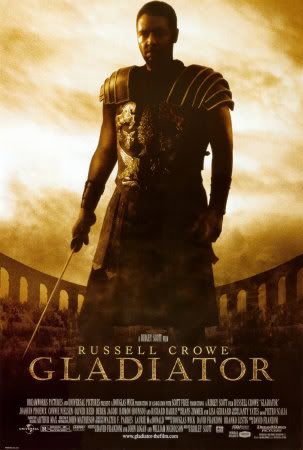
'Gladiator' movie review
'Gladiator' (2000 film) [Wikipedia]
Gladiator is a 2000 British–American epic historical drama film directed by Ridley Scott, starring Russell Crowe, Joaquin Phoenix, Connie Nielsen, Ralf Möller, Oliver Reed (in his final film role), Djimon Hounsou, Derek Jacobi, John Shrapnel, and Richard Harris. Crowe portrays the fictional character, loyal Roman general Maximus Decimus Meridius, who is betrayed when the emperor's ambitious son, Commodus, murders his father and seizes the throne. Reduced to slavery, Maximus rises through the ranks of the gladiatorial arena to avenge the murder of his family and his emperor.
Released in the United States on May 5, 2000, Gladiator was a box office success, receiving positive reviews, and was credited with rekindling interest in the historical epic. The film was nominated for and won multiple awards, notably five Academy Awards in the 73rd Academy Awards including Best Picture and Best Actor for Crowe.
This is a movie that has been reviewed so many times that I think that I will go a little further along the lines of looking at it from a Cisalpine perspective. Just from the get-go, this was a great movie. Great plot, great flow, great scenes, great performances, and great cinematography. Along with 'Braveheart', this was probably the greatest movie of it's type in the last three decades or more. Of particular interest was the computer-generated imagery.. in this, the digital era of film making.
Unlike 'Braveheart', which presented itself from the opposite perspective of the larger domineering military superpower, 'Gladiator' firmly took the stance that "glorious Rome" had a right to forcefully promote it's benevolent "idea" upon other cultures. Maximus described Rome as "the light" in a cruel dark world; while Senator Falco said in reference to the resisting Germanic tribes: "A people should know when they're conquered." The film seems to have been loosely based upon Julius Caesar and the Roman conquest of Gaul, as well as the Battle of the Teutoburg Forest. Only--in this case--with the Romans winning in Germania.
Set in 180 AD, the protagonist--Maximus--is referred to throughout the film as "the Spaniard." This would mean that he was a Romanized Celtiberian from the Roman province of Hispaniola (Spain), who rose through the military ranks to become a general. In the first scene, the Roman-German battle, the fearsome Roman weapons of war were put on display. Large fireballs were launched from huge catapults, hitting the battlefield like a modern air bombing. Large arrows were cranked up and fired from steel-plated cannons with devastating results. This army would frighten most modern armies in the world.
Leading up to the battle, General Maximus gave one of the great quotes from the movie. This movie was full of them.
[addressing his troops] Maximus: Fratres!
[cavalry addresses Maximus]
Maximus: Three weeks from now, I will be harvesting my crops. Imagine where you will be, and it will be so. Hold the line! Stay with me! If you find yourself alone, riding in the green fields with the sun on your face, do not be troubled. For you are in Elysium, and you're already dead!
[cavalry laughs]
Maximus: Brothers, what we do in life echoes in eternity.
The last line could just stand on it's own as a quote. I thought the earlier part was interesting in that "Elysium" would have apparently been the Roman equivalent of the Odinic "Valhalla." Also, the motivational speech was the 'Gladiator' equivalent to the speech in 'Braveheart'. The one difference being that the Romans were powerful and self-confident; while the Scots in 'Braveheart' needed to gather themselves to fight a larger powerful army... therefore, the more emotional speech.
Another quote which I thought was interesting was a line that Marcus Aurelius said to his daughter Lucilla: "If only you had been born a man, what a Caesar you would have made." It was an indirect reference to his son Commodus not being a viable choice as a successor; and really, for me at least, more of a reflection on the strong and noble character of Lucilla. That's the type of woman that you would want to govern!
In case you didn't know, the acronym "SPQR" is the Roman equivalent of "USA." Senātus Populusque Rōmānus ("The Senate and People of Rome").
Watching the movie, you can't help but notice the similarity between the "bloodsport" of the Roman Colosseum and the very rough modern sporting contests (soccer, rugby, American football, hockey, boxing, UFC, etc.). The first fight scene in the Colosseum reminded me of a football game! The deadly collisions were like big football hits. Even when a sword was tossed up to Maximus on a horse, it was like a quarterback pitching the football to a halfback.
In an earlier bloodsport scene, Maximus--after defeating his opponents in a life-and-death struggle--throws his sword into the columned box where the dignitaries sat (sort've like a press box?), and yelled out with outstretched arms "Are you not entertained! ...... Are you not entertained!!" in what seemed to be a mocking gesture.
Late in yesterday's 49ers-Seahawks game, a 49er defensive back named Eric Wright was kneed in the head and had to leave the game. Since it was a big game, he later returned, and ended up intercepting a pass to secure a victory. He returned from injury to "win" and "entertain" for the crowd. The Maximus line would have been very apt.
I should add that the digital imagery of what the Colosseum really looked like was very interesting, as-well-as much of the background scenery. This is one of those movies that a film buff would have a field day researching and collecting. I can't really do it justice. The acting performances were particularly good.
.
Gladiator is a 2000 British–American epic historical drama film directed by Ridley Scott, starring Russell Crowe, Joaquin Phoenix, Connie Nielsen, Ralf Möller, Oliver Reed (in his final film role), Djimon Hounsou, Derek Jacobi, John Shrapnel, and Richard Harris. Crowe portrays the fictional character, loyal Roman general Maximus Decimus Meridius, who is betrayed when the emperor's ambitious son, Commodus, murders his father and seizes the throne. Reduced to slavery, Maximus rises through the ranks of the gladiatorial arena to avenge the murder of his family and his emperor.
Released in the United States on May 5, 2000, Gladiator was a box office success, receiving positive reviews, and was credited with rekindling interest in the historical epic. The film was nominated for and won multiple awards, notably five Academy Awards in the 73rd Academy Awards including Best Picture and Best Actor for Crowe.
This is a movie that has been reviewed so many times that I think that I will go a little further along the lines of looking at it from a Cisalpine perspective. Just from the get-go, this was a great movie. Great plot, great flow, great scenes, great performances, and great cinematography. Along with 'Braveheart', this was probably the greatest movie of it's type in the last three decades or more. Of particular interest was the computer-generated imagery.. in this, the digital era of film making.
Unlike 'Braveheart', which presented itself from the opposite perspective of the larger domineering military superpower, 'Gladiator' firmly took the stance that "glorious Rome" had a right to forcefully promote it's benevolent "idea" upon other cultures. Maximus described Rome as "the light" in a cruel dark world; while Senator Falco said in reference to the resisting Germanic tribes: "A people should know when they're conquered." The film seems to have been loosely based upon Julius Caesar and the Roman conquest of Gaul, as well as the Battle of the Teutoburg Forest. Only--in this case--with the Romans winning in Germania.
Set in 180 AD, the protagonist--Maximus--is referred to throughout the film as "the Spaniard." This would mean that he was a Romanized Celtiberian from the Roman province of Hispaniola (Spain), who rose through the military ranks to become a general. In the first scene, the Roman-German battle, the fearsome Roman weapons of war were put on display. Large fireballs were launched from huge catapults, hitting the battlefield like a modern air bombing. Large arrows were cranked up and fired from steel-plated cannons with devastating results. This army would frighten most modern armies in the world.
[addressing his troops] Maximus: Fratres!
[cavalry addresses Maximus]
Maximus: Three weeks from now, I will be harvesting my crops. Imagine where you will be, and it will be so. Hold the line! Stay with me! If you find yourself alone, riding in the green fields with the sun on your face, do not be troubled. For you are in Elysium, and you're already dead!
[cavalry laughs]
Maximus: Brothers, what we do in life echoes in eternity.
The last line could just stand on it's own as a quote. I thought the earlier part was interesting in that "Elysium" would have apparently been the Roman equivalent of the Odinic "Valhalla." Also, the motivational speech was the 'Gladiator' equivalent to the speech in 'Braveheart'. The one difference being that the Romans were powerful and self-confident; while the Scots in 'Braveheart' needed to gather themselves to fight a larger powerful army... therefore, the more emotional speech.
Another quote which I thought was interesting was a line that Marcus Aurelius said to his daughter Lucilla: "If only you had been born a man, what a Caesar you would have made." It was an indirect reference to his son Commodus not being a viable choice as a successor; and really, for me at least, more of a reflection on the strong and noble character of Lucilla. That's the type of woman that you would want to govern!
In case you didn't know, the acronym "SPQR" is the Roman equivalent of "USA." Senātus Populusque Rōmānus ("The Senate and People of Rome").
Watching the movie, you can't help but notice the similarity between the "bloodsport" of the Roman Colosseum and the very rough modern sporting contests (soccer, rugby, American football, hockey, boxing, UFC, etc.). The first fight scene in the Colosseum reminded me of a football game! The deadly collisions were like big football hits. Even when a sword was tossed up to Maximus on a horse, it was like a quarterback pitching the football to a halfback.
In an earlier bloodsport scene, Maximus--after defeating his opponents in a life-and-death struggle--throws his sword into the columned box where the dignitaries sat (sort've like a press box?), and yelled out with outstretched arms "Are you not entertained! ...... Are you not entertained!!" in what seemed to be a mocking gesture.
Late in yesterday's 49ers-Seahawks game, a 49er defensive back named Eric Wright was kneed in the head and had to leave the game. Since it was a big game, he later returned, and ended up intercepting a pass to secure a victory. He returned from injury to "win" and "entertain" for the crowd. The Maximus line would have been very apt.
I should add that the digital imagery of what the Colosseum really looked like was very interesting, as-well-as much of the background scenery. This is one of those movies that a film buff would have a field day researching and collecting. I can't really do it justice. The acting performances were particularly good.
.
Labels:
ancient Rome,
art,
film,
movies,
Roman Colosseum,
sport
Thursday, October 31, 2013
Pegasus - The flag of Tuscany
Flag of Tuscany (Flags of the World)
Description of the Flag
The gonfalon was adopted on the 20th May 1975 and readopted with the coat of arms on the 3rd February 1995. The coat of arms is a sannitic shield, gules a Pegasus argent. The gonfalon is white with two narrow vertical red stripes, and the Pegasus in the middle. The words Regione Toscana appear under in silver. The Pegasus was the symbol of the Toscan National Liberation Committee during the Second World War.
--Pascal Vagnat, 22 September 1998
The white on red stripes are possibly derived from the red-white-red triband (the Austrian colours) adopted by Tuscany in the latter half of the 18th Century and dropped in 1848.
--Christopher Southworth, 14 September 2003
The pegasus image on the flag, gonfanon and arms has been taken from a coin made by the Florentine artist Benvenuto Cellini (the one who made the famous Perseo statue) in 1537. This coin can be seen in the National Museum of Bargello in Florence. White and red have been the traditional colors of Toscana since long time, not only during the Grand-Ducal period. Also note that white and red are the traditional colors of most Tuscan towns, including Firenze, Pistoia, Lucca, Pisa and Grosseto.
Pegasus (Wikipedia)
Pegasus (Ancient Greek: Πήγασος, Pégasos, Latin Pegasus) is one of the best known mythological creatures in Greek mythology. He is a winged divine stallion usually depicted as pure white in colour. He was sired by Poseidon, in his role as horse-god, and foaled by the Gorgon Medusa. He was the brother of Chrysaor, born at a single birthing when his mother was decapitated by Perseus. Greco-Roman poets write about his ascent to heaven after his birth and his obeisance to Zeus, king of the gods, who instructed him to bring lightning and thunder from Olympus. Friend of the Muses, Pegasus is the creator of Hippocrene, the fountain on Mt. Helicon. He was captured by the Greek hero Bellerophon near the fountain Peirene with the help of Athena and Poseidon. Pegasus allows the hero to ride him to defeat a monster, the Chimera, before realizing many other exploits. His rider, however, falls off his back trying to reach Mount Olympus. Zeus transformed him into the constellation Pegasus and placed him up in the sky.
Hypotheses have been proposed regarding its relationship with the Muses, the gods Athena, Poseidon, Zeus, Apollo, and the hero Perseus.
The symbolism of Pegasus varies with time. Symbol of wisdom and especially of fame from the Middle Ages until the Renaissance, he became one symbol of the poetry and the creator of sources in which the poets come to draw inspiration, particularly in the 19th century. Pegasus is the subject of a very rich iconography, especially through the ancient Greek pottery and paintings and sculptures of the Renaissance. Personification of the water, solar myth, or shaman mount, Carl Jung and his followers have seen in Pegasus a profound symbolic esoteric in relation to the spiritual energy that allows to access to the realm of the gods on Mount Olympus.
White horse (mythology) [Wikipedia]
White horses (which are rarer than other colours of horse) have a special significance in the mythologies of cultures around the world. They are often associated with the sun chariot, with warrior-heroes, with fertility (in both mare and stallion manifestations), or with an end-of-time saviour, but other interpretations exist as well. Both truly white horses and the more common grey horses, with completely white hair coats, were identified as "white" by various religious and cultural traditions.
Mythologies and traditions
European
Celtic
In Celtic mythology, Rhiannon, a mythic figure in the Mabinogion collection of legends, rides a "pale-white" horse. Because of this, she has been linked to the Romano-Celtic fertility horse goddess Epona and other instances of the veneration of horses in early Indo-European culture.
White horses are the most common type of hill figure in England. Though many are modern, the Uffington White Horse at least dates back to the Bronze Age.
In Scottish folklore, the kelpie or each uisge, a deadly supernatural water demon in the shape of a horse, is sometimes described as white, though other stories say it is black.
Greek
In Greek mythology, the white winged horse Pegasus was the son of Poseidon and the gorgon Medusa. Poseidon was also the creator of horses, creating them out of the breaking waves when challenged to make a beautiful land animal.
Norse
In Norse mythology, Odin's eight-legged horse Sleipnir, "the best horse among gods and men", is described as gray. Sleipnir is also the ancestor of another gray horse, Grani, who is owned by the hero Sigurd.
Slavic
In Slavic mythology, the war and fertility deity Svantovit owned an oracular white horse; the historian Saxo Grammaticus, in descriptions similar to those of Tacitus centuries before, says the priests divined the future by leading the white stallion between a series of fences and watching which leg, right or left, stepped first in each row.
Finno-Ugric
The war god in Hungarian mythology was Hadúr, who wears pure copper and is a metalsmith. The ancient Magyars sacrificed white stallions to him before a battle. Additionally, there is a story (mentioned for example in Gesta Hungarorum) that conquering Magyars paid a white horse to Moravian chieftain Svatopluk I (in other forms of the story, it is instead the Bulgarian chieftain Salan) for a part of the land that later became the Kingdom of Hungary.[citation needed] Actual historical background of the story is dubious because Svatopluk I was already dead when the first Hungarian tribes arrived. On the other hand, even Herodotus mentions in his Histories an Eastern custom, where sending a white horse as payment in exchange for land means casus belli. This custom roots in the ancient Eastern belief that stolen land would lose its fertility.
Four Horsemen of the Apocalypse (Wikipedia)
The Four Horsemen of the Apocalypse are described in the last book of the New Testament of the Bible, called the Book of Revelation of Jesus Christ to Saint John the Evangelist at 6:1-8. The chapter tells of a "'book', or 'scroll', in God's right hand that is sealed with seven seals". The Lamb of God, or Lion of Judah (Jesus Christ), opens the first four of the seven seals, which summons four beings that ride out on white, red, black, and pale horses. Although some interpretations differ, in most accounts, the four riders are seen as symbolizing Conquest, War, Famine, and Death, respectively. The Christian apocalyptic vision is that the four horsemen are to set a divine apocalypse upon the world as harbingers of the Last Judgment.
White Horse
I watched as the Lamb opened the first of the seven seals. Then I heard one of the four living creatures say in a voice like thunder, "Come and see!" I looked, and there before me was a white horse! Its rider held a bow, and he was given a crown, and he rode out as a conqueror bent on conquest.
--Revelation 6:1-2
Due to the above passage (the most common translation into English), the white rider is referred to as Conquest (not Pestilence, see below). The name could also be construed as "Victory," per the translation found in the Jerusalem Bible (the Greek words are derived from the verb νικάω, to conquer or vanquish). He carries a bow, and wears a victor's crown.
As evil
Artwork which shows the horsemen as a group, such as the famous woodcut by Albrecht Dürer, suggests an interpretation where all four horsemen represent different aspects of the same tribulation.
The first horseman is often associated with military conquest. One interpretation, which was held by evangelist Billy Graham, casts the rider of the white horse as the Antichrist, or a representation of false prophets, citing differences between the white horse in Revelation 6 and Jesus on the white Horse in Revelation 19. In Revelation 19, Jesus has many crowns, but in Revelation 6 the rider has just one.
As righteous
Irenaeus, an influential Christian theologian of the 2nd century, was among the first to interpret this horseman as Christ himself, his white horse representing the successful spread of the gospel. Various scholars have since supported this notion, citing the later appearance, in Revelation 19, of Christ mounted on a white horse, appearing as The Word of God. Furthermore, earlier in the New Testament, the Book of Mark indicates that the advance of the gospel may indeed precede and foretell the apocalypse. The color white also tends to represent righteousness in the Bible, and Christ is in other instances portrayed as a conqueror. However, opposing interpretations argue that the first of the four horsemen is probably not the horseman of Revelation 19. They are described in significantly different ways, and Christ's role as the Lamb who opens the seven seals makes it unlikely that he would also be one of the forces released by the seals.
Besides Christ, the horseman could represent the Holy Spirit. The Holy Spirit was understood to have come upon the Apostles at Pentecost after Jesus' departure from Earth. The appearance of the Lamb in Revelation 5 shows the triumphant arrival of Jesus in Heaven, and the white horseman could represent the sending of the Holy Spirit by Jesus and the advance of the gospel of Jesus Christ.
Globalist/UN Ideology
"We are in charge of God's selection process for planet Earth. He selects, we destroy. We are the riders of the Pale Horse, death. We do this for the sake of the world."
--Barbara Marx-Hubbard
Barbara Marx-Hubbard couldn't fight her way out've a wet paper bag, but the forces behind words should be taken seriously. However, this is an example of the "White Horse" symbology used within a Biblical meaning.
Other
WHITE HORSE - linked to instinct, purity and the drive of the physical body to release powerful and emotional forces, like rage with ensuing chaos and destruction.
--Excerpt from 'The Subconscious Psychosis of Dreams'
.
Description of the Flag
The gonfalon was adopted on the 20th May 1975 and readopted with the coat of arms on the 3rd February 1995. The coat of arms is a sannitic shield, gules a Pegasus argent. The gonfalon is white with two narrow vertical red stripes, and the Pegasus in the middle. The words Regione Toscana appear under in silver. The Pegasus was the symbol of the Toscan National Liberation Committee during the Second World War.
--Pascal Vagnat, 22 September 1998
The white on red stripes are possibly derived from the red-white-red triband (the Austrian colours) adopted by Tuscany in the latter half of the 18th Century and dropped in 1848.
--Christopher Southworth, 14 September 2003
The pegasus image on the flag, gonfanon and arms has been taken from a coin made by the Florentine artist Benvenuto Cellini (the one who made the famous Perseo statue) in 1537. This coin can be seen in the National Museum of Bargello in Florence. White and red have been the traditional colors of Toscana since long time, not only during the Grand-Ducal period. Also note that white and red are the traditional colors of most Tuscan towns, including Firenze, Pistoia, Lucca, Pisa and Grosseto.
| Pegasus |
Pegasus (Wikipedia)
Pegasus (Ancient Greek: Πήγασος, Pégasos, Latin Pegasus) is one of the best known mythological creatures in Greek mythology. He is a winged divine stallion usually depicted as pure white in colour. He was sired by Poseidon, in his role as horse-god, and foaled by the Gorgon Medusa. He was the brother of Chrysaor, born at a single birthing when his mother was decapitated by Perseus. Greco-Roman poets write about his ascent to heaven after his birth and his obeisance to Zeus, king of the gods, who instructed him to bring lightning and thunder from Olympus. Friend of the Muses, Pegasus is the creator of Hippocrene, the fountain on Mt. Helicon. He was captured by the Greek hero Bellerophon near the fountain Peirene with the help of Athena and Poseidon. Pegasus allows the hero to ride him to defeat a monster, the Chimera, before realizing many other exploits. His rider, however, falls off his back trying to reach Mount Olympus. Zeus transformed him into the constellation Pegasus and placed him up in the sky.
Hypotheses have been proposed regarding its relationship with the Muses, the gods Athena, Poseidon, Zeus, Apollo, and the hero Perseus.
The symbolism of Pegasus varies with time. Symbol of wisdom and especially of fame from the Middle Ages until the Renaissance, he became one symbol of the poetry and the creator of sources in which the poets come to draw inspiration, particularly in the 19th century. Pegasus is the subject of a very rich iconography, especially through the ancient Greek pottery and paintings and sculptures of the Renaissance. Personification of the water, solar myth, or shaman mount, Carl Jung and his followers have seen in Pegasus a profound symbolic esoteric in relation to the spiritual energy that allows to access to the realm of the gods on Mount Olympus.
White horse (mythology) [Wikipedia]
White horses (which are rarer than other colours of horse) have a special significance in the mythologies of cultures around the world. They are often associated with the sun chariot, with warrior-heroes, with fertility (in both mare and stallion manifestations), or with an end-of-time saviour, but other interpretations exist as well. Both truly white horses and the more common grey horses, with completely white hair coats, were identified as "white" by various religious and cultural traditions.
| The flag of Tuscany |
Mythologies and traditions
European
Celtic
In Celtic mythology, Rhiannon, a mythic figure in the Mabinogion collection of legends, rides a "pale-white" horse. Because of this, she has been linked to the Romano-Celtic fertility horse goddess Epona and other instances of the veneration of horses in early Indo-European culture.
White horses are the most common type of hill figure in England. Though many are modern, the Uffington White Horse at least dates back to the Bronze Age.
In Scottish folklore, the kelpie or each uisge, a deadly supernatural water demon in the shape of a horse, is sometimes described as white, though other stories say it is black.
Greek
In Greek mythology, the white winged horse Pegasus was the son of Poseidon and the gorgon Medusa. Poseidon was also the creator of horses, creating them out of the breaking waves when challenged to make a beautiful land animal.
| Sleipnir |
Norse
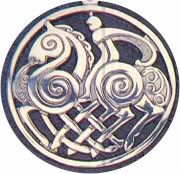
In Norse mythology, Odin's eight-legged horse Sleipnir, "the best horse among gods and men", is described as gray. Sleipnir is also the ancestor of another gray horse, Grani, who is owned by the hero Sigurd.
Slavic
In Slavic mythology, the war and fertility deity Svantovit owned an oracular white horse; the historian Saxo Grammaticus, in descriptions similar to those of Tacitus centuries before, says the priests divined the future by leading the white stallion between a series of fences and watching which leg, right or left, stepped first in each row.
Finno-Ugric
The war god in Hungarian mythology was Hadúr, who wears pure copper and is a metalsmith. The ancient Magyars sacrificed white stallions to him before a battle. Additionally, there is a story (mentioned for example in Gesta Hungarorum) that conquering Magyars paid a white horse to Moravian chieftain Svatopluk I (in other forms of the story, it is instead the Bulgarian chieftain Salan) for a part of the land that later became the Kingdom of Hungary.[citation needed] Actual historical background of the story is dubious because Svatopluk I was already dead when the first Hungarian tribes arrived. On the other hand, even Herodotus mentions in his Histories an Eastern custom, where sending a white horse as payment in exchange for land means casus belli. This custom roots in the ancient Eastern belief that stolen land would lose its fertility.
| The Pale Horse - Death |
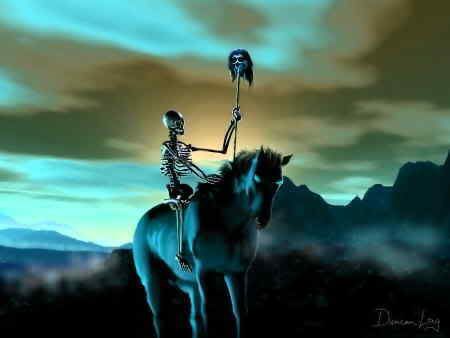
The Four Horsemen of the Apocalypse are described in the last book of the New Testament of the Bible, called the Book of Revelation of Jesus Christ to Saint John the Evangelist at 6:1-8. The chapter tells of a "'book', or 'scroll', in God's right hand that is sealed with seven seals". The Lamb of God, or Lion of Judah (Jesus Christ), opens the first four of the seven seals, which summons four beings that ride out on white, red, black, and pale horses. Although some interpretations differ, in most accounts, the four riders are seen as symbolizing Conquest, War, Famine, and Death, respectively. The Christian apocalyptic vision is that the four horsemen are to set a divine apocalypse upon the world as harbingers of the Last Judgment.
White Horse
I watched as the Lamb opened the first of the seven seals. Then I heard one of the four living creatures say in a voice like thunder, "Come and see!" I looked, and there before me was a white horse! Its rider held a bow, and he was given a crown, and he rode out as a conqueror bent on conquest.
--Revelation 6:1-2
Due to the above passage (the most common translation into English), the white rider is referred to as Conquest (not Pestilence, see below). The name could also be construed as "Victory," per the translation found in the Jerusalem Bible (the Greek words are derived from the verb νικάω, to conquer or vanquish). He carries a bow, and wears a victor's crown.
As evil
Artwork which shows the horsemen as a group, such as the famous woodcut by Albrecht Dürer, suggests an interpretation where all four horsemen represent different aspects of the same tribulation.
The first horseman is often associated with military conquest. One interpretation, which was held by evangelist Billy Graham, casts the rider of the white horse as the Antichrist, or a representation of false prophets, citing differences between the white horse in Revelation 6 and Jesus on the white Horse in Revelation 19. In Revelation 19, Jesus has many crowns, but in Revelation 6 the rider has just one.
As righteous
Irenaeus, an influential Christian theologian of the 2nd century, was among the first to interpret this horseman as Christ himself, his white horse representing the successful spread of the gospel. Various scholars have since supported this notion, citing the later appearance, in Revelation 19, of Christ mounted on a white horse, appearing as The Word of God. Furthermore, earlier in the New Testament, the Book of Mark indicates that the advance of the gospel may indeed precede and foretell the apocalypse. The color white also tends to represent righteousness in the Bible, and Christ is in other instances portrayed as a conqueror. However, opposing interpretations argue that the first of the four horsemen is probably not the horseman of Revelation 19. They are described in significantly different ways, and Christ's role as the Lamb who opens the seven seals makes it unlikely that he would also be one of the forces released by the seals.
Besides Christ, the horseman could represent the Holy Spirit. The Holy Spirit was understood to have come upon the Apostles at Pentecost after Jesus' departure from Earth. The appearance of the Lamb in Revelation 5 shows the triumphant arrival of Jesus in Heaven, and the white horseman could represent the sending of the Holy Spirit by Jesus and the advance of the gospel of Jesus Christ.
Globalist/UN Ideology
"We are in charge of God's selection process for planet Earth. He selects, we destroy. We are the riders of the Pale Horse, death. We do this for the sake of the world."
--Barbara Marx-Hubbard
Barbara Marx-Hubbard couldn't fight her way out've a wet paper bag, but the forces behind words should be taken seriously. However, this is an example of the "White Horse" symbology used within a Biblical meaning.
Other
WHITE HORSE - linked to instinct, purity and the drive of the physical body to release powerful and emotional forces, like rage with ensuing chaos and destruction.
--Excerpt from 'The Subconscious Psychosis of Dreams'
.
Subscribe to:
Posts (Atom)