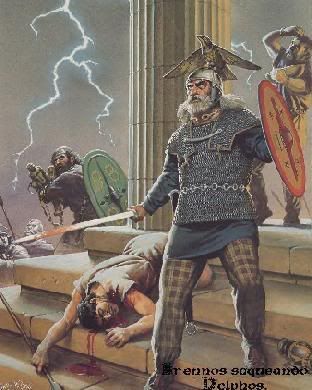
Brennus was covered here once before briefly ('Brennus of the 4th century BC'), and the question remains; should Brennus be thought of as our own noble ancestor who stood up against Roman oppressors, or as a foreign invader who only destroyed and plundered? I think the answer is somewhere in the middle.
I recall years ago of reading a Padanian website in English, where Brenno was mentioned as a northern hero. I distinctly remember reading at the end of that particular writing, something like "now Brenno is coming back!" A reference of his Gaulish spirit coming back.
To find the truth, we must recognize two items to begin with. First, Gaul and Cisalpine Gaul were the same culture; and second, the Romans had not invaded the heart of Cisalpine Gaul as of yet. While Brennus was from northern Gaul, there were strong cultural links, For example, part of the northern Gaulish tribe called the Cenomani, apparently migrated to what is now the area of lower Brescia and Verona. These migrations were common, and had occurred over centuries. Therefore, on one hand Brennus was legitimately a powerful figure to the Cisalpine Gauls; while on the other hand the Romans had not invaded the Gauls as of yet. You cannot "strike back" against someone for something they had not done yet; therefore Brennus was more of a plunderer than a resistance fighter. The simple truth is that the Romans and the Gauls are both part of our heritage. Most the the north were eventually to be culturally "Romanized Gauls." I've always tried to reason that prior to the rise of Rome, there was Gaulish influence in Tuscany and the south ("southern Cisalpina") and Etruscan influence in Lombardy and the north. Had Rome not risen to power, I think that the two cultures (Etruscan-Umbrian and Gaulish-Alpine) would have merged peacefully together. In fact, they already were. In conclusion, in my opinion--as far as this Etrusco-Gaulish ethnic identity concept is concerned--the invading Romans and the later invasion of Germanic tribes were ethno-cultural admixtures.... "secondary influences" as far as ethnicity. Also of interest is that both the Etruscans and the larger Celtic societies, expanded in relative peace. There existed only marginal "pushing" between Etruscans and Gauls; and while local Celtic tribes battled from time to time, it was hardly a clash of civilizations.
In the movie 'Brennus: Enemy of Rome', the Romans were the protagonists. Legitimately defending against an invading barbarian horde. Generally, the Romans are thought of as a civilizing influence amid their ever expanding empire. A cruel system expanding and civilizing an even crueler dark world. The documentary in part one is very interesting with an intentionally ironic title. It showed that the Celtic world (Gaul, British Isles, Spain, south Germany) had a system of roads linking trading centers which traded with other tribes, as well as with Etruscans, Greeks, Phoenicians, etc. They had advanced architecture, including buildings with deep cellars and multiple stories. Their clothing included material, designs, and colors which were very similar to the Scottish clans of much later times. Also, the style of music was similar across this "Celtic world." It probably wouldn't be entirely truthful to say that Brennus was to the Cisalpine Gauls, what Vercingetorix was to the northern Gauls. There were Cisalpine Gauls among Brennus' army, but Brennus himself was not from Cisalpine Gaul.
Random fact: I believe that in the movie 'Brennus: Enemy of Rome', Brennus twice made mention of the god "Thor." At one point saying "In the name of Thor!" Thor was a god in the Teutonic pantheon, and not present in Gaulish polytheism. Apparently the filmmakers perceived "the Gauls" as a particular Germanic tribe, instead of an entire culture made up of their own separate tribal groups. .
Vulture Graffix An English dubbed, Austrian print of Brennus Enemy of Rome (AKA: Brenno der herr des schreckens, AKA: Brenno il nemico di Roma, AKA: Battle of the Valiant). The film was made in 1963 about the sack of Rome in 387 BC. It was written by Adriano Bolzoni, Arpad DeRiso and Nino Scolaro and was directed by Giacomo Gentilomo. It stars Gordon Mitchell, Ursula Davis, Massimo Serato and Tony Kendall.
The story takes various elements from Livy's history of the Gauls' attack on Rome, plus Plutarch's biography of Camillus, and cleverly remixes them to fashion a ripping yarn. The banishment of the Roman general Camillus, the controversy over the spoils of Veii, the involvement of the Fabius brothers, the flight of the Vestal virgins from Rome, the barbarian who tugs the beard of a Roman elder, the honking of the sacred geese, and even Brennus's scornful "Woe to the vanquished!" as he heaps his sword onto the scales, are all from the historical record.... and all give tale to a fictional re imagining of the sack of Rome in 387 B.C. by Brennus, leading an army of Gauls.
Random fact: "Brennus" in Latin became Brenno in Italian. The city of Breno in northern Brescia possibly may have been named after Brennus, who would have been a hero in the Gaulish Alps. Ironically, the Gaulish sacking of early Rome directly led to the Roman invasion of the Alps centuries later.
Barbarians - The Primitive Celts docufans1 So you think you know everything about the Romans? They gave us sophisticated road systems, chariots and the modern-day calendar. And of course they had to contend with barbarian hordes who continually threatened the peace, safety and prosperity of their Empire. Didn't they? Terry Jones' Barbarians takes a completely fresh approach to Roman history. Not only does it offer us the chance to see the Romans from a non-Roman perspective, it also reveals that most of the people written off by the Romans as uncivilized, savage and barbaric were in fact organized, motivated and intelligent groups of people, with no intentions of overthrowing Rome and plundering its Empire.
Sibillini Mountains The Sibillini Mountains, or Sibylline Mountains (Italian: Monti Sibillini) are a mountain group in Italy, part of the central Apennines. Situated between eastern Umbria and the Marche, they are mostly composed of limestone rocks, formed in the Mesozoic and Cenozoic (100 to 50 million years ago) on the bottom of an extinct sea. The land emerged 20 million years ago. Most of the peaks are over 2,000 m (6,600 ft); the highest altitude is reached by Monte Vettore at 2,476 m (8,123 ft). .
"Silent Night" (German: Stille Nacht, heilige Nacht) is a popular Christmas carol, composed in 1818 by Franz Xaver Gruber to lyrics by Joseph Mohr in the small town of Oberndorf bei Salzburg, Austria. It was declared an intangible cultural heritage by UNESCO in 2011. The song has been recorded by a large number of singers from every music genre. The version sung by Bing Crosby is the third best-selling single of all-time.
"Angels We Have Heard on High" is a Christmas carol of French origin in the public domain. The song commemorates the story of the birth of Jesus Christ found in the Gospel of Luke, in which shepherds outside Bethlehem encounter a multitude of angels singing and praising the newborn child.