Showing posts with label Padanian-Americans. Show all posts

Thursday, January 28, 2021

USA's Faye Gulini wins two silver medals in Snowboard Cross World Cup, Valmalenco, Lombardia


USA's Faye Gulini vaults to silver in Snowboard Cross World Cup, Valmalenco, Italy | NBC Sports

January 23, 2021

NBC Sports

1.46M subscribers

American Faye Gulini places second in the Women's Big Final at the FIS Snowboard Cross World Cup event in Chiesa in Valmalenco. Italian Michela Moioli finished first.


************


Jumpin Pics: "Epic event and congrats to the riders"

Justice Unity: "Nice job ladies! Looks like so much fun!"

Mike0000: ❤️

James Viice: "Get 'em girl"

TRUNG NGUYEN: "Let's go, Faye Gulini!"

Max Power: "Yes, this is an Olympic sport."


************



Faye Gulini


Faye Gulini (born March 24, 1992) is a professional American snowboarder born in Salt Lake City, Utah. She competes for the US Snowboarding Team in the disciplines of snowboard cross, slopestyle and halfpipe. She is a three-time Olympian (2010, 2014, 2018).


************


Faye Gulini (USSkiAndSnowboard.org)


Faye Gulini (International Ski Federation)


************


In photo finish, Faye Gulini of USA grabs second silver in two days at SBX World Cup | NBC Sports

January 24, 2021

NBC Sports

1.46M subscribers

American Faye Gulini comes up second to Czech Eva Samkova in a photo finish at the FIS Snowboarding World Cup in Valmalenco, Italy on Sunday.


************


Believe it or not, the Winter Olympics is a years away, in China. Gulini is Marchese origin.


.

Monday, September 17, 2018

Total Wine - The glamour of the agricultural estate


Total Wine and More

Total Wine and More--or "Total Wine Superstore" as it shows on its store banner--is a chain of 130 stores nationwide. They specialize in wine, as well as all other types of alcoholic beverages and accessories. The owners are David and Robert Trone, who started the company as one small store in Delaware in 1991. I found the store to be very interesting just to walk through. It was large, spacious, and decorative to start with. Perhaps 60% of the store was wine-oriented; usually separated by country or region. There's a wide range of pricing, and I can say that the prices are comparatively good. When they first opened here, I thought that I would like it despite an over-saturation of the market locally.

Of course, there are many wines from nearby Napa and Sonoma counties; but the store features all other chief wine-producing regions, with an emphasis on France.. as well as Piedment. There's a large beer section, as well as all types of alcohol and accessories. There is also a temperature-controlled cigar room... adding a further touch of class... or at least perceived class. There is also a temperature-controlled fine wine section, a very nice large wine tasting room, and an education room where one can sign up for classes. Beverages and More is more beer oriented, with many non-alcoholic beverages. I know of a few particularly interesting and top notch liquor stores with a large selection, as well as small stores with a separate wine room it the back. In this market, personally, I don't think that I prefer either larger chains like Total Wine, or top notch smaller businesses.

Each store currently offers a free 230 page complimentary 'Guide to Wine'. The guide is filled with photos, the history of wine making, including separate histories such as in America, and all aspects of wine past and present. There's an interesting map of the chief wine-producing regions of the world. The tropics are not at all known for wine production. It's only in certain northern climates, many with hot summers and cold winters. South and central Europe, California and up through central Washington, most of New England, the northern part of the cone of South America, the Maghrib coast of northwest Africa, west and southeast Australia, northern New Zealand, and in a small area of southwest Australia, a part of the Chinese coast near North Korea, small pockets of central Japan, and a part of southwest South Africa.

www.TotalWine.com

Our own Cisalpine people were major pioneers, going back a long time, of the wine production in northern California, the cone of South America, and South Africa. As it is stated next to the map: Just over 19 million acres of the world's surface is planted with grape vines. Total Wine has a lot of business with French vintners from the famous wine-producing regions there; and the guide shows a lot of these chateaus. The guide states: Historians believe Italian wine has been produced for some 4,000 years. Italian wines are also featured to a large extend in the guide. The vast majority of Spain is of prime climate and soil for wine production; more per capita than any other country in the world it appears. Then it goes onto Portugal, Germany, Austria, and of course California.

Another wine producing region that has grown a lot in recent years is the state of Washington. I've been seeing a lot more Washington wines on the market lately. It then featured a few pages each on Oregon, New York and Virginia, South Africa, Australia, New Zealand, Argentina, Chile, Uruguay, Greece, and Israel; then it went into sparkling wine and dessert wine. There are a very large number of photographs within the guide. One thing that struck me is the many photos of the Trone family visiting with the families of these various vintners. I don't know if glamour is really the word, as it's something more than glamour, more than prestige; but there is a certain warmth surrounding the wine industry in general... much more so than any air of snobbishness. Vintners are essentially farmers living on farm estates. I suppose it could be said that wealthy vintners could represent the rural high socio-economic class... the old concept of a country gentleman.

I remember one time I was traveling with a couple of friends through Lake County, California--a growing wine area--during the the twilight hour. We stopped at Ployez Winery and discovered that it was closed. However, the owner Gerard invited us in anyway and we visited. He was originally from France; drawn to Lake County for it wine producing potential. There's still a particular good nature surrounding the industry. The Nichelini family winery near St. Helena--a winery with deep roots in the area--is another good example of this gracious spirit.


The old Cisalpine family wineries of northern California

There was a certain glory, at least in my perception, to the history of the Cisalpine vintners in northern California... largely of Ligurian or Tuscan descent. Even back to the 19th century, our pioneer ancestors were--by opportunity, will, and hard work--able to form, or help form, new communities in rural areas. That's just about the polar opposite of the modern urban sea of strangers. Most often, these clans did all of the work themselves, and enjoyed the benefits of their toil. They lived on beautiful estates, could propagate themselves and their own culture, and had the freedom to control their own destiny. They were their own boss. Of course, this would also pertain to all areas of farming as well.


Agriculture and the Sicilian immigrants in Louisiana

I recall one time listening to a man, from one of the Italian-American associations in Louisiana, speaking on the distinct history of Sicilian immigrants who settled in Louisiana and took over the agricultural work from the slaves who had done with work before the Civil War. Some of these Sicilians soon became small farmers themselves, and made do in difficult to farm wetlands. He was describing how the French/Catholic or European/Latin culture of New Orleans and south Louisiana was largely the same as from what they remembered, and how it was easy for them to adapt. Basically what he was saying is that there was a certain glory (he didn't actually use that word) to this time period... from that perspective. We have to remember today that this was a totally different time. It could be harsh, so family and community were important.


German farming communities in the Midwest

During roughly the 20 years following the Civil War, about 6 million German immigrants (Germany, Austria, Switzerland, Prussia) emigrated to the United States... largely to the Midwest. They formed farming communities in what was then a large frontier region. Of course, these communities reflected German language and culture. There certainly was a particular glory to this time period, and for a long time after that, from a their perspective. Unlike today, these family clans also did all of the work themselves. According to Thomas Sowell, the more research he did, the more he realized just how much German immigrants detested the institution of slavery. These farmers lived by a certain code of honor surrounding their business and work, and slavery was against everything they believed in.


My favorite white wine: Beringer White Zinfandel

White Zinfandel is a great option for someone who doesn't really like wine. It is sweet and light, and leaves none of the sour or bitterness that some wines create. Beringer does a great job of delivering a quality product for an awesome price.

.

Monday, July 16, 2012

Cisalpine American History


Taken from the History Channel documentary 'Italians in America' (1998). Narrated by Joseph Campanella. Sorry about the poor quality.


Names mentioned:

Christopher Columbus (Ligurian)
John Cabot (Ligurian)
Amerigo Vespucci (Tuscan)
Philip Mazzei (Tuscan)
Leonardo da Vinci (Tuscan)
Antonio Vivaldi (Venetian)
Galileo Galilei (Tuscan)
Constantino Brumidi (Roman/Greek)
A. P. Giannini (Ligurian)

.

Thursday, July 12, 2012

Oscar-winning film star Ernest Borgnine dies in LA at age 95

Borgnine being honored with the Screen Actors Guild Life Achievement Award in 2011


Oscar-winning film star Ernest Borgnine dies in LA at age 95

Ernest Borgnine, who created a variety of memorable characters in both movies and television and won the best-actor Oscar for his role as a lovesick butcher in "Marty" in 1955, died Sunday. He was 95.

Borgnine's longtime spokesman, Harry Flynn, told The Associated Press that Borgnine died at Cedars-Sinai Medical Center in Los Angeles with his family by his side.

A prolific and talented character actor, Borgnine was known for gruff, villainous roles such as the heavy who beats up Frank Sinatra in "From Here to Eternity" and one of the bad guys who harasses Spencer Tracy in "Bad Day at Black Rock."

Borgnine, who earned a salary of $5,000 for playing his Academy-Award winning role Marty, once said "I would have done it for nothing."

Borgnine, who was born Ermes Effron Borgnino on Jan. 24, 1917 in Hamden, Conn., began acting after serving in the Navy during World War II. He made his film debut in 1951's "Whistle at Eaton Falls" before winning an Academy Award four years later. He appeared in other notable films including "Jubal," "Flight of the Phoenix," "The Dirty Dozen,""The Wild Bunch," "The Poseidon Adventure," "Johnny Guitar," and "Escape from New York."

"No Stanislavsky. I don't chart out the life histories of the people I play," Borgnine told The New York Times in 1973 when asked about his acting methods. "If I did, I'd be in trouble. I work with my heart and my head, and naturally emotions follow."

Sometimes he prayed, he said, or just reflected on character-appropriate thoughts. "If none of that works," he added, "I think to myself of the money I'm making."

He was also known as the Navy officer in the television series "McHale's Navy," which aired from 1962-66. Younger audiences would know him as the voice of Mermaid Man in "Spongebob Squarepants."

Borgnine earned an Emmy Award nomination at age 92 for his work on the series "ER," and was honored with the Screen Actors Guild Life Achievement Award in 2011.

"The Oscar made me a star, and I'm grateful," AP reports that Borgnine told an interviewer in 1966. "But I feel had I not won the Oscar I wouldn't have gotten into the messes I did in my personal life."

The actor was married five times, including to singer Ethel Merman, who became his third wife in 1964. The marriage barely lasted a month.

He is survived by his fifth wife, Tova Traesnaes — whom he married in 1973 —his children Christofer, Nancee and Sharon Borgnine; a stepson, David Johnson; six grandchildren; and his sister, Evelyn Verlardi.

.

Saturday, June 30, 2012

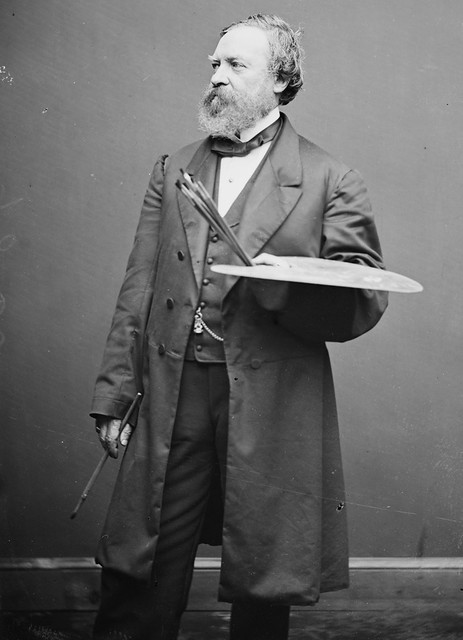
Constantino Brumidi: Artist of the Capitol

Brumidi was half Roman, so we conisder that at least an honorary Cisalpine; and in our opinion, a Padanian-American. Modern Romans are northern in character. It's surprising that there isn't much information out there on him, considering that his craftmanship is still very much featured in the U.S. capitol building. Here is a sample of that artwork. It appears--to put it bluntly--like any situation where someone was contracted to do a job, did it very well, and was forgotten about.

June 10, 2008: Rep. Ackerman manages legislation on the House floor to posthumously award Constantino Brumidi, the Artist of the Capitol, with a Congressional Gold Medal.


Constantino Brumidi (from Wikipedia)

Constantino Brumidi (July 26, 1805 – February 19, 1880) was a Greek/Italian-American historical painter, best known and honored for his fresco work in the Capitol Building in Washington, DC.


Parentage and early life

Brumidi was born in Rome, his father a Greek from Filiatra in the province of Messinia, Greece, and his mother an Italian. He showed his talent for fresco painting at an early age and painted in several Roman palaces, among them being that of Prince Torlonia. Under Gregory XVI he worked for three years in the Vatican.


Emigration and following work

The occupation of Rome by French forces in 1849 apparently persuaded Brumidi to emigrate, having joined the short-lived risorgimental Roman Republic, and he sailed for the United States, where he became a naturalized citizen in 1852. Taking up his residence in New York City, the artist painted a number of portraits. Subsequently he undertook more important works, the principal being a fresco of the Crucifixion in St. Stephen's Church, for which he also executed a Martyrdom of St. Stephen and an Assumption of Mary. He also executed frescoes at Taylor's Chapel, Baltimore, Maryland.

In 1854 Brumidi went to Mexico, where he painted an allegorical representation of the Holy Trinity in the Mexico City cathedral. On his way back to New York he stopped at Washington D.C. and visited the Capitol. Impressed with the opportunity for decoration presented by its vast interior wall spaces, he offered his services for that purpose to Quartermaster General Montgomery C. Meigs. This offer was accepted, and about the same time he was commissioned as a captain of cavalry.

His first art work in the Capitol Building was in the meeting room of the House Committee on Agriculture. At first he received eight dollars a day, which Jefferson Davis, then Secretary of War of the United States, helped increase to ten dollars. His work attracting much favourable attention, he was given further commissions, and gradually settled into the position of a Government painter. His chief work in Washington was done in the rotunda of the Capitol and included the Apotheosis of George Washington in the dome and the Frieze of American History, which contains allegorical scenes from American history. His work in the rotunda was left unfinished at his death, but he had decorated many other sections of the building, most notably hallways in the Senate side of the Capitol now known as the Brumidi Corridors.

In the Cathedral-Basilica of Sts. Peter and Paul in Philadelphia, Pennsylvania, he pictured St. Peter and St. Paul. Brumidi was a capable, if conventional painter, and his black and white modeling in the work at Washington, in imitation of bas-relief, is strikingly effective. He decorated the entrance hall of Saleaudo, located at Frederick, Maryland, and listed on the National Register of Historic Places in 1979.

He died in Washington, DC.

Forgotten for many years, Brumidi's role was rescued from obscurity by Myrtle Cheney Murdock.

.