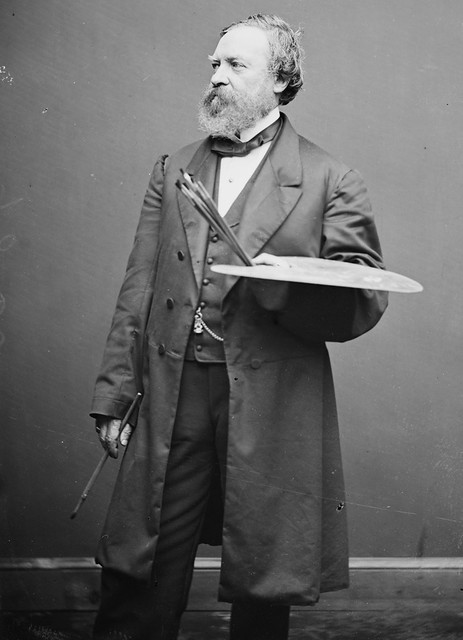
Showing posts with label painters. Show all posts
Tuesday, May 31, 2016
Giulio Romano - Mannerist Artist
Giulio Romano - Italian Mannerist Painter
muziczone1
Giulio Romano -Italian Mannerist Painter
circa 1499-1546
Giulio Romano
Giulio Romano (c. 1499 – 1 November 1546) was an Italian painter and architect. A pupil of Raphael, his stylistic deviations from high Renaissance classicism help define the 16th-century style known as Mannerism. Giulio's drawings have long been treasured by collectors; contemporary prints of them engraved by Marcantonio Raimondi were a significant contribution to the spread of 16th-century Italian style throughout Europe.
cont'd
.
Labels:
architecture,
artists,
Mantua,
Middle Ages,
painters,
Renaissance,
Rome
Saturday, June 30, 2012
Constantino Brumidi: Artist of the Capitol
Brumidi was half Roman, so we conisder that at least an honorary Cisalpine; and in our opinion, a Padanian-American. Modern Romans are northern in character. It's surprising that there isn't much information out there on him, considering that his craftmanship is still very much featured in the U.S. capitol building. Here is a sample of that artwork. It appears--to put it bluntly--like any situation where someone was contracted to do a job, did it very well, and was forgotten about.
June 10, 2008: Rep. Ackerman manages legislation on the House floor to posthumously award Constantino Brumidi, the Artist of the Capitol, with a Congressional Gold Medal.
Constantino Brumidi (from Wikipedia)
Constantino Brumidi (July 26, 1805 – February 19, 1880) was a Greek/Italian-American historical painter, best known and honored for his fresco work in the Capitol Building in Washington, DC.
Parentage and early life
Brumidi was born in Rome, his father a Greek from Filiatra in the province of Messinia, Greece, and his mother an Italian. He showed his talent for fresco painting at an early age and painted in several Roman palaces, among them being that of Prince Torlonia. Under Gregory XVI he worked for three years in the Vatican.
Emigration and following work
The occupation of Rome by French forces in 1849 apparently persuaded Brumidi to emigrate, having joined the short-lived risorgimental Roman Republic, and he sailed for the United States, where he became a naturalized citizen in 1852. Taking up his residence in New York City, the artist painted a number of portraits. Subsequently he undertook more important works, the principal being a fresco of the Crucifixion in St. Stephen's Church, for which he also executed a Martyrdom of St. Stephen and an Assumption of Mary. He also executed frescoes at Taylor's Chapel, Baltimore, Maryland.
In 1854 Brumidi went to Mexico, where he painted an allegorical representation of the Holy Trinity in the Mexico City cathedral. On his way back to New York he stopped at Washington D.C. and visited the Capitol. Impressed with the opportunity for decoration presented by its vast interior wall spaces, he offered his services for that purpose to Quartermaster General Montgomery C. Meigs. This offer was accepted, and about the same time he was commissioned as a captain of cavalry.
His first art work in the Capitol Building was in the meeting room of the House Committee on Agriculture. At first he received eight dollars a day, which Jefferson Davis, then Secretary of War of the United States, helped increase to ten dollars. His work attracting much favourable attention, he was given further commissions, and gradually settled into the position of a Government painter. His chief work in Washington was done in the rotunda of the Capitol and included the Apotheosis of George Washington in the dome and the Frieze of American History, which contains allegorical scenes from American history. His work in the rotunda was left unfinished at his death, but he had decorated many other sections of the building, most notably hallways in the Senate side of the Capitol now known as the Brumidi Corridors.
In the Cathedral-Basilica of Sts. Peter and Paul in Philadelphia, Pennsylvania, he pictured St. Peter and St. Paul. Brumidi was a capable, if conventional painter, and his black and white modeling in the work at Washington, in imitation of bas-relief, is strikingly effective. He decorated the entrance hall of Saleaudo, located at Frederick, Maryland, and listed on the National Register of Historic Places in 1979.
He died in Washington, DC.
Forgotten for many years, Brumidi's role was rescued from obscurity by Myrtle Cheney Murdock.
.
June 10, 2008: Rep. Ackerman manages legislation on the House floor to posthumously award Constantino Brumidi, the Artist of the Capitol, with a Congressional Gold Medal.
Constantino Brumidi (from Wikipedia)
Constantino Brumidi (July 26, 1805 – February 19, 1880) was a Greek/Italian-American historical painter, best known and honored for his fresco work in the Capitol Building in Washington, DC.
Parentage and early life
Brumidi was born in Rome, his father a Greek from Filiatra in the province of Messinia, Greece, and his mother an Italian. He showed his talent for fresco painting at an early age and painted in several Roman palaces, among them being that of Prince Torlonia. Under Gregory XVI he worked for three years in the Vatican.
Emigration and following work
The occupation of Rome by French forces in 1849 apparently persuaded Brumidi to emigrate, having joined the short-lived risorgimental Roman Republic, and he sailed for the United States, where he became a naturalized citizen in 1852. Taking up his residence in New York City, the artist painted a number of portraits. Subsequently he undertook more important works, the principal being a fresco of the Crucifixion in St. Stephen's Church, for which he also executed a Martyrdom of St. Stephen and an Assumption of Mary. He also executed frescoes at Taylor's Chapel, Baltimore, Maryland.
In 1854 Brumidi went to Mexico, where he painted an allegorical representation of the Holy Trinity in the Mexico City cathedral. On his way back to New York he stopped at Washington D.C. and visited the Capitol. Impressed with the opportunity for decoration presented by its vast interior wall spaces, he offered his services for that purpose to Quartermaster General Montgomery C. Meigs. This offer was accepted, and about the same time he was commissioned as a captain of cavalry.
His first art work in the Capitol Building was in the meeting room of the House Committee on Agriculture. At first he received eight dollars a day, which Jefferson Davis, then Secretary of War of the United States, helped increase to ten dollars. His work attracting much favourable attention, he was given further commissions, and gradually settled into the position of a Government painter. His chief work in Washington was done in the rotunda of the Capitol and included the Apotheosis of George Washington in the dome and the Frieze of American History, which contains allegorical scenes from American history. His work in the rotunda was left unfinished at his death, but he had decorated many other sections of the building, most notably hallways in the Senate side of the Capitol now known as the Brumidi Corridors.
In the Cathedral-Basilica of Sts. Peter and Paul in Philadelphia, Pennsylvania, he pictured St. Peter and St. Paul. Brumidi was a capable, if conventional painter, and his black and white modeling in the work at Washington, in imitation of bas-relief, is strikingly effective. He decorated the entrance hall of Saleaudo, located at Frederick, Maryland, and listed on the National Register of Historic Places in 1979.
He died in Washington, DC.
Forgotten for many years, Brumidi's role was rescued from obscurity by Myrtle Cheney Murdock.
.
Labels:
American history,
art,
artists,
Constantino Brumidi,
Latium,
Padanian-Americans,
painters,
Roman,
Washington D.C.
Wednesday, November 30, 2011
"Masters of Venice" at the de Young Museum
Masters of Venice: Renaissance Painters of Passion and Power from the Kunsthistorisches Museum, Vienna
October 29, 2011 - February 12, 2012
Masters of Venice: Renaissance Painters of Passion and Power is a worldwide exclusive presentation of 50 paintings by Venetian painters Titian, Giorgione, Veronese, Tintoretto, Mantegna, and more, primarily from the sixteenth century, all on loan from the Gemäldegalerie of the Kunsthistorisches Museum in Vienna. Featured are outstanding examples of the work of these artists that were collected by the archdukes and emperors of the Habsburg family, which are among the most celebrated holdings in the collections of the Gemäldegalerie.
Key works include Titian’s sumptuous Danáe (1560s), Mantegna’s tortured Saint Sebastian (1457–1459) and four rare paintings by Giorgione, including The Three Philosophers (ca. 1508–1509) and Portrait of a Young Woman (Laura) (1506). The exhibition also includes works by Palma, Bordone, Bassano, and more. Together, these examples represent the range of Venetian accomplishment in Renaissance-era painting.
October 29, 2011 - February 12, 2012
Masters of Venice: Renaissance Painters of Passion and Power is a worldwide exclusive presentation of 50 paintings by Venetian painters Titian, Giorgione, Veronese, Tintoretto, Mantegna, and more, primarily from the sixteenth century, all on loan from the Gemäldegalerie of the Kunsthistorisches Museum in Vienna. Featured are outstanding examples of the work of these artists that were collected by the archdukes and emperors of the Habsburg family, which are among the most celebrated holdings in the collections of the Gemäldegalerie.
Key works include Titian’s sumptuous Danáe (1560s), Mantegna’s tortured Saint Sebastian (1457–1459) and four rare paintings by Giorgione, including The Three Philosophers (ca. 1508–1509) and Portrait of a Young Woman (Laura) (1506). The exhibition also includes works by Palma, Bordone, Bassano, and more. Together, these examples represent the range of Venetian accomplishment in Renaissance-era painting.
Educational Resources (link for further study)
This exhibition, featuring works that were once part of the collection of the Habsburg family, offers you and your students a unique opportunity study works from the Renaissance. Highlighting artists such as Titian, Giorgione, Tintoretto and Veronese, the exhibition traces the Renaissance, High Renaissance and Venetian Mannerism through these artist’s paintings—many never before seen in San Francisco. The exhibition also provides a rich opportunity for Bay Area teachers to expand their curriculum by utilizing the show to look at literary, aesthetic, social and economic differences and similarities when comparing 16th-century Venice and its artistic output with San Francisco and the FAMSF collections.
The resources assembled here may provide you and your students with ideas for viewing the exhibition and for conducting follow-up activities to expand the experience.
Ticket Information
Admission prices: adults $20, seniors 65+ $17, students with current ID $16, youths 6–17 $10, members and children 5 and under free.
Groups of 10 or more have access to priority booking and discounted rates. For additional information please contact the group sales office at groupsales@famsf.org or by calling 415.750.3620.
Reserve your tickets now
Member tickets
Catalogue
Exhibition catalogue available
Related Lectures & Events
Tuesday December 6, 2011
Docent Lecture: "Masters of Venice: Renaissance Painters of Passion and Power from the Kunsthistorisches, Vienna," Rita Dunlay
1:00 pm
Today's Docent Tours
11:00 am
1:00 pm
Press Release
Masters of Venice: Renaissance Painters of Passion and Power From the Kunsthistorisches Museum, Vienna
Credit Line
This exhibition is organized by the Fine Arts Museums of San Francisco in collaboration with the Gemäldegalerie of the Kunsthistorisches Museum, Vienna.
Major Patron
Penny and James George Coulter
San Francisco Auxiliary of the Fine Arts Museums
Patrons
Athena and Timothy Blackburn
William G. Irwin Charity Foundation
Sponsors
T. Robert and Katherine Burke
Samuel H. Kress Foundation
Mrs. James K. McWilliams
Greta R. Pofcher
Education programs presented in conjunction with the exhibition are sponsored by Wells Fargo and the S. D. Bechtel, Jr. Foundation.
This exhibition is supported by an indemnity from the Federal Council on the Arts and the Humanities.
.
Labels:
art,
artists,
exhibit,
Northern California,
painters,
Renaissance,
San Francisco,
Venetian,
Veneto,
Venice
Subscribe to:
Posts (Atom)
_-_Portrait_of_Do%C3%B1a_Isabel_de_Requesens_-_Louvre_612_Joconde_000PE026978.jpg)