
Bob Gillies - Associated Press - October 14, 2009
TORONTO – Mona Lisa has something new to smile about.
A portrait of a young woman thought to be created by a 19th century German artist and sold two years ago for about $19,000 is now being attributed by art experts to Leonardo da Vinci and valued at more than $150 million.
The unsigned chalk, ink and pencil drawing, known as "La Bella Principessa," was matched to Leonardo via a technique more suited to a crime lab than an art studio — a fingerprint and palm print found on the 13 1/2-inch-by-10-inch work.
Peter Paul Biro, a Montreal-based forensic art expert, said the print of an index or middle finger matched a fingerprint found on Leonardo's "St. Jerome" in the Vatican.
Technical, stylistic and material composition evidence — including carbon dating — had art experts believing as early as last year that they had found another work by the creator of the "Mona Lisa."
The discovery of the fingerprint has them convinced the work was by Leonardo, whose myth and mystery already put him at the center of such best-sellers as "The Da Vinci Code" and "The Lost Symbol."
Biro examined multispectral images of the drawing taken by the Lumiere Technology laboratory in Paris, which used a special digital scanner to show successive layers of the work.
"Leonardo used his hands liberally and frequently as part of his painting technique. His fingerprints are found on many of his works," Biro said. "I was able to make use of multispectral images to make a little smudge a very readable fingerprint."
Alessandro Vezzosi, director of a museum dedicated to Leonardo in the artist's hometown of Vinci, Italy, said Wednesday he was "very happy" to hear about the fingerprint analysis, saying it confirmed his own conclusion that the portrait can be attributed to Leonardo with "reasonable certainty."
"For me, it's extraordinary there is confirmation" through the fingerprint, although "it's not like I had any doubt," he said in a telephone interview with The Associated Press.
Even before the fingerprint discovery, Vezzosi said several experts agreed with his conclusion, which was based on "historical, artistic, stylistic (and) aesthetic" considerations.
Based on its style, the portrait has been dated to 1485-1490, placing it at a time when Leonardo (1452-1519) was living in Milan.
Canadian-born art collector Peter Silverman bought "La Bella Principessa" — or "The Beautiful Princess" — at the gallery in New York on behalf of an anonymous Swiss collector in 2007 for about $19,000. New York art dealer Kate Ganz had owned it for about nine years after buying it at auction for a similar price.
One London art dealer now says it could be worth more than $150 million.
If experts are correct, it will be the first major work by Leonardo to be identified in 100 years.
Ganz still doesn't believe it is a Leonardo.
"Nothing that I have seen or read in the past two years has changed my mind. I do not believe that this drawing is by Leonardo da Vinci," Ganz told the AP on Wednesday. She declined to comment further.
Silverman said he didn't expect Ganz to acknowledge it's a Leonardo because that would damage her credibility, adding that if she wants to "go against science and say the Earth is not round," then that's her prerogative.
"Thank God, we have the fingerprint because there will still be those doubting Thomases out there saying it couldn't possibly be and giving all sorts of reasons for it. We not only have a fingerprint, but a palm print."
He said the palm print was found in the neck of the portrait's subject, who is believed to be the daughter of a 15th century Milanese duke.
Biro said the two main ideas to emerge from the news are the discovery of "an important lost work by Leonardo," and how "science, technology, scholars and art historians are learning to work together to solve these incredibly complex puzzles."
Silverman said the Swiss collector first raised suspicions about the drawing, saying it didn't look like 19th century artwork. When Silverman saw it at the Ganz gallery in 2007, he thought it might be a Leonardo, although the idea seemed far-fetched. He hurriedly bought it for his Swiss friend and then started researching it.
"Of course, you say, 'Come on, that's ridiculous. There's no such thing as a da Vinci floating around,'" Silverman said. "I started looking in the areas around da Vinci and all the people who could have possibly done it and through elimination I came back to da Vinci."
Last year, Silverman asked Nicholas Turner, a former curator of drawings at the J. Paul Getty Museum and the British Museum. Turner said it was a Leonardo.
Silverman described the Swiss collector as a very rich man who has promised to buy him "lunch and dinner and caviar for the rest of my life if it ever does get sold."
Vezzosi said the portrait seemed to be of a prospective bride and compared its purpose to today's photos of clients of Internet matchmaking agencies.
As for the possibility of finding other Leonardo works, "there are thousands of lost works of Leonardo, mainly pages from codexes or drawings," Vezzosi said, but discovering a lost or undocumented painting would be "much more difficult."
Associated Press writer Frances D'Emilio in Rome contributed to this report.
Yahoo News Link

Monday, October 19, 2009
La Bella Principessa


Sunday, October 18, 2009
First Look: 2010 Ferrari 458 Italia

By Marty Padgett - TheCarConnection.com
July 28, 2009
Ferrari says its new 2010 458 Italia will replace the F430 this fall when it makes a world debut at the Frankfurt auto show.
The new two-seat, mid-engined, V-8 supercar from Maranello is new from the ground up, according to the Italian automaker. They also believe it's one of the biggest leaps forward for the company ever in terms of technology, performance and emissions.
The core of the new supercar is a 4.5-liter engine (hence the name, plus an "8" for its cylinder count) that puts out 570 horsepower and 400 pound-feet of torque. Ferrari promises the new engine, coupled to a seven-speed dual-clutch transmission, will shuttle the 458 Italia to 60 mph in less than 3.4 seconds--comparable to a Nissan GT-R. Top speed should reach 202 mph.
The core of the new supercar is a 4.5-liter engine (hence the name, plus an "8" for its cylinder count) that puts out 570 horsepower and 400 pound-feet of torque. Ferrari promises the new engine, coupled to a seven-speed dual-clutch transmission, will shuttle the 458 Italia to 60 mph in less than 3.4 seconds--comparable to a Nissan GT-R. Top speed should reach 202 mph.
The performance envelope is much bigger than the car it replaces, the F430, and the new 458 Italia benefits from more racing influences than ever, the automaker says in a release. Namechecking F1 champion Michael Schumacher at every opportunity, Ferrari says the handling, design, even the shape of the steering wheel get their inspiration from Formula One, with the input of Schumacher.
With a weight balance of 48/52 and a double-wishbone suspension in front and multilinks in the rear, the 458 Italia's handling will be race-ready, it's claimed. And new traction systems derived from anti-lock brakes should make the new car up to the safety standards of Ferrari's other new model, the California hardtop convertible.
Weight-saving construction techniques have kept the 458 Italia to a lean 3042 pounds, and Ferrari promises low fuel consumption for the class, which includes the Lamborghini Gallardo and potentially, the Lexus LF-A supercar, along with the Nissan GT-R.
We'll have more from this fall's 2009 Frankfurt auto show.
First Look: 2010 Ferrari 458 Italia (link with images)
Monday, October 5, 2009
Interesting excerpt from 'The Lombard Laws'
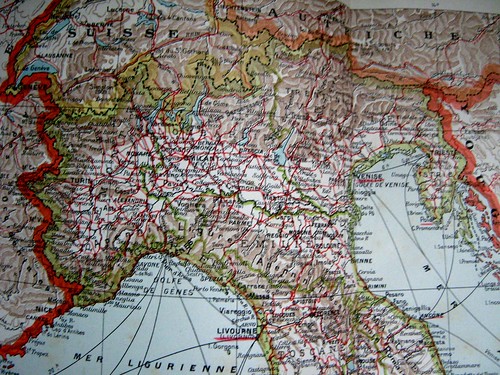
The foreward of the book was written by Edward Peters, who was the man who edited 'The History of the Lombards'. This excerpt is of the paragraph from the bottom of page X to the top of page XI in the foreward.
"In a year of campaigning in Italy, taking cities by force or, more usually, by surrender, the Lombard armies under their king Alboin reached and captured Milan, the former imperial capital. From 568 until Alboin's death in 572 the Lombard conquest of Italy progressed erratically, the king remaining in the north and isolated bands of Lombards under war-leaders penetrating south and even westward into Frankish Gaul. After Alboin's death, the reluctance or inability of the Lombards to establish a successor led to ten years of fragmented rule by Lombard war-leaders called dukes. By the end of the sixth century Italy was divided irregularly between Lombards and imperial occupation forces, with the Duchy of Rome, ruled by a military duke and its bishop, caught uneasily between the two hostile forces. From the pontificate of Gregory I (590-604) to that of Stephen II (752-754), Italy witnessed a century and a half of this balance between Lombard and imperial forces. In 751, however, Lombard pressure finally penetrated the imperial city of Ravenna, and the Lombards won the whole of northern Italy. It was the Lombard triumph against the imperial Byzantine forces that turned their attention once again to the center of Italy and to Rome; faced by such a threat and with no assistance from Constantinople forthcoming, the pope appealed once again to the Franks in Gaul for aid. The successful expeditions of Pepin and Charlemagne precipitated the fall of the Lombard kingdom in 774 and the transformation of the imperial enclave that was papal Rome into the kennel of the later papal state. Lombard law survived in the Frankish north of Italy, however, and after the decline of Carolingian imperial power in the ninth century, Lombard principalities in the south of Italy remained, face to face with their old enemies, the Byzantine forces. Not until the eleventh-century Norman conquest of southern Italy and Sicily did these last Lombard territories fall."
Second, the following quote: "In 751, however, Lombard pressure finally penetrated the imperial city of Ravenna, and the Lombards won the whole of northern Italy." Ravenna continued to be a Byzantine-Roman stronghold, but was indeed captured by the Langobards. Therefore, the Langbard Kingdom encompassed ALL of the north! The two satellite dukedoms of Benevento and Spoleto were independent. Some even smaller factions of Langobards continued to migrate south as far as Sicily, but research on that subject seems to be small and sporadic. That is likely the source for some Sicilians with surnames like Lombardo, Lombardozzi, etc.
Third, it was only when the Langobards moved against Papal Rome itself that forced the hand of the forces that be. Charlemagne saved the Papacy with a massive Frankish army. The Langobards were in disarray, with a lot of infighting, and coupled with the fact that they were moving against Rome, all led to probably their only real loss in war. They were trounced by the Frankish army. Had they kept their eyes on Langbard, and solidified themselves, Langbard may have survived long after 774.
Lastly, even after Langbard was destroyed, the southern duchies of Benevento and Spoleto continued on. Amazingly, they lasted until late in the eleventh century. In my fantasy mind, I imagine that they would not have even entered the south, or anywhere else at all, and focused their effort on maintaining the north. They could have continued on for centuries, and into modern history. They would have had to play ball with the powers of finance (Vatican, Switzerland, London, etc.), and maybe could have formed a USA-like colony in Argentina (minus the slave-trade). They could have stayed away from tribal territories as well, and exchanged certain technologies for peace. But that's just a fantasy.
Sunday, October 4, 2009
Octoberfest & Padanian beer
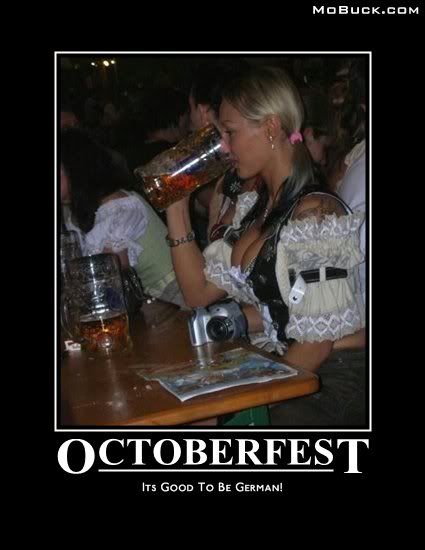
"Oktoberfest is a 16 day festival held each year in Munich, Germany, running from late September to early October. It is one of the most famous events in Germany and the world's largest fair, with some six million people attending every year, and is an important part of Bavarian culture. Other cities across the world also hold Oktoberfest celebrations, modeled after the Munich event."
A few Padanian beers:
Forst Beer - South Tyrolean (originally Austrian-German)
Birra Moretti - A beer well-known in the United States. From Udine (Friuli-Venezia Giulia).
Birra Peroni - Another beer well-known in the United States. From Vigevano (Lombardy).
Birra Pedavena - Occasionally seen in the United States. From Milan, and is a very good beer!
***************************************************************************
10-6-09 Addition: Also, anonymous has informed us the following, "You forget to list the best Padan Beer, THERESIANER Brewery 1766 from Trieste. It won the German DGL Medal in 2006." See theresianer.com. This beer is from the Treviso province.
10-24-09 Addition: Halloween is, in fact, the Christianized form of the old Celtic festival of Samhain. For example, the tradition of the "jack-o'-lantern goes back many centuries.
Saturday, October 3, 2009
History of the Lemon
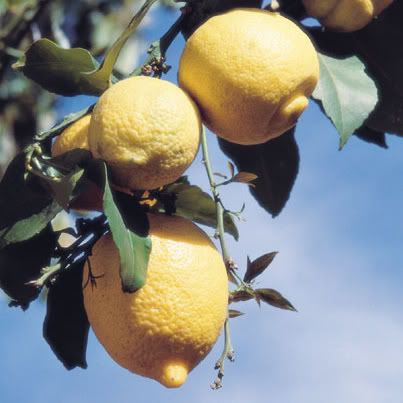 Lemon (from Wikipedia)
"The first real lemon cultivation in Europe began in Genoa in the middle of the fifteenth century. It was later introduced to the Americas in 1493 when Christopher Columbus brought lemon seeds to Hispaniola along his voyages."
The lemon is a small evergreen tree (Citrus limon) originally native to Asia, and is also the name of the tree's oval yellow fruit. The fruit is used for culinary and nonculinary purposes throughout the world – primarily for its juice, though the pulp and rind (zest) are also used, mainly in cooking and baking. Lemon juice is about 5% (approximately 0.3 mole per liter) citric acid, which gives lemons a tart taste, and a pH of 2 to 3. This makes lemon juice an inexpensive, readily available acid for use in educational science experiments. Because of the tart flavor, many lemon-flavored drinks and candies are available on the market, including lemonade.
History
The exact origin of the lemon has remained a mystery, though it is widely presumed that lemons first grew in India, northern Burma, and China. In South and South East Asia, it was known for its antiseptic properties and it was used as an antidote for various poisons. It was later introduced to Persia and then to Iraq and Egypt around AD 700. The lemon was first recorded in literature in a tenth century Arabic treatise on farming, and was also used as an ornamental plant in early Islamic gardens. It was distributed widely throughout the Arab world and the Mediterranean region between AD 1000 and AD 1150.
 Lemons entered Europe (near southern Italy) no later than the first century AD, during the time of Ancient Rome. However, they were not widely cultivated. The first real lemon cultivation in Europe began in Genoa in the middle of the fifteenth century. It was later introduced to the Americas in 1493 when Christopher Columbus brought lemon seeds to Hispaniola along his voyages. Spanish conquest throughout the New World helped spread lemon seeds. It was mainly used as ornament and medicine. In 1700s and late 1800s, lemons were increasingly planted in Florida and California when lemons began to be used in cooking and flavoring.
In 1747, James Lind's experiments on seamen suffering from scurvy involved adding Vitamin C to their diets through lemon juice. The name lemon was originated from Arabic līmūn and Persian limun through Old Italian and Old French limone.
Friday, October 2, 2009
Alberto da Giussano and Barbarossa - Part VII: The Carroccio
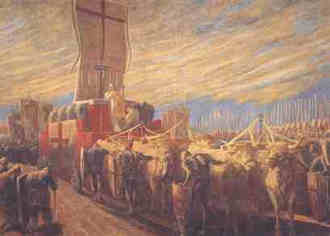
A Carroccio was a war chariot drawn by oxen, used by the medieval republics of Italy. It was a rectangular platform on which the standard of the city and an altar were erected; priests held services on the altar before the battle, and the trumpeters beside them encouraged the fighters to the fray.
In battle the Carroccio was surrounded by the bravest warriors in the army and it served both as a rallying-point and as the palladium of the city's honour; its capture by the enemy was regarded as an irretrievable defeat and humiliation. It was first employed by the Milanese in 1038, and played a great part in the wars of the Lombard League against the emperor Frederick Barbarossa. It was afterwards adopted by other cities, and first appears on a Florentine battlefield in 1228.
The Florentine Carroccio was usually followed by a smaller cart bearing the Martinella, a bell to ring out military signals. When war was regarded as likely the Martinella was attached to the door of the Church of Santa Maria in the Mercato Nuovo in Florence and rung to warn both citizens and enemies. In times of peace the Carroccio was in the keeping of a great family which had distinguished itself by signal services to the republic.
The carro della guerra of Milan was described in detail in 1288 by Bonvesin de la Riva in his book on the "Marvels of Milan". Wrapped in scarlet cloth and drawn by three yoke of oxen that were caparisoned in white with the red cross of Saint George, the city's patron, it carried a crucifix so massive it took four men to step it in place, like a ship's mast.
***************************************************************************
I looked it up again and the opening date, in Italy, for 'Barbarossa' is October 9. Of course, we need to find out when it opens in the United States, and we will just have to make a point to monitor this. It could be a month, or several months.
Thursday, October 1, 2009
Alberto da Giussano and Barbarossa - Part VI: Battle of Legnano
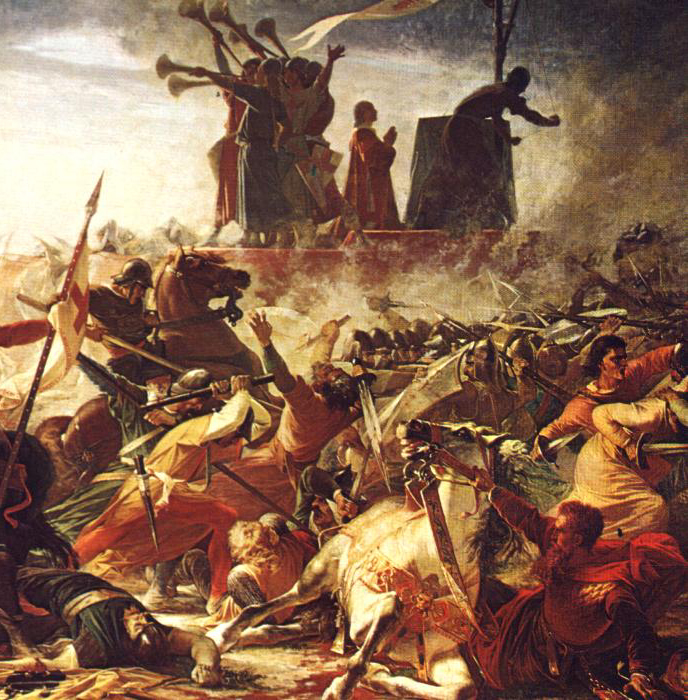
With October now here, and this month being the release date of the upcoming Italian movie 'Barbarossa', here is another segment of our Alberto Giussano and Barbarossa series: The Battle of Legnano. There probably should be an entry just for the "Oath of Pontida," which was the event which united the city-states into the Lombard League, but there wasn't an adequate text in English. It was one of the most brutal wars of the last millennium: The Holy Roman Empire versus The Lombard League.
Battle of Legnano
The Battle of Legnano was fought on May 29, 1176, between the forces of the Holy Roman Empire, led by emperor Frederick Barbarossa, and the Lombard League.
The Lombard League
The Lombard League was formed in 1167, largely out of the Veronese League. It was a Union of Lombard cities promising each other unity, against the Emperor Frederick I Barbarossa. The Lombardy cities swore the oath at Pontida, a small village in Lombardy.
After the disastrous defeat of Pope Alexander III at the Battle of Monte Porzio in May 1167 against Imperial forces, the Lombard League remained as the last legitimate fighting force opposing the Emperor and was therefore heavily backed by the Pope.
Kenneth Pennington wrote: "Alexander’s inability to control Rome and the Papal States was due to his conflict with Frederick. Although he attempted to support the cities of Lombardy, he had neither the power nor the resources to render effective assistance."
Frederick's 5th Italian Campaign
In September 1174, Frederick embarked on his 5th Italian Campaign, to quench the constant revolts in Lombardy and his quarrels with Pope Alexander III. Frederick led a force of 8,000 knights over the Alps and arrived in Piedmont in late September. His cousin Henry the Lion and his forces, were once again not a part of the Imperial campaign. Frederick wanted to take revenge on Susa, for its "evil" behaviour of 1168, and on the 30 September his forces captured and burned down the town. His next aim was the town of Asti, which he captured after a seven day siege. In October, Frederick finally received the promised Imperial reinforcements from Bohemia. Upon Frederick's rapid and fierce initial success, Margraviate William of Montferrat and the Count of Biandrate, abandoned the Lombard League.
Siege of Alessandria
The siege of Alessandria was an important event in Frederick's 5th Campaign as this was a campaign of revenge, with the aim of the total destruction of the Lombard League and the removal of the Pope Alexander III. Frederick's next goal was therefore the Lombard city of Alessandria. Alessandria was founded by Milanese refugees, who fled after Frederick's forces burned and destroyed the City of Milan in 1162 and named after Pope Alexander III. The siege of the "Straw City", called so because all the roofs were covered with straw, began at the end of October. To Frederick's surprise and anger, his forces were not able to take the city so he had to spend the winter in front of its gates. On Holy Saturday, Fredericks forces managed to enter the city by digging tunnels under its walls, but the attack was repulsed by the Milanese with heavy losses. Alessandria withstood, and that was the first victory of the Lombard League. Frederick had to break off the siege due to an advancing Lombard army and retreated to Pavia.
Treaty of Montebello
On 16 April 1175, Frederick and the Lombard League negotiated peace at the Castle of Montebello but after long talks, negotiations broke with no result. Frederick knew that a battle was imminent and traveled to Chiavenna to meet Henry the Lion. Henry the Lion however refused to help his cousin as he thought that Frederick's defeat would allow him to obtain greater power.
The Battle
After Frederick's setback at Alessandria, the failed agreement of Montebello and the refusal of his cousin Henry the Lion to help him, Frederick finally received some good news and reinforcements from Germany. The German reinforcements crossed Lukmanier Pass into the Lake Como region in April 1176. Frederick I Barbarossa, Philipp I of Heinsberg and Archbishop Wichmann of Magdeburg rode secretly from Pavia along the Ticino River, to meet the reinforcements and to lead them to a joint operation with his main forces. Frederick received 1,000 knights and 1,000 foot soldiers from 16 different German rulers. At Como, Lombard imperialist allies increased the reinforcements to about 3,000 knights and foot soldiers, however, the Imperial army was largely a cavalry force of German knights.
The Milanese were informed about Frederick's plan and prepared for battle. A Carroccio, or a sacred war wagon drawn by oxen, was built and was decorated with the city standard and an altar upon which the cross of Archbishop Aribert of Milan was erected. In 1038, Archbishop Aribert led the victorious defence of Milan against the Holy Roman Emperor Conrad II, and therefore his cross was a symbol of victory against the Empire. According to Sire Raoul, a chronicler from Milan, 900 knights came from Milan and around 550 knights from three other towns, the rest of the League's forces were foot soldiers. The "Company of Death" was a foot soldier unit, that according to Milanese chronicles was led by Alberto da Giussano, and formed the core of the Lombard infantry. While Frederick and his reinforcements were on their way back to Pavia to join the main Imperial force, the Lombard League placed about 3,500 men near the west bank of the Olona. The infantry with the Milanese war cart, the carroccio, stood in a hastily fortified position at Borsano. The Lombards knew that Frederick was about to skirt through their area, however, the Lombards did not know how close Frederick already was. At dawn on the 29 May, the Lombard League sent a reconnaissance unit of 700 horsemen to the Seprio landscape. At the same time, the emperor had crossed the Olona and was marching south from Cairate, five miles northeast of Busto Arsizio. Here, the battle commenced. The Lombard reconnaissance and the 300 Imperial vanguard clashed. The clash was brief and bloody and with Frederick already on the horizon, the Lombard reconnaissance broke off and fled beyond Borsano. Now, Frederick and his Imperial German army launched a rampant and brutal attack on the Lombard League forces near Borsano - Legnano. The Lombard cavalry was largely routed but managed to escape the skirmish, leaving the infantry and carroccio on its own. Frederick advanced to the carroccio, and assaulted the infantry and the Company of Death with his cavalry.
M.B. Synge wrote this about the Company of Death: "Nine hundred desperate patriots forming the Company of Death defended the sacred car. Seeing the Germans were gaining ground, fearful for the safety of their treasure, they suddenly knelt down and renewed their vow to God that they would perish for their country."
The infantry positioned itself in a phalanx-like line. The fight around the carroccio was a long and bloody fight in which the Lombard League infantry brought the Imperial army to a stalemate. Despite the difficulties the Imperial cavalry had against the Lombard infantry, it would have still prevailed in the long run. Finally, the Lombard League forces received help from its regrouped cavalry and from a Brescian cavalry that was called to aid by the fleeing reconnaissance troops. The regrouped reconnaissance troops and the Brescian cavalry jointly attacked Frederick's army from the rear. The decisive assault was made by the Brescians, who managed to break through the lines and attack Frederick directly. In this attack, his guards and standard-bearer were killed, and Frederick was thrown off his horse and believed to be dead. Upon this, the Imperial troops panicked and fled, pursued to the Ticino by the Leagues cavalry. The generals tried to rally the men in vain. The booty and prisoners taken by the League were immense.
Aftermath
After the battle, Frederick's rule over Lombardy was decisively broken. The knights that managed to escape, gathered in Pavia. There, they brought the news of Frederick's presumed death to his wife Beatrice I, Countess of Burgundy. Beatrice and the Empire mourned Frederick's demise but after several days the Emperor appeared at the gates of Pavia.
H. E. Marshall wrote: "Then, greatly to the joy of all, after three days Barbarossa suddenly appeared before the gates of Pavia. Although wounded and bruised and left for dead Frederick had not been killed."
The victory of the Lombard League forced Frederick to travel to Venice. In the Peace of Venice, 1177, Frederick and Pope Alexander III reconciled. The Emperor acknowledged the Pope's sovereignty over the Papal States, and in return Alexander acknowledged the Emperor's overlordship of the Imperial Church. The Peace of Venice were heavily instigated by Archbishop Wichmann of Magdeburg, who was amongst the defeated at Legnano. The cities of Lombardy, however, continued to fight until 1183, when, in the Peace of Constance, Frederick conceded their right to freely elect town magistrates. The Treaty was cast in bronze.
Frederick did not forgive Henry the Lion for refusing to come to his aid in 1176. Taking advantage of the hostility of other German princes to Henry, Frederick had Henry tried in absentia by a court of bishops and princes in 1180, declared that Imperial law overruled traditional German law, and had Henry stripped of his lands and declared an outlaw.
On 27 January 1186, Frederick's son Henry VI married Constance of Sicily in Milan as a sign that peace had really been established.
Actual battlefield
The battle is traditionally tied to the name of Legnano, since the League's forces came from that town. Actually, as local historians have ascertained, the battle was fought a couple miles west of Legnano, where today Villa Cortese and Borsano, frazioni of Busto Arsizio, stand.
***************************************************************************
"Nine hundred desperate patriots forming the Company of Death defended the sacred car. Seeing the Germans were gaining ground, fearful for the safety of their treasure, they suddenly knelt down and renewed their vow to God that they would perish for their country."
That country was not "Italy." I'm not going to argue about whether it should be called Cisalpine Gaul, Etruria, Langbard, Padania, or the Subalpine/Po River Valley; but it was a Nation. "Italy" should be "the Italian peninsula," just as there is "the British Isles," "the Balkins," "the Iberian peninsula," "Scandinavia," etc. So for clarity, it should be Europe, then for reference "northern, southern, Eastern, or southern Europe, and then these "regions."