Basically, a "Padanist" is a person who believes in "Padanism"--the concept that the Cisalpine region, people, history, and culture are unique, great, and worth protecting. I would amend that the "Cisalpine culture" is a "group of related cultures." This idea of a clear "cultural grouping" isn't much different than what we have seen with German, modern-Celtic, Slavic, or Greek cultures since the middle of the nineteenth century. We use the word "Cisalpine" for discussion because "Padanian" is a politically-charged word.. at least for now.
"Pan-Padanism" is something related, but different. It's the concept of acknowledging a diaspora, and getting in touch with manifestations of a root-culture in different parts of the world. Here in northern California, we are at least fifty years removed from even a small degree of immigration from the Cisalpine ancestral homeland... which was chiefly from the northwest region. However, there was a type of chain-migration which existed for about a century. Still, fifty years--and it's really more like seventy years--is a long time. We've collectively lost touch. If we wish to get back in touch, then wouldn't it be best to do it globally?
Regions and flag ideas
Europe
Naturally we would look to the Lega Nord political party for inspiration. The proposed flag (see above) is an ancient green rosette/sun of the alps symbol on white background. They used green as it's a Celtic color; however, sometimes blue or red have been associated with the Celts/Gauls. I think "Gaulish"--or "Celto-Gaulish"--is more the term to describe that part of Cisalpine history. The flag's alternative would be white rosette on green background; as would any Cisalpine flag discussed below.
 South America
Argentina is the largest "Cisalpine colony" outside of the ancestral homeland. A significant (one-third?) percentage of the Argentine population is of Cisalpine ancestry. More generally, the "cone of South America" was a region of great settlement of Lombardians, Ligurians, Piedmontese, etc. Argentina clearly stands out, and it's flag is bacially light blue and white. A light blue rosette on white background would seem to be a natural flag for the South American colony in general.
North America
Northern California stands out as the chief area of past settlement of the Cisalpine peoples on this continent. The California flag is mainly red and white. The largest country, Canada, has a red and white flag, Even the old "red ensign" flag of pre-1965 Canada was red. The flag of the United States is largely red and white. Even the Mexican flag is two-thirds "red and white." Yes, some of our people settled in Mexico along with some other non-Hispanic European immigrants.
Even beyond that, red and white seems to be the natural colors in Cisalpine history. The flags of Lombardy and Milano are red cross on white background, and sometimes the opposite, as well as historical Genoese flags. Also the flag of Piedmont is white cross on dark red background; and historical flags of Venice and Tuscany are red. The Lombardian Crusaders painted the red cross on white background on the walls of Jerusalem, and this symbol represents "the religion of our people" (the primary religion, not the only one--or lack thereof).
I would propose the red rosette on white background as the natural flag of the Cisalpines on this continent. The white rosette on red background may tend to look strange to others, but the red on white seems to emit positive energy. In general, the rosette/sun of the Alps symbol is now "the symbol of our people" in the same way that the ancient symbol of Saturn was adopted as the symbol of the Jewish people worldwide.. not just in Israel. Ironically, the Alpine-rosette shares some of the same mathematical dimentions as the Saturnian-hexagram.
 South Africa/Zimbabwe
The small Cisalpine population in what was Rhodesia, which included farming communities who fed the nation, has basically been dismantled permanently. Still, in South Africa there are Cisalpine communities, and the Cisalpines have been a part of the country for a long time. The old flag of South Africa was an orange-white-blue, top-to-bottom tricolor. The orange bar on top stood out, and could be used as the Cisalpine flag of the region. Orange rosette on white background--two-thirds of the old Afrikaner flag--but not the blue.... so it's not an "Afrikaner flag," but a mild reminder of the Cisalpine history in the region.
Australia/New Zealand
Both the flag of Australia, and the flag of New Zealand are blue with some white. Therefore, this darker shade of blue on a rosette on white background would seem to clearly be the colors of the Cisalpines of the region.
Alternate symbols
Many concerns adopt "alternate symbols" to use. I think any symbol, arms, or flags which are clearly part of our ancestral history are fair game. However, as sort've a second symbol, the Gothic-style Catholic cross is one which can be seen above-right; and as perhaps a third symbol, the solar cross seen above-right, symbolizing the various ancient spiritual traditions of the Cisalpine hearth which go back deep in our history. However, generally, Roman Catholicism is "the religion of our people."
.
Video description from YouTube user zzzuucx:
The origin of the Saint Nicholas tradition - from "Religion and Ethics Newsweekly" on PBS. Nicholas is the patron saint of children (hence the holiday), sailors, fishermen, merchants, the falsely accused, repentant thieves, pharmacists, archers, and notably pawnbrokers. The three gold balls that represent the pawn industry come directly from the St. Nicholas legend. To pay for the dowry of three young women, St. Nicholas threw three bags of gold through the window of the parents' home - one of which landed in a shoe drying by the fireplace. The three balls represent the three bags of gold. This is also the origin of the tradition of chocolate coins in the Christmas stocking.
****************************************************************
For the pagan/mythological (Germanic & Roman) aspect of the tradition of Santa Claus, see 'How Odin became Santa Claus'
.
Frank Sinatra was of half-Cisalpine ancestry.. Genoese. Actually, I saw him perform once; at the Circle Star Theater in San Carlos, California (about 30 miles south of San Francisco), it's not there anymore. That was in the mid-90s. My father had watched him perform in San Francisco several decades earlier. Thinking back, it would have almost seemed appropriate to acknowledge his Genoese ancestry since the San Francisco/San Jose area had been so heavily influenced by people from Liguria... going back well over a century. However, he was such a universal icon. The surname "Sinatra" is of Sicilian origin. In terms of talent and personality, for better or worse, I don't think there was an entertainer who was quite like him.
.
I missed this seasonally, but this video just sort've came together for me. However, we are still in the Fall. To change the subject, I suppose that I'm not the only one who has fallen in love with certain software programs which slowly become obsolete... and the newer versions of Windows force them out.... aaaand, the newer versions are awful. I loved Corel Photo Paint 8, but it's just no longer compatible, and the newer versions are really, really bad. They're ridiculously confusing and positively limited. There's a big difference between that, and merely getting used to the newer versions of Word, which really just take some time getting used to. I used to really love the older WordPerfect office, more than Word, but I guess it's just a matter of going with what it pragmatic and available.
The Raven witch and the Autumnal equinox
Equinox
http://en.wikipedia.org/wiki/Autumnal_equinox
An equinox occurs twice a year (around 20 March and 22 September), when the tilt of the Earth's axis is inclined neither away from nor towards the Sun, the center of the Sun being in the same plane as the Earth's equator. The term equinox can also be used in a broader sense, meaning the date when such a passage happens. The name "equinox" is derived from the Latin aequus (equal) and nox (night), because around the equinox, night and day are about equal length.
Wheel of the Year
http://en.wikipedia.org/wiki/Wheel_of_the_Year
Autumnal equinox
The holiday of the autumnal equinox, Harvest Home, Mabon, the Feast of the Ingathering, Meán Fómhair or Alban Elfed (in Neo-Druidic traditions), is a Pagan ritual of thanksgiving for the fruits of the earth and a recognition of the need to share them to secure the blessings of the Goddess and the God during the coming winter months. The name Mabon was coined by Aidan Kelly around 1970 as a reference to Mabon ap Modron, a character from Welsh mythology.[27] Among the sabbats, it is the second of the three Pagan harvest festivals, preceded by Lammas / Lughnasadh and followed by Samhain.
[Music: 'Dream Weaver by Michelle Mays; 'Celtic Requiem Chant' by Elliot Simons]
.
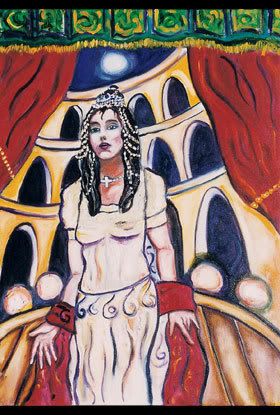
Tosca
Music by Giacomo Puccini
Libretto by Luigi Illica and Giuseppe Giacosa
SAN FRANCISCO OPERA PRODUCTION
Puccini's masterful melodrama is a sexually charged, edge-of-your-seat thriller, in which a great singer, a rebellious painter and a corrupt police chief engage in a deadly test of wills. Music director Nicola Luisotti, "one of his generation's most accomplished Puccini conductors" (Opera News), leads two astonishing casts.
One stars Angela Gheorghiu, "in a part she seems to have been born to play" (Opera Today) and "who, like Tosca, is a born diva" (The Independent, London); Massimo Giordano, praised by The New York Times for his "ardent, expressive singing;" and veteran baritone Roberto Frontali, who brought "vocal brass and weight" (The Dallas Morning News) to San Francisco Opera's The Girl of the Golden West (2010).
The next cast stars Patricia Racette, who "tapped into Tosca's combination of regal and all-too-human traits and backed up her vibrant characterization with singing of considerable expressive fire" (Opera News); tenor Brian Jagde, lauded for his "beautiful singing, now nuanced, now ringing and forceful" (Washington Post); and Mark Delavan (Wotan in the Ring cycle, 2011), a singer of "ferocious power" (San Francisco Chronicle).
Sung in Italian with English supertitles
Approximate running time: 2 hours, 40 minutes including two intermissions
Pre-Opera Talks are free to ticketholders and take place in the main theater in the Orchestra section, 55 minutes prior to curtain.
Production photos: Cory Weaver
**************************************************
See the above link for the cast, credits, profiles, synopsis, times, prices, seating, etc.
.
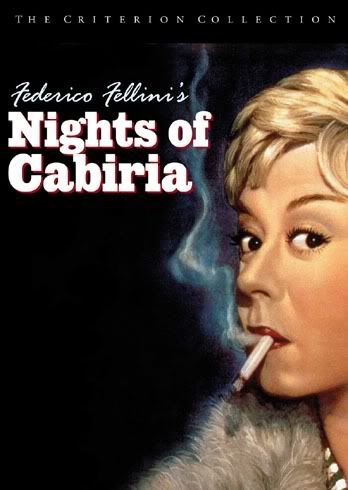
Nights of Cabiria (Wikipedia)
Nights of Cabiria (Italian: Le notti di Cabiria) is a 1957 Italian romantic drama film directed by Federico Fellini and starring Giulietta Masina, François Périer, and Amedeo Nazzari. Based on a story by Fellini, the film is about a waifish prostitute who wanders the streets of Rome looking for true love but finds only heartbreak. In 1998 the film was rereleased, newly restored and with a crucial scene that censors had cut.
The name Cabiria is borrowed from the 1914 Italian film Cabiria, while the character of Cabiria herself is taken from a brief scene in Fellini's earlier film 'The White Sheik'. It was Masina's performance in that earlier film that inspired Fellini to make this film. But no one in Italy was willing to finance a film which featured prostitutes as heroines. Finally, Dino de Laurentiis agreed to put up the money. Fellini based some of the characters on a real prostitute whom he had met while filming 'Il Bidone'. For authenticity, he had Pier Paolo Pasolini, known for his familiarity with Rome's criminal underworld, help with the dialogue.
The American musical and movie Sweet Charity is based on Fellini's screenplay.
When I started watching this movie, I had no idea as to what to expect. The movie revolves around "Cabiria," who was a prostitute--although this is downplayed in certain ways and just not really presented that way, as she often hung out with normal 20ish people--who lived in a house in a downtrodden district in or on the edge of Rome. She is a very engaging character who always wears her emotions on her sleeve. I can't really describe the character, who was almost like Sandra Dee meets Gwen Stefani with a little Audrey Tautou thrown in... and loud!! Bad things always seemed to happen to her, but she was never down for very long before some experience would make her smile or dance. You don't want anything really bad to happen to her, and you want her to get her life together, but it always does. At the end, something really horrible happens to her where she doesn't want to go on; but then shortly later she is smiling, and the theme seems to be "life is worth living" no matter what happens. The movie always keeps your attention. There's never a dull moment with the bantam Cabiria.
I don't watch a whole lot of movies now, but when I do, I always look it up and cross-reference names, dates, places, etc. This movie was no exception. There are some interesting tie-ins with all of that here. Old movies are like a time capsule. I mean, it's not like this was a hundred years ago... it was from the late fifties; in some ways a long time, and in other ways not very long. However, in this movie they all seem to have passed away. I see more of a deeper meaning in older Italian or European movies, rather than those from Hollywood...which is almost like a political or social engineering machine now. There's a certain innocence to older Italian cinema, generally a certain honesty. There's a movie poster on the above link, and a few images and posters from the movie here.
"Spoiler Alert" beyond this point!
Plot
The film opens with Cabiria happy and laughing, on a river bank with her current boyfriend and live-in lover. He pushes her into the river and steals her purse which is full of money. She cannot swim and very nearly drowns, but is rescued and revived at the last possible moment by helpful ordinary people who live a little further down the river.
The rest of the plot follows Cabiria as she plies her trade, interacts with her best friend and neighbor Wanda, and searches for a chance to better her life. She is frequently mistreated and taken advantage of, but she has some interesting adventures, and manages to keep her basic attitude to life positive.
Eventually, she meets Oscar, an accountant, who seems genuinely kind and who promises her a happy future. At first she is cautious and suspicious, but after several meetings she falls passionately in love with him and they are to be married—after only a few weeks. However, during a walk in a wooded area, on a cliff overlooking a lake Oscar becomes distant and starts acting nervous. Cabiria realizes that—just like her earlier lover—Oscar intends to push her over the cliff and steal her money (she sold her house and possessions and keeps all the money in her purse). She throws her purse at his feet, sobbing in convulsions on the ground as he abandons her.
She later picks herself up and stumbles out of the wood in tears. In the film's famous last sequence, Cabiria walks the long road back to town when she is met by a group of young people riding scooters, playing music, and dancing. They happily form an impromptu parade around her until she begins to smile through her tears.
.
Fiesta Nacional de La Cerveza - Oktoberfest Argentina en Villa General Belgrano
Cisalpine people make up a large percentage of Argentina's population. Perhaps one-third. There was a lot of tie-ins within the era of Cisalpine immigration to the cone of South America and northern California. If you're a Cisalpine descendant in California and the Pacific Northwest... you could very easily be living in Buenos Aires today. As Americans, we spend so much time geopolitically worrying about unrelated-foreign places in the world instead of our own connections!
.


 South America
 South Africa/Zimbabwe