
Tuesday, March 4, 2014
Strip the City - Venice
Strip the City - Venice by limukohou
From last week's 'Strip the City' program on the Science Channel. It's hard to believe that millennium old tree posts--protected from erosion in mud--have held up the city for all this time.
.


Sunday, February 16, 2014
$2.2 Million Lamborghini Sesto Elemento Will Blow Your Mind

$2.2 Million Lamborghini Sesto Elemento Will Blow Your Mind
Brian Warner - CelebrityNetWorth.com - February 7, 2014
Are you in the market for a new car? Looking for something a little more sporty than your current whip? Do you have a couple million dollars lying around gathering dust? If you answered yes to these questions, then
 we highly recommend you consider buying the new $2.2 Million Lamborghini Sesto Elemento. The $2.2 million sticker price makes this Lambo the second most expensive car in the world, right behind the $2.4 million Bugatti Veyron Super Sport. If you are still interested, you better act fast because Lamborghini is only producing 20 Sesto Elementos.
So what do you get for $2.2 million? "Sesto Elemento" literally translates to "Sixth Element" which is a reference to the fact that the car is made almost entirely out of an extremely expensive rare carbon fiber and is therefore the lightest Lamborghini ever manufactured. The car weighs 2200 pounds which is less than most sub-contact mini-cars. The name, unfortunately, is not a reference to "The Fifth Element", one of the greatest movies of all time, but the Sesto Elemento is absolutely out of this world. The car is powered by a 570 horsepower V10 engine. Combined with a semi-automatic six speed paddle-shift transmission and nearly 400 lbs of torque, the Lamborghini Sesto Elemento can go from 0-60 in 2.6 seconds and has a top speed of 217 MPH! For comparison, the 2013 Ford Taurus takes 13 seconds to go from 0-60 and has a top speed of 133 MPH.
Let's say you are rich enough to afford the Sesto Elemento and lucky enough to be one of the only 20

What do you think of the Lamborghini Sesto Elemento? Would you pay $2.2 million for a car you could never drive on the streets?
[More images]
.
Sunday, February 9, 2014
Trader Joe's 'Fearless Flyer" - February 3, 2014

5 Cheese Frusta
Ancient Grain Pizza
Family Style Meat Lasagna
Organic Tomato Basil Marinara
Organic Whole Wheat Spaghetti
Porcini Mushroom & Truffle Triangoli (produced in Italy)
Italian Breadsticks with Olive Oil (produced in Italy)
Lattemiele Cookies (from Piemonte)
Grifone Sangiovese (from Tuscany)
.
Friday, January 31, 2014
"Italian horror movies": Part 2

*************************
From '12 Classic Italian Horror Movies You Need To See Before You Die' by Clare Simpson:
Hardly anything in the world gives me as much pleasure as Italian horror movies. They just make me really happy. Even the really crappy ones like Manhattan Baby (directed by Lucio Fulci) or – heaven forbid – anything directed by Bruno Mattei. Yes, I will sit down to that man’s films. I love cannibals, I love zombies, i positively adore all sorts of Italian horror based mayhem. I am also a huge fan of Giallo movies, and as some of you may have read, I wrote an article rating the best Giallo movies a while back.
The line dividing Giallo and straight out horror often becomes blurred in Italian cinema. Take a film like Torso (The Bodies Bear Traces of Carnal Violence). On one level it is a typical Giallo concerning a murder-mystery – a who dunnit with a masked killer running around – one of the most obvious motifs in the Giallo genre. On another level, it can be read as a typical straight slasher horror film – which is how it was marketed to overseas audiences.
In this list, I have mainly tried to focus on pure Italian horror, however some Giallo elements inevitably sneak in. There is a lot of pilfering and copying in Italian horror cinema, so I have attempted to pick the most original movies possible as well as the classics we all know and love. So please enjoy 12 Classic Italian Horror Movies – and if you have your own favourites please list them below.
**************************************************
If you can remember watching television before the cable-age, then you probably saw some of these movies and maybe didn't even realize that they were Italian or European. Someone compiled a list of the 50 top Italian horror directors, which gives a good quick overview of this sub-genre.
.
Hardly
anything in the world gives me as much pleasure as Italian horror
movies. They just make me really happy. Even the really crappy ones like
Manhattan Baby (directed by Lucio Fulci) or – heaven forbid – anything
directed by Bruno Mattei. Yes, I will sit down to that man’s films. I
love cannibals, I love zombies, i positively adore all sorts of Italian
horror based mayhem. I am also a huge fan of Giallo movies, and as some
of you may have read, I wrote an article rating the best Giallo movies a
while back.
The line dividing Giallo and straight out horror often becomes blurred in Italian cinema. Take a film like Torso (The Bodies Bear Traces of Carnal Violence). On one level it is a typical Giallo concerning a murder-mystery – a who dunnit with a masked killer running around – one of the most obvious motifs in the Giallo genre. On another level, it can be read as a typical straight slasher horror film – which is how it was marketed to overseas audiences.
In this list, I have mainly tried to focus on pure Italian horror, however some Giallo elements inevitably sneak in. There is a lot of pilfering and copying in Italian horror cinema, so I have attempted to pick the most original movies possible as well as the classics we all know and love. So please enjoy 12 Classic Italian Horror Movies – and if you have your own favourites please list them below.
Read more at http://whatculture.com/film/12-classic-italian-horror-movies-you-need-to-see-before-you-die.php#t7ZFKkbzaIOWlBm3.99
Thursday, January 30, 2014
"Italian horror movies": Part 1
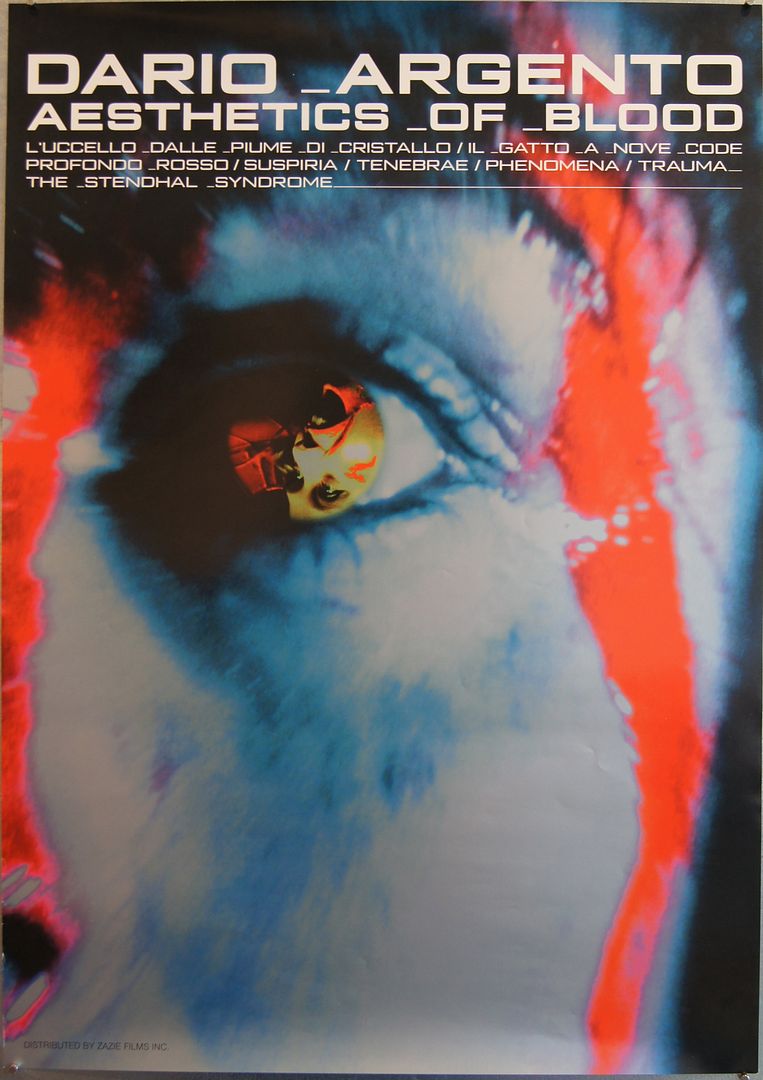
It has become much more mainstream in recent years, but the independent element is as strong as ever. I have always enjoyed horror movies. I'm not as much for zombie or slasher films. I prefer paranormal or mystery-based thrillers. Horror films seem to be a refreshing creative license for the producers to take chances, be overzealous, be silly, be shocking--without the worry of too much artistic criticism. Of course, there is the more finely artistic element to it. The rest mostly fall into the category of exploitation films.
The Europeans have been at least as much the early pioneers of this genre. The 1922 silent German horror film 'Nosferatu' is regarded as "an influential masterpiece of cinema," and clearly a forerunner of the early classic American horror films. The "Hammer films" from the UK were very popular in the United States going back many decades, especially in the 60s and 70s. Recently I watched again the Hammer film 'Tales from the Crypt (1972), and it was very eery. I think that someone who is not a particular fan of this genre would probably enjoy being creeped out by it. It was eerily though-provoking.
The "cabin in the woods" concept has long been a favorite backdrop; as it forms a little world unto itself... in which the story unfolds. Just last week, the Independent Film Channel had a double-feature of just this theme: 'Cabin Fever' (2002), an American film; and 'The Last House in the Woods' (2006), an Italian film. This popular horror flick was something like an Italian version of 'The Texas Chainsaw Massacre'. I don't know much about Italian horror in particular, but I know that Dario Argento has long been a big name in this genre. I recall watching some of these films as a kid, often late at night, and wasn't even aware that they were from Italy... or Germany, Spain, etc. I specifically remember one called 'Bay of Blood' (1971), directed by Mario Brava.
I recall one time a friend who really knows a lot about the Italian horror genre mentioning that Anna Falchi had appeared in many of these films and is well-known in Europe as a "scream queen." In the United States, to me, Linnea Quigley is one that comes to mind in this category. Elizabeth Kaitan is another one that I really remember. American Theaters which played the exploitation films within this genre were called "Grindhouse" theaters. I don't know of any theater that specifically fits that description anymore, but it's a curious concept. One exploitation horror film which I thought was eerily artistic was Rob Zombie's 'House of 1000 Corpses' (2003).
When I was a child in the Bay Area, there was a program on KTVU called 'Creature Features' (1971-1984). Actually this apparently was a syndicated program, and this was our locally-hosted broadcast. This was a much bigger cultural element since there weren't the cable channels, internet, video games, IPad's, etc. as there is now. This was even before VCR's! Locally it was hosted by the late Bob Wilkins, who was a unique type of host who always kept everyone up-to-date on the horror or similar conventions that would come around. One movie that was frequently broadcast was George Romero's 'Night of the Living Dead' due to its popularity. That movie, and Romero's films since, have directly led to this "zombie craze" that we see today.
I had mentioned earlier the 1922 move 'Nosferatu'. In 2000, there was a British "remake" of a sort called 'Shadow of the Vampire', staring John Malkovich and Willem Dafoe. I thought it was worth a mention because it was somehow an acknowledgement of the whole of this element of our culture since 1922... and it was a good movie. Interestingly, it was a fictional horror movie about the "making" of the original film in Slovakia.
.
Friday, January 17, 2014
Giorgio de Santillana
Giorgio de Santillana [Wikipedia]
Giorgio Diaz de Santillana (Rome, 30 May 1902 – Beverly, Massachusetts, 1974) was an Italian-American philosopher of science and historian of science, and professor at MIT. He moved to the United States in 1936 and became a naturalized US citizen in 1945. In 1948, he married. In 1941 he commenced his academic career at the Massachusetts Institute of Technology (MIT), becoming an Assistant Professor the following year. From 1943 to 1945 he served in the United States Army as a war correspondent. Following the war, in 1945 he returned to MIT and was made an Associate Professor in 1948 and a full Professor of the History of Science in the School of Humanities in 1954. In 1969, he published a book entitled: Hamlet's Mill, An Essay on Myth and the Frame of Time with Dr. Hertha von Dechend. This book focussed upon the understanding of the connection between the mythological stories of Pharaonic Egypt, Babylon, Greece, Christianity, etc. and the ancient observations pertaining to the stars, planets and, most notably, the 26,000 year precession of the equinoxes.[1]
Isis, a professional journal of the history of science, included an obituary by friend, Professor Nathan Sivin in Volume 67 (1976), pages 439-443. An excerpt can be found online.
http://platonism347.tripod.com/de_santillana.htm
Bibliography
Development of rationalism and empiricism. With Edgar Zilsel. Chicago: University of Chicago Press, 1941. (International encyclopedia of unified science Foundations of the unity of science ; v2 no.8).
Leonardo Da Vinci (1956)
Crime of Galileo. London: Heinemann, 1958.
The Origins of Scientific Thought: from Anaximander to Proclus, 600 BC to 300 AD. London: Weidenfeld & Nicolson, 1961.
Reflections on Men and Ideas (1968)
Hamlet's Mill. With Hertha von Dechend (1915–2001). Boston: Gambit Inc., 1969.
The Mentor Philosophers: The Age of Adventure: Renaissance Philosophers
Further reading
Payne-Gaposchkin, Cecilia (1972). "Review of Hamlet's Mill, by Giorgio de Santillana and Hertha von Dechend". Journal for the History of Astronomy 3: 206–211. Bibcode:1972JHA.....3..206P.
**************************************************
From the video (YouTube user cfapps7865)
Joe and John Anthony West discuss the theory behind one of my all time favorite books, 'Hamlet's Mill' written by Giorgio de Santillana and Hertha von Dechen. This fascinating,.. but of course highly criticized book brings into question the self-congratulatory assumptions of Western science about the unfolding development and transmission of knowledge. This is a truly seminal and original thesis, a book that should be read by anyone interested in myth and science, and the interactions between the two.
From book: "Mistaking cultural history for a process of gradual evolution, we have deprived ourselves of every reasonable insight into the nature of culture. It goes without saying that the still more modern habit of replacing "culture" by "society" has blocked the last narrow path to understanding history. Our ignorance not only remained vast, but became pretentious as well." (page 71)
From The Joe Rogan Experience, Podcast 226
Full interview:
http://www.youtube.com/watch?v=swEmL2a-h5o
http://en.wikipedia.org/wiki/Hamlet%27s_Mill
http://www.bibliotecapleyades.net/hamlets_mill/hamletmill.htm
http://podcasts.joerogan.net/
**************************************************
From MaverickScience.com
We are not alone in this belief. For several decades now, the words of Giorgio de Santillana and Hertha von Dechend have served as a rallying cry for those of us who believe ancient astronomical conceptions pervade myth:
"The real actors on the stage of the universe are very few, if their adventures are many. The most 'ancient treasure'--in Aristotle's word--that was left to us by our predecessors of the High and Far-Off Times was the idea that the gods are really stars, and that there are no others. The forces reside in the starry heavens, and all the stories, characters and adventures narrated by mythology concentrate on the active powers among the stars, who are the planets."
--'Hamlet's Mill
**************************************************
An emerging pioneer, beyond his lifetime
Giorgio de Santilana was a pioneer into areas of revisionist science which are too numerous to go into detail about now, including the scientific basis for astrology, the electric universe, Saturn as a dwarf star, the Venus-Mars connection, and the reconfiguration of our solar system.
**************************************************
1-19-14 Addition: I couldn't help but add here the irony that Santilana was from Rome, where Saturn was a very big part of Rome's ancient spirituality and culture. In fact, the archaic name for the Roman-Italian peninsula was "Saturnia." The irony being that Saturn is extremely relevant in his theories, which are only gaining momentum now.
.
Tuesday, December 31, 2013
Fibonacci: Sacred Geometry in Nature
The above video is part of a short movie from Spain inspired by Fibonacci, numbers, geometry, and nature. As remarkable as it it today to witness science decoding of the codes of nature, Leonardo Fibonacci accomplished a significant part of this in the early 1200's. So significant is the "Fibonacci sequence" that it is just as relevant today. Using the scientific method of the Fibonacci number sequence, American Dr. Stephen Marquardt was able to tie these mathmatics to the beauty ratio of the human face. Sometimes the image of the core of the shell of a snail or of marine life is used as a symbol of the "Fibonacci number." This number code exists deep in nature.
*************************
Fibonacci (Wikipedia)
Leonardo Pisano Bigollo (c. 1170 – c. 1250) – known as Fibonacci, and also Leonardo of Pisa, Leonardo Pisano, Leonardo Bonacci, Leonardo Fibonacci – was an Italian mathematician, considered by some "the most talented western mathematician of the Middle Ages."
Fibonacci is best known to the modern world for the spreading of the Hindu–Arabic numeral system in Europe, primarily through his composition in 1202 of Liber Abaci (Book of Calculation), and for a number sequence named the Fibonacci numbers after him, which he did not discover but used as an example in the Liber Abaci.
*************************
"All life is biology. All biology is physiology. All physiology is chemistry. All chemistry is physics. All physics is math."
--Dr. Stephen Marquardt
.
Subscribe to:
Posts (Atom)