Sunday, October 31, 2010

Another Sopranosim

Although not a fan of the show, A&E has the current rights to it and the syndicated broadcasts are shown every morning at 6 AM. Occasionally I have it on as I get up. This morning I couldn't help but notice a scene which, without going into much background, portrayed a rape incident. The victim's ex-husband entered the hospital room to see her.

This character, who I believe was supposed to be of Calabrian ancestry, was a somewhat tall gentlemanly man in his fifties. Well spoken and educated, he took great offense at the portrayal of Italian-Americans in the mainstream media, even going so far as to say that it was a roadblock to an "Italian president."

As he entered the hospital room, he tried to keep his composure as health care staff and law enforcement officials conducted their work. After a few moments, a police detective stated that the perpetrator had been arrested. The individual's last name was "Rossi." Suddenly, this man became noticeably uncomfortable. Showing more emotion than he had when he first saw his ex-wife, he blurted out something like "That's an Italian name!? I thought that witnesses described him as a Puerto Rican??"

The basic gist of it was that he has such a chip on his shoulder, that he took it almost personally that the perpetrator of this particular type of hideous crime had the name "Rossi." Of course, all this was fictional, but I couldn't help but think of what this man might think of many everyday face-to-face meetings with people?

To digress, the criminal in this fictional account was, according to the story, Puerto Rican. Some Puerto Ricans have surnames of Irish, Corsican, and Sardinian origin. This due to immigrants to the island, perhaps a century or more ago, and who melded with the local population; hence the name "Rossi." Then it occurred to me, this individual placed a lot of importance on even the intrinsic concept of "an Italian name." I just wanted to pull this issue away from this portrayal of a crime; one that, if genuinely proven, probably should be rewarded with the death penalty.... into just everyday life. Everyday interactions.

I can't help but think of what this man, and there are probably many like him, would think of maybe someone like me? To digress for just a moment, he, being from New York City, would have had almost no contact with anyone whose ancestry was is what we like to call "the northern nations," unless he traveled to "Italy." This is not good or bad in of itself, but just a fact. When studying the villages of eastern Lombardy, where my ancestors came from, it's clear that very few of them had village names (of their original dialect; used prior to 1860) that he would recognize as "Italian-sounding" The local Lombard dialects wouldn't even be recognized as "Italian" either (the Tuscan language was implemented as the official "Italian language") . However, the surnames would be recognizable to him as "Italian."

Some of those surnames would sound different than what he might be used to. Some of them being of Gallic origin. A few names from long gone eras may appear, like "Mitterpergher" in Lombardy, and many surnames in the tri-Veneto region have no vowel ending, but are very native. However, some surnames in say Sicily reflect long past eras as well; like "Martines" or "Mondinier." More often than not, a name like "Cuomo" would sound foreign in non-cosmopolitan areas in the north. I wonder what Mario Cuomo, himself very similar to the character we are looking at here, would assess that fact? In short, there's an honest aspect to this, and a dishonest one.

Maria Laurino took the challenging step of trying to sift through this issue in her 2001 book 'Were You Always an Italian?: Ancestors and Other Icons of Italian America'. It took courage to take on this issue. Without going into all of the data, I will merely quote the famous anthropologist Carlton Coon:

"No country in Europe in which one language and one cultural tradition prevail shows a greater diversity of race between its southern and its northern extremities than does Italy. The binding element which is common to all sections is the Alpine, which has reƫmerged from obscure beginnings through a superstructure composed of Dinaric, Nordic, and various kinds of Mediterranean accretions. Italy stands on the fence between the Alpine and Mediterranean worlds."

As we have gone over time and time again, even that "common language" is absolute pure fiction; no disrespect on the Tuscan dialect intended. Also, Catholicism is a very culturally ambiguous concept. Many people of entirely different cultures are "Catholic."

I recall some years ago, some high ranking political figure in Greece, I don't recall offhand his name or position, stated that "Italians" have spread the mafia all around the world. On one level, he was correct that there is no "Greek mafia." There is a present black market anywhere in the world, but nothing comparable to the mafia of Sicily, Calabria, or Campania, in, for example, Greece, Spain, or Germany. On the other hand, it was a moronic statement in that there are about five million people of "Italian" ancestry in the Brazilian province of Sao Paulo, and no mafia; many millions more in Argentina, with no mafia. Part of this is that most of those people are of "northern nations" descent.

Getting back to our Sopranos character. IF he was of Calabrian descent, and IF he took such matters so personally, then he might well have an achy heart today. The Calabrian 'Ndrangheta is possibly the world's most powerful organized crime group. They make literally billions per year in drug profits. Their GNP is higher than that of small countries like Estonia. In reality, he shouldn't take that personally; although it is quite a curiosity subject! Why Calabria? There are many areas in Europe which are historically poorer and have been subjected to much greater oppression than Calabria or Sicily. On the other hand, I don't think that I have ever heard of a "bad Italian neighborhood" (in a Southern Italian/American sense).

Lets cut to the chase. As a people, US northerners, the Gallo-Tuscan types, have taken it worse than the traditional Italian-Americans. WE are not responsible for any of the negative stereotypes, real or imagined. The image of "Italians" around the world contains some of the lowest stereotypes, with sarcasm sprinkled on top for good measure ('Analize This'); along with the highest forms of culture and ingenuity. Whether anyone likes it or not, the term "Italian" many times arouses negativity or emotion from non-Italians; just subtle enough to make someone NOT want to touch the subject, yet annoying enough to cause despair, especially if one is Gallo-Tuscan in ethnic origin.

Whether it be a quote like from the Greek politician, Camorra wars in Naples, or Robert DeNiro movies, this shouldn't have anything to do with us anyway! I had written about his subject on a few occasions, and minced my words a little. I probably injected a few awkward sentences when I backtracked a little bit to soften it up. This, again, is due to the subtle nature of the subject. One stereotype that I get a lot is "the Italian workplace bully." Okay, we can go into the "good and bad in every group" thing. From the description and names, it seemed pretty clear to me that the bullies of these stories were Southern Italian. Ironically, I can only think of one place that I ever worked where there were some vicious bullies. A lot of ex-cons and social undesirables who made life miserable, who were of various backgrounds. Everything BUT Italian. In fact, the few Italians (almost all Southern Italian) were probably the nicest guys there. I guess it's like an "opposite character" of a national and/or ethnic group. For example, many or most Germans are gregarious, back-slapping, drinking beer on Octoberfest, etc., then the opposite negative stereotype of cool, calculating, and emotionless. Well, maybe it's the same thing here. A warm, gregarious people, and the opposite character: temper, bully, bad attitude, etc.

We should coin a term to describe all the times that someone rags on "Italians" and we have to decide on whether to go along with it, laugh, try to say that we're not really the same type of Italian, or take offense as though we were all one big Italian family that should stick up for one-another no matter what. One thing is for sure, it's not "self-loathing" in the Mario Cuomo/"Were you always an Italian" idea of the term. I guess it's all relative. I guess someone could say that as a white person, I should feel guilty for slavery in America. As a human being, maybe someone could say that I should feel bad for how we pollute the environment.

I remember one time working for a company, it was graveyard shift, and the large heavy man who was the operations manager got angry with one of the other managers. The other man was "demographically Russian," even though his ethnic heritage was from one of those "stan" countries near Afghanistan. The OPS manager called him by an ethnic slur with "Russian" attached to the end of it. Then they went at it. My point is that, beyond this interaction between these two, the one individual was actually not even an ethnic Russian at all. There are many examples of this, which I won't go into, but one would hope that someone, if they had to make this type of remark... would AT LEAST GET THE STEREOTYPE CORRECT!!! Russians, in RUSSIA PROPER, visually are beautiful people, largely ancestors of Vikings! And here, some big slob can defame their name, and the person isn't even really Russian anyway. It's sort've like insulting a person, and then tacking on this added THING that I can't even coin a term for.

.

Monday, October 25, 2010

The Etruscans and Arthur Kemp

This is in response to an entry on the Arthur Kemp blog entitled 'Etruscans: DNA Evidence Proves March of the Titans Correct Once Again'.

The article is based on a 2006 DNA study on native Tuscans. The conclusion was that modern Tuscans are not related to the ancient Etruscans, as had long been thought.

One of the problems with "geographical categorizations" is that racial stocks in certain regions of the world change over time. Therefore a DNA test might show, for example, that a person of Indo-European descent has genetic links to Iran. In reality, it would much more likely be to ancient Persia, and perhaps even thousands of years ago when the demographics were different. The same could be said for many other regions.

When members of the British National Party voluntarily underwent DNA tests, most showed a somewhat significant genetic link to the Middle East. In reality, that link was to the ancient Mediterraneans of that region, long before massive numbers of people of a different racial stock migrated out of the Saudi Peninsula and spread the Islamic faith there. All it meant was that the English and the Middle Easterners shared some common ancestry, despite the fact that those ancestors went in entirely different genetic directions. The ancient Middle Easterners largely became, for all intents and purposes, Saudis. The ancient Mediterranean Britons became basically Germans. Therefore, for someone to state that Englishmen and Iraqis of today, are genetic cousins, would not be intellectually honest.

The article goes on to the hypothesis that the Langobards displaced the mixed-race Roman population. In reality, at least throughout most of the northern half of the Italian peninsula, the population was made up of culturally "Romanized" Gauls as the historical record is absolutely crystal clear on. In Tuscany, Kemp's hypothesis is closer to the truth, and down onto the southern Langobard duchies of Benovento and Spoleto. Still, the wild sweeping generalization seems to show his lack of historical understanding of at least most of the north.

Now, as far the Tuscan DNA study, the article accurately summed up the results:

"DNA testing on Etruscan bones recovered from graves showed that they were completely unrelated to modern Tuscan people.

"DNA testing on the modern Tuscan people showed that their genetic origin was in Anatolia, which is located in modern Turkey, bounded by the Black Sea to the north and the Caucasus to the northeast — smack bang where it should be."

The only problem is that Arthur Kemp wants his cake and eat it too. Up to, and during the Roman period, there was no "Turkey," and there were no "Turks." Using his logic, one could conclude that the Iroquois built New York City, that Aborigines constructed Sydney, or that England was originally settled by immigrants from Iraq.

The region that is now Turkey was the hub of the Eastern Roman Empire. Before that, much of it was part of Greece. A good portion of it was settled early on by Celtic tribes. According to the 'History of Turkey' Wikipedia page:

"The history of Turkey refers to the history of the country now called Turkey. Although the lands have an ancient history, Turkic migration to the country is relatively new. The Turks, a society whose language belongs to the Turkic language family started moving from their original homelands to the modern Turkey in the 11th century. After the Turkic Seljuq Empire defeated forces of the Byzantine Empire at the Battle of Manzikert, the process was accelerated and the country was referred to as 'Turchia' in the Europe as early as the 12th century.[1] The Seljuq dynasty controlled Turkey until the country was invaded by the Mongols following the Battle of Kosedag. During the years when the country was under Mongol rule, some small Turkish states were born. One of these states was the Ottoman beylik which quickly controlled Western Anatolia..." [Source: 'Turkey'; James Bainbridge].

Arthur Kemp can't have it both ways. If Tuscans are really Turks, then Iraqi immigrants were the original settlers of England. In reality, both of those Mediterranean peoples had no genuine link to modern Turks or Iraqis outside of the very "limited shared ancestry" concept, by which entirely different racial stocks could easily have "some common ancestors." It can't be "heads I win, tails you lose." YOU CANNOT HAVE IT BOTH WAYS.

Modern Tuscans, which we consider OUR folk, are not culturally or genetically similar to modern Turks. Although the study showed some strong evidence to support Kemp's politics, his final conclusion was intellectually dishonest. Some years back, someone was poking around a Roman graveyard and found some surnames consistent with Byzantine origins, and Kemp concluded that this meant that the native inhabitants were actually Turks. That was junk science. First of all, the Byzantines were not "Turkish." Even then, how do we know that the graveyard wasn't specifically a Byzantine cemetery? Were other cemeteries from that period studied? How do we know that the twenty seven ancient Etruscans, from which the DNA was obtained, were not atypical individuals; perhaps from elsewhere?

In the British Isles, remains of Roman legionnaires have been discovered. Some of those soldiers had identification documents showing that they were natives of Syria, Carthage, and elsewhere. Although they probably were basically Phoenician or ancient Mediterranean, which would for all intents and purposes would still place them within the range of "Indo-European," one could easily slant the evidence to the contrary. One BNP official, whose DNA was tested, showed 8% historically recent Sub-Saharan African mtDNA markers; likely originating from the importation of West African slaves. Again, someone could very easily slant that evidence. In reality, one would probably need to take a dozen tests to get an accurate reading of various genetic stocks. A single DNA ancestry test will occasionally blow up the admixture of any particular genetic stock, so 2% could read as perhaps 10% of whatever racial stock was being analyzed.

It's probably safe to say that England is probably more purely "Indo-European" than, say, Spain or Sicily. However, when studying data, an intellectually honest researcher can't decide for themselves, depending on their own ideology, that "heads I win, tails you lose." In other words, you can't use one set of rules to come to a conclusion in one area; and an entirely different set of rules to come to a conclusion in another area.

.

Saturday, September 25, 2010

Cernic Rite


The Cernic tradition was an ancient religion native to mainly ancient Gaul, Alpine Germany, and Cisalpine Gaul; and which also seemed to exist in Iberia, some parts of Scandinavia, and perhaps elsewhere.


CERNUNNOS

http://en.wikipedia.org/wiki/Cernunnos

Cernunnos (also Cernenus and Cern) is a Celtic god whose representations were widespread in the ancient Celtic lands of western Europe. Cernunnos is associated with horned male animals, especially stags and the ram-horned snake; this and other attributes associate him with produce and fertility.

Everything known about this deity comes from two inscriptions from France and one from Germany.


Evidence

A rock carving of Cernunnos in the National park of Naquane, Italy.[4]
Cernunnos was proposed to have been identified as the illustration on the Snake-witch picture stone, which shows a possibly horned figure holding snakes in his/her hands, from Gotland, Sweden.[citation needed]

Archaeological sources such as inscriptions and depictions from Gaul and Northern Italy (Gallia Cisalpina) have been used to define Cernunnos.


[Music: 'Lacrimae Lugus' by Crystalmoors

"Celtic/Pagan Black Metal band from Cantabria, Spain" (YouTube user BlackDeath)

http://www.myspace.com/crystalmoors
http://www.fotolog.com/crystalmoors ]


Monday, September 13, 2010

"Wine tasting in Genoa" ..... Nevada


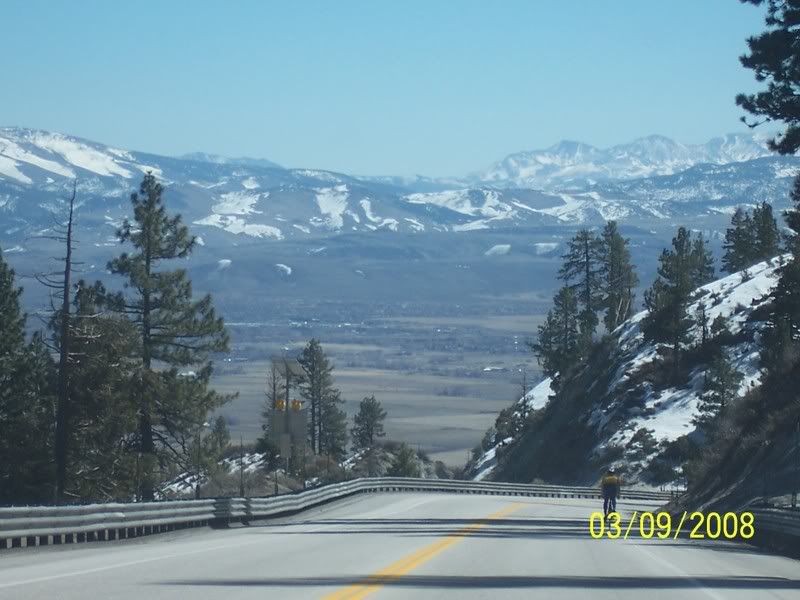
Last year, while visiting South Lake Tahoo, I picked up a brochure entitled 'Wine Tasting in Genoa'. It was subtitled 'Nevada's First Settlement', and was referencing Tahoe Ridge Winery in Genoa, Nevada. The winery is fairly new, having been founded in 1990. The brochure shows that the town and winery are located twenty miles east of South Lake Tahoe. From the brochure: "Nestled in the picturesque town of Genoa, on the eastern slope of the great Sierra Nevada mountain range, lies the home of Tahoe Ridge Winery & Marketplace. Tahoe Ridge sources grapes from high quality growers who farm vineyards throughout Nevada and California."

The winery seems to have everything a large wine operation usually has, including entertainment events. Their events schedule shows that on September 5th, Victoria Vox performed there live; on September 18th, they will host an Annual Grape Stomp at their marketplace and bistro; and on October 17th, Beppe Gambetta, a musical artist from Genova, will perform there as well. From the website: "From Genova, Italy comes this smiling troubadour for his fourth appearance in the Carson Valley. Beppe’s diverse blend of styles range from romantic Italian ballads to traditional Americana and Bluegrass. His sense of humor accentuates his performances while his blazingly quick flatpicking style weaves multi-layered melodies that mesmerize the house."


From Wikipedia's Genoa, Nevada webpage:

"Genoa is an unincorporated township in Douglas County, Nevada, United States. Founded in in 1850, it was the first settlement in what became the Nevada Territory. It is situated within Carson Valley and is about 42 miles (68 km) south of Reno.

"Located within Utah Territory before the Nevada Territory was created in 1861, Genoa was first settled by Mormon pioneers. The settlement originated as a trading post called Mormon Station, which served as a respite for travelers on the California trail. Orson Hyde changed the name of the community to Genoa, after Genoa, Italy. The original Mormon settlers withdrew in 1857 when they were recalled by Brigham Young due to the Utah War.

"The community was the home to Nevada's first hotel, newspaper and court. Nevada's first newspaper, the Territorial Enterprise was founded in Genoa in 1858, but moved to Virginia City, Nevada in 1860. Another first for the state, the Genoa Bar, billed "Nevada's oldest thirst parlor," was patronized by Mark Twain, Teddy Roosevelt and Johnny Cash and was used in John Wayne and Clint Eastwood films. The village was also the set for the movie Misery, starring Kathy Bates. The village doubled in size with buildings added and then removed after the filming.

"Much of Genoa, including the original fort, station and hotel was destroyed in a fire in 1910, but replica of the fort was built in 1947. Every year since 1919 Genoa has held a festival called The Candy Dance, where candy, food and crafts are sold to support its town government. The Candy Dance is usually held during the final weekend of September. Many pioneers rest in the Genoa graveyard including Snowshoe Thompson, his wife and his son.

"A mile south of Genoa is David Walley's Resort, a famous natural hot springs and spa, now a mediocre resort. It was first built in 1862 and known as Walley's Hot Springs.

"Unlike the city of Genoa in Italy, the Nevada community's name is pronounced with the accent on the second syllable: juh-NO-uh.

"Genoa Historic District

"In 1975, the community was listed as a historic district on the National Register of Historic Places."


The town's website states about their town "Nevada's First Recorded Permanent Settlement." It was founded in 1851.


From the website's "Visit Genoa" page:

"Historic charm attracts visitors year-round

"Historic Genoa, Nevada, is nestled at the base of the eastern slope of the Sierra Nevada Range, just 25 minutes east of beautiful Lake Tahoe, and one hour south of Reno.

"It is home to Mormon Station Memorial State Park which commemorates the settlement of Nevada in 1851, when the first permanent trading post was established by a group of Mormon traders from Salt Lake City.

"Genoa’s natural beauty and historic charm still beckon travelers and local wildlife. It is not unusual to spot mule deer as they come down from the forested area on the west side of Genoa and cross local roads to graze on vegetation or fields along the Carson River Valley to the east of Genoa.

"The small town of approximately 250 residents and many local amenities and shops, welcomes visitors for a day trip or longer restful stay. Plan to learn about Genoa’s past with a visit to Mormon Station State Park Museum, Genoa Courthouse Museum, the Genoa Cemetery and the Hanging Tree. Stroll through a variety of shops, and be sure to make time for a leisurely lunch or dinner. Click HERE to download the Greater Genoa Business Association Walking Tour Map of town attractions, including shops, dining, drinking and lodging accommodations.

"Considering a stay in Genoa? There is much to do in the surrounding area including hiking, biking, golfing, flying, fishing and shopping, just to name a few. Click here to link to the Carson Valley Visitors Authority for more information about Genoa and the surrounding Carson Valley.

"Be sure to mark your calendar for the last weekend in September to visit the town’s annual Candy Dance Arts and Crafts Faire. Since 1919, the residents of Genoa have made the wonderful homemade candy sold during the weekend and complimented by a Saturday night dinner-dance. Over the years the event has evolved, and today the Genoa Candy Dance is well-known as one of the greatest craft fairs in Northern Nevada drawing artisans from all over the west who come to sell their wares."


There are more tourist links on this page for Carson County, but I think that I'll just leave it at that. The whole Tahoe area is a great place to explore.

.

Tuesday, September 7, 2010

Langbard Kingdom: A Catholic Nation


Langbard Kingdom: A Catholic Nation

Soon after the establishment of the Langbard Kingdom, the Langobard Nation officially adopts Catholicism. Prior to that, they had been roughly half Arian Christian and half pagan (Ásatrú).


Langbard Kingdom

http://en.wikipedia.org/wiki/Kingdom_of_the_Lombards


[Music: 'Angelic Salutation', 'Hail Mary', or 'Ave Maria' by Barbara Bonney; sung in German]


Monday, August 23, 2010

Villa Toscano Winery in Amador County


The Villa Toscano Winery was featured on this weeks In Wine Country, which airs on Sunday evening on local NBC affiliates. In fact, you may watch the program on their website InWineCountry.com throughout the week. Actually, the "wine country" is not just Napa County, but a much larger region of Northern California. Also, the above image is not the Villa Tuscany. The winery is located in Plymouth, California, which has a population of less than one thousand. The program showed the winery as a very pleasant place to visit. Beyond a place to wine taste, purchase wine, or take a tour; it's a place to have lunch at their bistro, enjoy a massage, or walk off on your own along the vinyards. They seem to even have some rooms for rent.
.

Tuesday, August 17, 2010

New findings from ancient tomb in Italy

New findings from ancient tomb in Italy
UPI - August 5, 2010
ROME, Aug. 5 (UPI) -- A royal tomb in an Etruscan necropolis in central Italy has yielded fresh archaeological finds during a summer dig, researchers say.

Tarquinia, one of the richest Etruscan sites in the Lazio region of Italy, is home to dozens of tombs, but researchers were only recently given permission to excavate the "Queen's Tomb" in detail, ANSA reported.

Dating to the mid-seventh century B.C., the crypt is thought to have been a royal burial site although no remains have ever been found.

Researchers uncovering the crypt say they are finding images and decorations found in other contemporary cultures, suggesting the ancient city had much wider links with the outside world than previously thought.

Archaeologists believe the royal tomb was created by a team of foreign architects and craftsmen, strong evidence of a solid network of ties and trade with other civilizations, they said.

The necropolis of Tarquinia contains 6,000 graves cut into the rock but has won worldwide fame for its painted tombs.

Nearly 200 crypts at the site are decorated with frescos in the early Etruscan and Greek style.

Considered one of the most important galleries of ancient art, the Tarquinia necropolis has been on UNESCO's world heritage list since 2004.
.