
Tuesday, September 30, 2014
'The Four Seasons' (Vivaldi)
The Four Seasons (Vivaldi)
The Four Seasons (Italian: Le quattro stagioni) is a set of four violin concertos by Antonio Vivaldi. Composed in 1725, The Four Seasons is Vivaldi's best-known work, and is among the most popular pieces in the classical music repertoire.
.


Saturday, August 30, 2014
California Wine: Santa Cruz Mountains

Santa Cruz Mountains blend chill and warmth for Pinot to Cabernet
By Patrick Comiskey - San Francisco Chronicle - August 23, 2014
The San Andreas Fault runs right through the Santa Cruz Mountains appellation, separating parts of the Pacific plate to the west and the North American plate to the east. Between them, geographical chaos ensues. Not surprisingly, it can seem hard to get around by car, with all the winding mountain roads.
There are more than 70 vineyards and wineries in the area, but aside from Ridge and David Bruce, nearly all are tiny and obscured behind mantles of towering redwoods and Douglas firs. The region is largely defined by elevation, and the fog line, so you won’t see many vines planted below 800 feet.
The slopes are so dramatic, and the climatic conditions so variable, that the Santa Cruz Mountains are one of those rare places in the state where it’s possible to farm Pinot Noir, Chardonnay and Cabernet Sauvignon on the same estate.
“We’re definitely on the cool side for Cabernet,” says winemaker Jeffrey Patterson, who grows all three, “and probably a little on the warm side for Pinot Noir.”
Patterson farms and makes wine at Mount Eden Vineyards, one of the mountains’ most historic properties, a hidden enclave that has been continuously farmed for grapes since 1946, when a stockbroker named Martin Ray ventured to the property outside Saratoga, seeking high-elevation slopes upon which to plant Pinot Noir. From his aerie, Ray was one of the era’s most cantankerous but also talented winemakers, a gadfly for everything from proper cellar methods to more transparent varietal labeling.
When you factor in Ray’s tenure, Mount Eden remains the oldest continuous producer of Pinot Noir and Chardonnay in the country.

Known for: Pinot Noir, Chardonnay, Cabernet Sauvignon.
Defining features: Proximity to the Pacific and its effects result in an appellation with a wildly varying climate. Sedimentary and volcanic soils, depending on which side of the San Andreas Fault you’re on.
Places to visit: Mount Eden Vineyards (tours only by appointment), 22020 Mount Eden Rd., Saratoga. (408) 867-5832. www.mounteden.com.
Ridge Vineyards (weekends, and weekdays by appointment), 17100 Monte Bello Road, Cupertino. (408) 867-3233. www.ridgewine.com.
Thomas Fogarty Winery, 19501 Skyline Drive, Woodside. (650) 851-6777. www.fogartywinery.com.
**************************************************
A few Santa Cruz County wineries, not necessary in the mountains:
http://www.bruzzonevineyards.com/
http://www.domenicowinery.com/
http://www.lanebbiawinery.com/
http://www.larusticanadorsa.com/
http://www.muccigrosso.com/
http://www.regalewine.com/
http://www.traviesowinery.com/
http://villadelmontewinery.com/
http://www.zayantevineyards.com/
http://www.santewinery.com/
http://www.bargetto.com/
**************************************************
Santa Cruz Mountains Winegrowers Association
http://scmwa.com/
.
Friday, August 29, 2014
"6 Californias" initiative quietly moving foreward - Part 3
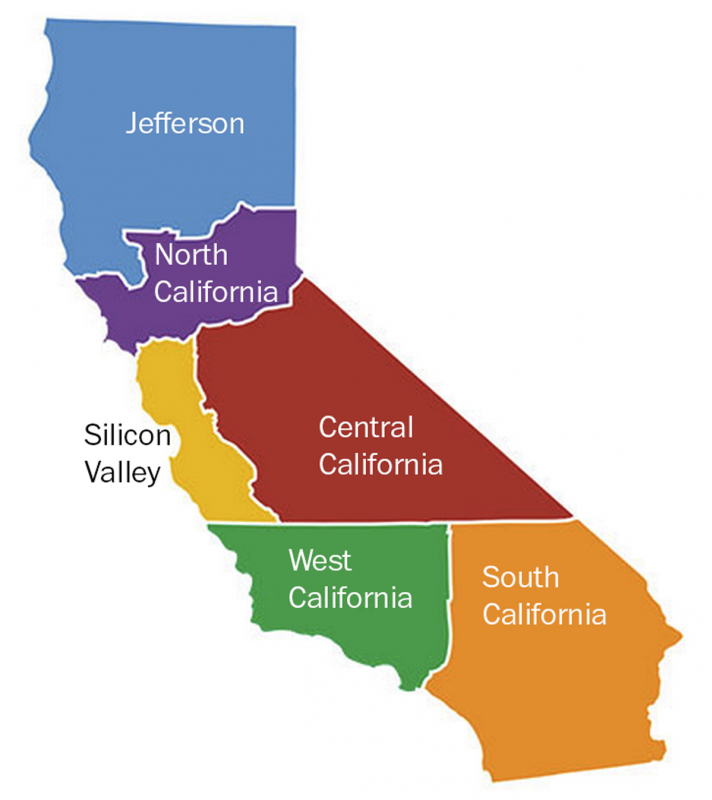
"Six California" feels like a coalition of Silicon Valley concerns--the new billionaires--flexing their muscles against the modern state establishment. If this passes in 2016, which is unlikely, they would have their own defacto state. These concerns may actually just be using this as a launching pad for long-term goals to be reached stepping-stone style at some later point. Things change fast in California. Who would have thought that San Francisco would be turning Republican, as it is in a slow steady pace though gentrification. As is usually the case, this isn't some idea that Tim Draper thought up; he's a figurehead for these Silicon Valley concerns.
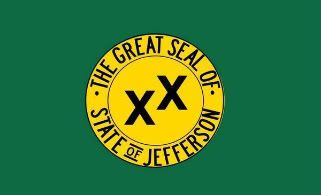
The State of Jefferson is a proposed U.S. state that would span the contiguous, mostly rural area of southern Oregon and northern California, where several attempts to secede from Oregon and California, respectively, have taken place in order to gain statehood.
This region on the Pacific Coast is the most famous of several that have sought to adopt the name of Thomas Jefferson, the third President of the United States. Thomas Jefferson sent the Lewis and Clark expedition into the Pacific Northwest in 1803, and envisioned the establishment of an independent nation in the western portion of North America which he dubbed the "Republic of the Pacific", hence the association of his name with regional autonomy. The independence movement (rather than statehood) is instead known as Cascadia.The State of Jefferson is a proposed U.S. state that would span the contiguous, mostly rural area of southern Oregon and northern California, where several attempts to secede from Oregon and California, respectively, have taken place in order to gain statehood.
This region on the Pacific Coast is the most famous of several that have sought to adopt the name of Thomas Jefferson, the third President of the United States. Thomas Jefferson sent the Lewis and Clark expedition into the Pacific Northwest in 1803, and envisioned the establishment of an independent nation in the western portion of North America which he dubbed the "Republic of the Pacific", hence the association of his name with regional autonomy. The independence movement (rather than statehood) is instead known as Cascadia.
**************************************************
The movement(s) for a Jefferson state go back to 1941, with the most recent starting in 1998 (JeffersonState.com). Naturally they're excited with this proposal, as it includes the full portion of Jefferson as far as California is concerned (they want to include part of southern Oregon as well). They don't feel represented by Sacramento (or Salem) both politically or culturally. The website must be under reconstruction, as it usually has a lot of webpages and an archive of podcasts.
.
Thursday, August 28, 2014
"6 Californias" initiative quietly moving foreward - Part 2
Six California initiative to create six new states
by Josh Jones - StanfordReview.org - February 10, 2014
No US territory has gained statehood since Hawaii in 1959, but that hasn’t been for a lack of trying. In November 2012, a majority of Puerto Ricans voted in a “non-binding referendum” in favor of statehood. In November of 2013, eleven counties voted to secede to form the state of North Colorado. Five counties voted in the affirmative.
And late last year, venture capitalist and Silicon Valley millionaire Tim Draper revealed his plan to split California into six new states. He isn’t the first to call for dividing California, either. A South California was proposed as recently as 2011 by Riverside County Supervisor Jeff Stone, and the ‘State of Jefferson,’ a contingent of several northern Californian and southern Oregonian counties, has been trying to garner support for secession since the 1850s.
The Six Californias Initiative would split the state into six—‘Jefferson,’ ‘North California,’ ‘Central California,’ ‘Silicon Valley,’ ‘West California,’ and ‘South California.’
While most current secession movements are due to friction between big-city liberals and small-town conservatives, Mr. Draper has resurrected another common separatist complaint – the state is simply too big and unmanageable.
“The weather is so good here that people don’t want to move out no matter how much they spend for the worst services,” Draper affirms. “We spend the most on education and we are 46th in performance. We spend among the most for prisons, and we have among the highest recidivism rates. We used to spend 26% on infrastructure and now we spend 3%. Overall, the state is a failure for its constituents, and there are a lot of good people who have tried to make it work for all of us.”
The solution? Free market economics, says Draper. “The monopoly needs to be broken up, so that states can compete with each other for counties and constituents and so Californians can choose the state that works for them.” Under the plan, statesmen would need to effectively ‘court’ their citizens during a period of stabilization in which counties would have the option of switching over to adjacent states before borders are finalized.
California is currently ranked as the world’s ninth largest economy, and accounts for roughly 13% of the United States’ GDP. The state also makes up 12% of the US population. While the average US Senator represents a little over 3 million people, Senators Barbara Boxer and Dianne Feinstein represent nearly 19 million—each. Some have raised the question–can two people adequately represent 38 million Californians in the Upper House?
But Draper questions California’s ability to represent its constituents even on the more ‘basic’ state level: “California is a state of many issues and values. In the south, people are concerned about immigration. In the north, taxation without representation. In the Central Valley, it is all about water to feed the world. In Silicon Valley, it is about having a government that can keep up with technology. By trying to be all things to all people, California has failed us all.”
More than a few lack Draper’s enthusiasm. With opponents bemoaning everything from the carving up of the California education system to the tragedy of adding stars to the US flag, many see the switch to six states as reaching for too much, too soon. Others have dismissed the Six California Initiative as a ploy by the Silicon Valley elite to escape anti-business regulations and shrug off the responsibility of supporting impoverished regions such as Los Angeles. Draper disagrees.
“It turns out that the people with the most to gain are [those] who are currently in the poorer areas. The existing ungovernable California is not working for them. The people of [the proposed states of] ‘Jefferson’ and ‘Central California’” are the most anxious to create their own states. In Jefferson, they are upset with a “fire tax” that only affects them and very little of the money finds its way back up to Jefferson. In Central California, they are constantly at war with Sacramento over water. The real question is why we are allowing a state to continue to exist when all systems are failing, and there are people who are poor and poorly represented in government.”
The movement has shown signs of gaining momentum. On February 4th the Washington Times highlighted a California legislative report that declared Draper’s plan “clearly legal and doable”. According to the Times article, organizers are working to collect the 1 million signatures needed for the initiative to appear on the ballot in 2014.
Of course, the plan would ultimately have to be approved by Congress. When asked whether this could pose a potential roadblock, Draper responded, “I actually expect New York to move to create 3 states. Texas might create 5. Local representation is better representation. I don’t think Washington can be so selfish as to keep people from better representation.”
Will California buy it? Draper certainly thinks so. “I think the best way to get support is from [the] grassroots. It will take time. People often have a resistance to change, but once they start thinking about what their state could be if it got a fresh start, people become evangelists.”
.
Wednesday, August 27, 2014
Famous Cisalpines outside of Padania: Part 5
From the video description: Jeno Paulucci and Neil Cavuto discuss the Great Depression in relation to modern hard times (2011).
From the video description:
While Joan Veon passed away in October of 2010, this may be one of the most important videos that you watch this year.
This explains how the One World Government is here now and how those countries that refuse to be a part of it can be taken out.
Up until September 1994, Joan Veon was just a businesswoman. As a result of attending the United Nations Conference on Population and Development in Cairo, Egypt, she received her “wake up call” as she found there was more going on at the global level than most Americans knew, understood or were being told.
From the video description: On the March 26, 2014 edition of "Nature of Reality Radio" I welcomed Michael Cremo who is the co-author of the book "Forbidden Archeology" and a regular guest on the History Channel show "Ancient Aliens." We discussed how much of mainstream archaeology and history is either fraudulent or not telling the whole truth...
.
Tuesday, August 26, 2014
Famous Cisalpines outside of Padania: Part 4
From the video description: Remembering Diane Cilento, one of Queensland's greatest acting exports, who passed away after a long battle with cancer (2011).
One of Graciano Rocchigiani early tests, against former middleweight contender Mustafa Hamsho (Düsseldorf; 1987; short fight).
An interview with well-known artist and San Francisco native Layla Fanucci.
.
Monday, August 25, 2014
Famous Cisalpines outside of Padania: Part 3
The Puppini Sisters singing 'Boogie Woogie Bugle Boy'. They've performed all over the world. Marcella Puppini in the middle.
B.C. Lions running back Jon Volpe scores a touchdown. From the video description: Often overlooked in lists of the greatest CFL games of all time is this 1991 classic between the Toronto Argonauts and the B.C. Lions.
Funny little interview. Journalist "Paul Lemieux" (Giovanni Ribisi) interviews Kristin Cavallari in another edition of 'One on One'.
.
Subscribe to:
Posts (Atom)