
Showing posts with label Northern Italy. Show all posts
Showing posts with label Northern Italy. Show all posts
Tuesday, October 23, 2012
Visions Of Italia Northern Style
'Visions of Italia - Northern Style' was a VHS tape, produced by PBS about twenty years ago, which presents the Cisalpine landscape from the air. It is available now on DVD and Blu-ray. I remember, it was a big deal back then, and was sold for $100. Is it the most beautiful land in the world? You can decide for yourself.
Part 2
Part 3
Part 4
Part 5
Part 6
.


Tuesday, May 29, 2012
New deadly quake shakes northern Italy

New deadly quake shakes northern Italy [Yahoo News link with links to images on bottom]
Stephen Jewkes - Reuters - May 29, 2012
CAVEZZO, Emilia-Romagna (Reuters) - An earthquake killed 16 people and injured about 350 in northern Italy on Tuesday, spreading fear among thousands of residents living in tents after a similarly strong tremor in the same region flattened their homes nine days ago.
Rescuers were searching through the rubble of houses and warehouses in the Emilia-Romagna region, where several building sites had just reopened after the previous quake on May 20.
Officials said 16 people were confirmed dead, more than twice the number killed in the May 20 quake that, like Tuesday's, had its epicenter near the city of Modena. The number of those forced to leave their homes doubled to 14,000.
Many residents ran out of buildings when they felt the 5.8-magnitude tremor, which hit shortly after 3 a.m. EDT just as operations to rebuild the quake-struck region were under way.
"As we were coming down the stairs, we heard the sound of crumbling houses around us. There was a big cloud of dust," said 72-year-old Giulio in Cavezzo, a badly damaged village about 30 km (20 miles) from Modena where three died.
Rescuers searched tirelessly for survivors despite initial operations being hampered by disruption to the mobile phone network and to the railway network around Bologna.
A woman was pulled alive from the debris of her house in Cavezzo after 12 hours searching, according to Sky Italia.
The quake was the most deadly to strike Italy since 2009 when a tremor partially destroyed the central city of L'Aquila, killing about 300 people and leaving thousands homeless.
With its streets deserted, Cavezzo looked like a ghost town. A shop in the centre still had fruit displayed on stalls outside in the street.
In a nearby empty coffee shop a half-eaten croissant was left on a plate on the bar and an apron lay on the floor.
"It's a disaster, I've never seen anything like it. An endless series of very strong tremors after those of May 20, which had already pulled everything to its knees," said a very shaken Stefano Draghetti, mayor of Cavezzo.
"We need a lot of help to restart, from those who can - the state, the European community."
Italian media showed buildings and shopping malls shaking and collapsing under the force of the quake and ambulances racing across towns. Churches and factories were badly damaged.
In Medolla, also near the epicenter, an electromedical equipment plant collapsed, killing a worker. Rescuers were frantically searching for three other workers still believed to be under the rubble, a Reuters witness said.
"The situation is one of great fear and uncertainty," said Salvatore Iannizzotto, provincial head for the Modena police.
"The population was becoming more relaxed and slowly moving back into their homes. They have now left their homes again."
The civil protection service was setting up new emergency campsites to provide residents with shelter for the night.
Stephen Jewkes - Reuters - May 29, 2012
CAVEZZO, Emilia-Romagna (Reuters) - An earthquake killed 16 people and injured about 350 in northern Italy on Tuesday, spreading fear among thousands of residents living in tents after a similarly strong tremor in the same region flattened their homes nine days ago.
Rescuers were searching through the rubble of houses and warehouses in the Emilia-Romagna region, where several building sites had just reopened after the previous quake on May 20.
Officials said 16 people were confirmed dead, more than twice the number killed in the May 20 quake that, like Tuesday's, had its epicenter near the city of Modena. The number of those forced to leave their homes doubled to 14,000.
Many residents ran out of buildings when they felt the 5.8-magnitude tremor, which hit shortly after 3 a.m. EDT just as operations to rebuild the quake-struck region were under way.
"As we were coming down the stairs, we heard the sound of crumbling houses around us. There was a big cloud of dust," said 72-year-old Giulio in Cavezzo, a badly damaged village about 30 km (20 miles) from Modena where three died.
Rescuers searched tirelessly for survivors despite initial operations being hampered by disruption to the mobile phone network and to the railway network around Bologna.
A woman was pulled alive from the debris of her house in Cavezzo after 12 hours searching, according to Sky Italia.
The quake was the most deadly to strike Italy since 2009 when a tremor partially destroyed the central city of L'Aquila, killing about 300 people and leaving thousands homeless.
With its streets deserted, Cavezzo looked like a ghost town. A shop in the centre still had fruit displayed on stalls outside in the street.
In a nearby empty coffee shop a half-eaten croissant was left on a plate on the bar and an apron lay on the floor.
"It's a disaster, I've never seen anything like it. An endless series of very strong tremors after those of May 20, which had already pulled everything to its knees," said a very shaken Stefano Draghetti, mayor of Cavezzo.
"We need a lot of help to restart, from those who can - the state, the European community."
Italian media showed buildings and shopping malls shaking and collapsing under the force of the quake and ambulances racing across towns. Churches and factories were badly damaged.
In Medolla, also near the epicenter, an electromedical equipment plant collapsed, killing a worker. Rescuers were frantically searching for three other workers still believed to be under the rubble, a Reuters witness said.
"The situation is one of great fear and uncertainty," said Salvatore Iannizzotto, provincial head for the Modena police.
"The population was becoming more relaxed and slowly moving back into their homes. They have now left their homes again."
The civil protection service was setting up new emergency campsites to provide residents with shelter for the night.
QUAKE WOUNDS ITALY
The quake hit one of the most productive regions in a country struggling with a deep economic recession.
Farmers estimated the damage of the previous quake to agriculture in one of Italy's most fertile areas at more than 200 million euros ($250 million).
Sports car maker Ferrari and motorcycle firm Ducati closed their plants in the region for safety reasons. The world's top pasta-maker Barilla, based in Parma, evacuated a plant for 15 minutes but said production had not stopped. Italian bank BPER closed around 20 branches for safety reasons while medical products company Sorin said its plant in Mirabella had been damaged.
The quake was felt across northern and central Italy, including in the most populous northern city Milan. The area was hit by several large aftershocks, one of 5.6 magnitude
Schools and buildings were evacuated as far south as Florence. A soccer match between Italy and Luxembourg in Parma scheduled later on Tuesday was called off.
Emilia-Romagna, famed for its cured ham and mature Parmesan cheese, is in the middle of the Po plain, traditionally considered safer than other areas of seismic Italy.
Several historic buildings, some hit by the previous quake, suffered further damage.
In the town of San Felice sul Panaro whose imposing 14th-century Estense Castle was badly damaged in the quake just over a week ago, three workers were killed by a crumbling warehouse.
"The situation is very serious, some people are stuck under the rubble," Alberto Silvestri, the town's mayor, told Italian television.
Italian media also reported serious damage to the Baroque cathedral of Carpi and the Te Palace in Mantua, an architectural masterpiece from the Renaissance.
Prime Minister Mario Monti, whose cabinet is due to approve fresh emergency measures on Wednesday, tried to reassure the population in an impromptu news conference.
"I want to assure everyone that the state will do all that it must do, all that is possible to do, as fast as it can to guarantee the return to normality in a region so special, so important, so productive for Italy," he said.
French President Francois Hollande's office said France stood ready to provide Italy with any experts or logistical aid it might need. Greece was among the first nations to offer help.
A 3.8 magnitude quake was also felt in western Bulgaria on Tuesday, causing no casualties or serious damage, the National Geophysical Institute said. It had its epicenter near Pernik.
(Writing by Lisa Jucca; Additional reporting by Antonella Cinelli and Steve Scherer in Rome, Svetlana Kovalyova, Antonella Ciancio and Lisa Jucca in Milan; Editing by Pravin Char)
The quake hit one of the most productive regions in a country struggling with a deep economic recession.
Farmers estimated the damage of the previous quake to agriculture in one of Italy's most fertile areas at more than 200 million euros ($250 million).
Sports car maker Ferrari and motorcycle firm Ducati closed their plants in the region for safety reasons. The world's top pasta-maker Barilla, based in Parma, evacuated a plant for 15 minutes but said production had not stopped. Italian bank BPER closed around 20 branches for safety reasons while medical products company Sorin said its plant in Mirabella had been damaged.
The quake was felt across northern and central Italy, including in the most populous northern city Milan. The area was hit by several large aftershocks, one of 5.6 magnitude
Schools and buildings were evacuated as far south as Florence. A soccer match between Italy and Luxembourg in Parma scheduled later on Tuesday was called off.
Emilia-Romagna, famed for its cured ham and mature Parmesan cheese, is in the middle of the Po plain, traditionally considered safer than other areas of seismic Italy.
Several historic buildings, some hit by the previous quake, suffered further damage.
In the town of San Felice sul Panaro whose imposing 14th-century Estense Castle was badly damaged in the quake just over a week ago, three workers were killed by a crumbling warehouse.
"The situation is very serious, some people are stuck under the rubble," Alberto Silvestri, the town's mayor, told Italian television.
Italian media also reported serious damage to the Baroque cathedral of Carpi and the Te Palace in Mantua, an architectural masterpiece from the Renaissance.
Prime Minister Mario Monti, whose cabinet is due to approve fresh emergency measures on Wednesday, tried to reassure the population in an impromptu news conference.
"I want to assure everyone that the state will do all that it must do, all that is possible to do, as fast as it can to guarantee the return to normality in a region so special, so important, so productive for Italy," he said.
French President Francois Hollande's office said France stood ready to provide Italy with any experts or logistical aid it might need. Greece was among the first nations to offer help.
A 3.8 magnitude quake was also felt in western Bulgaria on Tuesday, causing no casualties or serious damage, the National Geophysical Institute said. It had its epicenter near Pernik.
(Writing by Lisa Jucca; Additional reporting by Antonella Cinelli and Steve Scherer in Rome, Svetlana Kovalyova, Antonella Ciancio and Lisa Jucca in Milan; Editing by Pravin Char)
Tuesday, June 30, 2009
Barbarians II: The Lombards
Barbarians II: The Lombards
[For more great documentaries, visit TheDocumentaryCenter.blogspot.com]
At its peak, the Roman Empire feared nothing in Heaven or on Earth. Perhaps they should have paid closer attention to the pagan rabble. Coming in waves from the dark forests of Europe, the hordes drove the mighty empire to its knees. Relentless, unmerciful and united only in their hatred for Rome, each of these warrior tribes - Vandals, Saxons, Franks and Lombards - had its own violent agenda, dark rites, savage tactics, and secret weapons. Barbarians 2 follows these four fearsome tribes as they cut a swath of destruction through the heart of the Roman world. Barbarians 2 recreates the world of these invaders through breathtaking stunts, large-scale battle reenactments, and a fast-paced, exciting narrative.
THE LOMBARDS: The ferocious tribe partial to severing their foes' heads and stealing their women. Their brutal leader, Alboin, overcame Roman defenses, surrounded The Eternal City, and forced a captured foe's wife to drink from her slain father's skull.
"Estimates of the number range between about fifty thousand and two hundred thousand adult males, so we may be talking about a population of four or five hundred thousand people altogether." --Professor Thomas Noble, Chairperson, Department of History, University of Notre Dame, on the Lombard invasion population numbers in 568 A.D. during verbal interview for the History Channel's 'Barbarians II: The Lombards'
Monday, June 29, 2009
The Legacy of the Etruscans
The Legacy of the Etruscans
Gary Biltcliffe Lecture
Gary Biltcliffe, Independent Researcher,presents the ancient Pelasgi and Etruscan connections with Britain, magnificent megalithic stonework, lost cities, and the city state society of archaic Europe.
"We keep on believing the teaching that the Greeks and above all the Romans are the peoples to whom the Western world owes its origins. All of this is considerably exaggerated and based on historical falsehoods. However, I have ascertained instead that it is the Etruscans, coming from the east, who are the true founders of our European culture." --Professor Graziano Baccolini, University of Bologna, 'Reflections on the Etruscan Civilization'
Monday, March 2, 2009
Early Celtic Presence in Northern Italy

[Thanks to Insubria87 for this entry: His original post 'Early Celtic Presence in Northern Italy']
EARLY CELTIC PRESENCE IN NORTHERN ITALY
People of European History
The Celts of the Latène age (475 to 20 BC) are named for the important archaeological finds at La Tène on the lake of Neuchâtel in Switzerland and are counted among the most important people of European history. Their central area of influence stretched from the Marne and Mosel, over southern France, and southern Germany, reaching to southern Poland and the Carpathians. The actual origins of the Celts is unknown. Myths and legends give a very contradictory picture.
Origins and Early History

Clear references to the history of the Celts are first found in the late Bronze age (the 13th century BC) with the beginning of the Canegrate culture. The name comes from the archaeological excavation at "Canegrate" (http://en.wikipedia.org/wiki/Canegrate) near Legnano north of Milan, where important finds were made. The Canegrate culture was founded by Celts who came from the Northwest alpine region and settled in the area between the Lake of Maggiore and the Lake of Como. They brought a language with them from which "Old-Celtic" continuously developed. They lived in direct proximity to the Golasecca-Celts of the Ticino (their name stems from the important archaeological finds in "Golasecca" at the place where the Ticino river flows out of the Lake of Maggiore) and the Helvetians in the north whose settlements reached far towards southern Germany.
Cultura di Canegrate
Golasecca culture
The Golasecca culture is a proto-historic pre-Celtic culture in northern Italy of which the type-site is Golasecca in the province of Varese, Lombardy (northern Italy). Sites characteristic of Golasecca culture have been identified in eastern Lombardy, Piedmont, the Canton Ticino and Val Mesolcina, in a territory stretching north of the Po River to sub-alpine zones, between the course of the Serio to the east and the Sesia to the west. The site of Golasecca, where the Ticino exits from Lake Maggiore, was particularly suitable for long-distance exchanges, in which Golaseccans acted as intermediaries between Etruscans and the Halstatt culture of Austria, supported on the all-important trade in salt.
In a broader context, the subalpine Golasecca culture is the very last expression of the Middle European Urnfield culture of the European Bronze Age. The culture's richest flowering was Golasecca II, in the first half of the sixth to early fifth centuries BCE. It lasted until it was overwhelmed by the Celts in the fourth century and was finally incorporated into the hegemony of the Roman Republic.

situation of the Golasecca culture to the south of the Hallstatt culture.
Golasecca culture is divided for convenient reference into three parts: the first two cover the period of the ninth to the first half of the fifth century BCE; the third, coinciding with La Tène A-B of the later Iron Age in this region and extending to the end of the fourth century BCE, is marked by increasing Celtic influences, culminating in Celtic hegemony after the conquests of 388 BCE. The very earliest finds are of the Late Bronze Age (ninth century), apparently building upon a local culture.[1]
Cremation near the burial site, followed by ash and bone burials in terracotta jars, in excavated pits set at determined distances one from the other in scattered necropolises, characterize a culture of many small village settlements.
In Golasecca culture some of the first evolved characteristics of historic society may be seen, in the specialized use of materials and the adaptation of the local terrain. The early-period habitations were circular wooden constructions along the edge of the river's floodplain; each was built on a low basement of stone round a central hearth and floored with river pebbles set in clay. Hand-shaped ceramics, made without a potter's wheel, were decorated in gesso. The use of the wheel is known from the carts in the Tomb of the Warrior at the Sesto Calende site. Amber beads from the Baltic sea across the Amber Road and obsidian reveal networks of long-distance trade. From the seventh century onwards some tombs contain burial goods imported from Etruscan areas and Greek objects[2]
The settlements depended on domesticated animals: remains reveal the presence of goats, sheep, pigs, cattle and horses. Some legume and cereal crops were cultivated; nuts and fruits were collected. The dugout boats from Castelletto Ticino and Porto Tolle are conserved at the museum of Isola Bella. Metal, though rare, was in increasing use.
Undeciphered written characters are found incised in ceramics or on stone.
The Golasecca culture is best known by its burial customs, where an apparent ancestor cult imposed respect of the necropoli, a sacred area untouched by agrarian use or deforestation. The early-period burials took place in selected raised positions oriented with respect to the sun. Burial practices were direct inhumation or in lidded cistae. Stone circles and alignments are found. Burial urns were painted with designs, with accessory ceramics, such as cups on tall bases. Bronze objects are usually of wearing apparel: pins and fibulas, armbands, rings, earrings, pendants and necklaces. Bronze vessels are rare. The practice of cremation persists into the second period (early sixth to mid-fourth centuries)
The old sites—Golasecca, Sesto Calende, Castelletto Ticino—maintained their traditional autochthonous character through the sixth century, when outside influences begin to be detectable. At the beginning of the fifth century, pastoral practices resulted in the development of new settlements in the plains.

The first finds were discovered at several locations in the comune of Golasecca in 1824, by the antiquarian abate Giovan Battista Giani, who identified the clearly non-Roman burials as remains of the battle between Hannibal and Scipio Africanus[3]. In 1865 Louis Laurent Gabriel de Mortillet, a founder of European archaeology, rightly assigned the same tombs to the early Iron Age. The modern assessment of Golasecca culture is derived from the campaigns of 1965-69 on Monsorino, directed by Mira Bonomi.
Lepontii
The Lepontii were an ancient people occupying portions of Rhaetia (in modern Switzerland and Italy) in the Alps during the time of the Roman conquest of that territory. The Lepontii have been variously described as a Celtic, Ligurian, Raetian, and Germanic tribe. However, most evidence, including recent archeological excavations, and their association with the 'Golasecca culture' of Northern Italy, indicates a Celtic origin although they might actually be an amalgamation of Raetians (who were of Etruscan origin) and Celts.
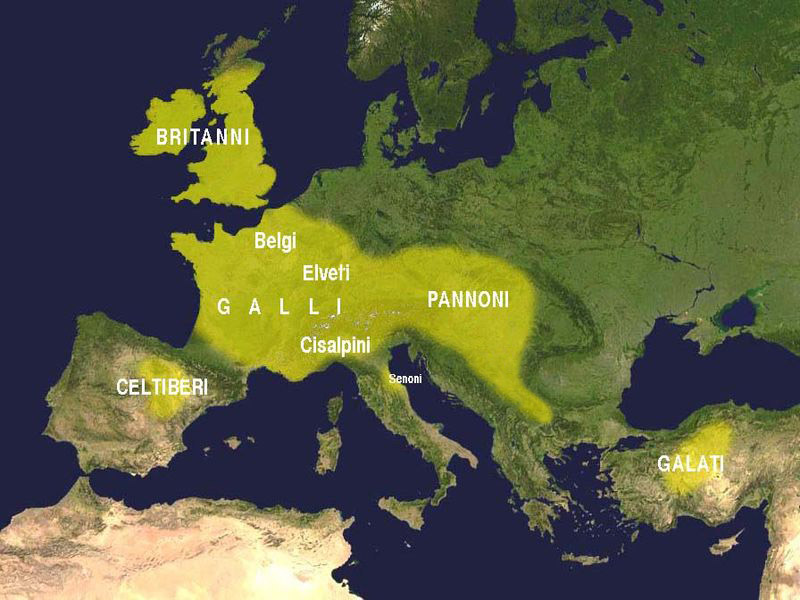
The chief town of the Lepontii was Oscela, now Domodossola, Italy, and their territory included the southern slopes of the St. Gotthard Pass and Simplon Pass, corresponding roughly to present-day Ossola and Ticino. See also: Lepontic language. This map of Rhaetia [1] shows the location of the Lepontic territory, in the south-western corner of Rhaetia. The area to the South, including what was to become the Insubrian capital Mediolanum (modern Milan), was Etruscan around 600-500 BC, when the Lepontii began writing tombstone inscriptions in their alphabet (one of several Etruscan-derived alphabets in the Rhaetian territory).
Lepontic language
Lepontic is an extinct Celtic language that was spoken in parts of Rhaetia and Cisalpine Gaul (today's Northern Italy) between 700 BC and 400 BC. Sometimes called Cisalpine Celtic, it is considered a dialect of the Gaulish language and thus a Continental Celtic language (Eska 1998).
The language is only known from a few inscriptions discovered that were written in the alphabet of Lugano, one of five main varieties of Northern Italic alphabets, derived from the Etruscan alphabet. These inscriptions were found in an area centered on Lugano, including Lago di Como and Lago Maggiore. Similar scripts were used for writing the Rhaetic and Venetic languages, and the Germanic runic alphabets probably derive from a script belonging to this group.

Lepontic was assimilated first by Gaulish, with the settlement of Gaulish tribes north of the River Po, and then by Latin, after the Roman Republic gained control over Gallia Cisalpina during the late second and first century BC.
The grouping of all of these inscriptions into a single Celtic language is disputed, and some (including specifically all of the older ones) are said to be in a non-Celtic language related to Ligurian (Whatmough 1933, Pisani 1964). Under this view, which was the prevailing view until about 1970, Lepontic is the correct name for the non-Celtic language, while the Celtic language is to be called Cisalpine Gaulish. Following Lejeune (1971), the consensus view became that Lepontic should be classified as a Celtic language, albeit possibly as divergent as Celtiberian, and in any case quite distinct from Cisalpine Gaulish. Only in recent years, there has been a tendency to identify Lepontic and Cisalpine Gaulish as one and the same language.
While the language is named after the tribe of the Lepontii, which occupied portions of ancient Rhaetia, specifically an Alpine area straddling modern Switzerland and Italy and bordering Cisalpine Gaul, the term is currently used by many Celticists to apply to all Celtic dialects of ancient Italy. This usage is disputed by those who continue to view the Lepontii as one of several indigenous pre-Roman tribes of the Alps, quite distinct from the Gauls who invaded the plains of Northern Italy in historical times.

The older Lepontic inscriptions date back to before the 5th century BC, the item from Castelletto Ticino being dated at the 6th century BC and that from Sesto Calende possibly being from the 7th century BC (Prosdocimi, 1991). The people who made these inscriptions are nowadays identified with the Golasecca culture, which has been ascribed a Celtic identity (De Marinis, 1991). The extinction date for Lepontic is only inferred by the absence of later inscriptions.
http://en.wikipedia.org/wiki/Lepontic_language
Ligures
The Ligures (singular Ligus or Ligur; English: Ligurians, Greek: Λίγυες) were an ancient people who gave their name to Liguria, which once stretched from Northern Italy into southern Gaul. According to Plutarch they called themselves Ambrones which means ¨people of the water¨. The Ligures inhabited what now corresponds to Liguria, northern Tuscany, Piedmont, part of Emilia-Romagna, part of Lombardy, and parts of southeastern France.
Classical references and toponomastics suggest that the Ligurian sphere once extended further into central Italy (Taurisci): according to Hesiod's Catalogues (early 6th century BC) they were one of the three main "barbarian" peoples ruling over the Western border of the known world (the others being Aethiopians and Scythians). Avienus, in a translation of a voyage account probably from Marseille (4th century BC) speaks of the Ligurian hegemony extending up to the North Sea, before they were pushed back by the Celts. Ligurian toponyms have been found in Sicily, the Rhône valley, Corsica and Sardinia.


It is not known for certain whether they were a pre-Indo-European people akin to Iberians; a separate Indo-European branch with Italic and Celtic affinities; or even a branch of the Celts or Italics. Kinship between the Ligures and Lepontii has also been proposed. Another theory traces their origin to Betica (modern Andalusia).
The Ligures were assimilated by the Romans, and before that by the Gauls, producing a Celto-Ligurian culture.
Tribes
Numerous tribes of Ligures are mentioned by ancient historians, among them:
Ligurian language
The Ligurian language was spoken in pre-Roman times and into the Roman era by an ancient people of north-western Italy and south-eastern France known as the Ligures. Very little is known about this language (mainly place names and personal names remain) which is generally believed to have been Indo-European; it appears to have shared many features with other Indo-European languages, primarily Celtic (Gaulish) and Italic (Latin and the Osco-Umbrian languages).
Xavier Delamarre argues that Ligurian was a Celtic language, similar to but not the same as Gaulish. His argument hinges on two points: firstly, the Ligurian place-name Genua (modern Genoa, located near a river mouth) is claimed by Delamarre to derive from PIE *genu-, "chin(bone)". Many Indo-European languages use 'mouth' to mean the part of a river which meets the sea or a lake, but it is only in Celtic that reflexes of PIE *genu- mean 'mouth'. Besides Genua, which is considered Ligurian (Delamarre 2003, p. 177), this is found also in Genava (modern Geneva), which may be Gaulish. However, Genua and Genava may well derive from another PIE root with the form *genu-, which means "knee" (so in Pokorny, IEW [1]).
Delamarre's second point is Plutarch's mention (Marius 10, 5-6) that during the Battle of Aquae Sextiae in 102 BC, the Ambrones (who may have been a Celtic tribe) began to shout "Ambrones!" as their battle-cry; the Ligurian troops fighting for the Romans, on hearing this cry, found that it was identical to an ancient name in their country which the Ligurians often used when speaking of their descent (outôs kata genos onomazousi Ligues), so they returned the shout, "Ambrones!".
Delamarre points out a risk of circular logic - if it is believed that the Ligurians are non-Celtic, and if many place names and tribal names that classical authors state are Ligurian seem to be Celtic, it is incorrect to discard all the Celtic ones when collecting Ligurian words and to use this edited corpus to demonstrate that Ligurian is non-Celtic or non-Indo-European.
Strabo on the other hand states "As for the Alps... Many tribes (éthnê) occupy these mountains, all Celtic (Keltikà) except the Ligurians; but while these Ligurians belong to a different people (hetero-ethneis), still they are similar to the Celts in their modes of life (bíois)."
The Ligurian-Celtic question is also discussed by Barruol (1999).
Herodotus (5.9) wrote that sigunnai meant 'hucksters, peddlers' among the Ligurians who lived above Massilia.
http://en.wikipedia.org/wiki/Ligurian_language
Friday, November 14, 2008
Ancient Greek Connections

The term "Magna Graecia" means "Greater Greece," referring specifically to the ancient Greek colonies in Southern Italy and Sicily. There were also Greek colonies all over the Black Sea coasts, the Mediterranean coasts, North Africa coasts, around Asia Minor, and up to the British Isles. I think they were more-or-less autonomous, but don't hold me to that point. During Alexander the Great's conquests, the empire was expanded to a huge area, but I doubt that much of it reflected the culture of Greece, due to it's sheer size. What we're discussing here is the Greek influence, over centuries, that was made in small steps apparently, and not really by conquest, and did indeed reflect Greek culture. Specifically, how it affected Northern Italy.
On the Italian peninsula, Naples was the furthest northern colony of strong significance. I said of "strong significance," and not of any significance. Southern France also had a number of colonies, but not much in Northern Italy. The reason is that the Etruscan civilization was flourishing, encompassing from roughly north of Naples, to the edge of Lake Garda. Not all of the north, but most of it.
We see, stretched across Southern France, an underrated amount of influence. Similar to Southern Italy. One colony outpost was at "Massilia," which is modern Marseilles. West of Marseilles is the coastal region of the Languedoc, also a former Greek colony. In fact, incredibly, up to the nineteenth century, they actually spoke a Greek dialect! The following text is from pages 91-92 of the book 'Rule By Secrecy' (Jim Marrs; 2000), in the section regarding the Cathars:
"The Languedoc, formerly known as Occitania, encompassed the Mediterranean coast west of Marseilles, the Black and Corbieres Mountains and the Pyrenees, which separated the area from Spain. An independent state, the region was more closely tied to the Spanish frontier and the vestiges of the old Septimanian kingdom than to the newly forming French nation. Languedoc was a crossroads where travelers passed to and from the Middle East via Muslim Iberia and the sea.
"With the breakup of the Carolingian empire created by Charlemagne following his hard-won conquest of the area in A.D. 801, this corner of the old Roman Empire fell under the control of various kings of the Francia or Franks, the name of which soon would be applied to the entire nation—France.
"Languedoc was home to a number of ancient towns, many of which traced their origin to the Greeks and early Romans. It had its own traditions, culture, and its own language. The language of Occitania or Langue d’Oc gave the area both its identification and its name.
Perhaps due to this convergence of ideas and traditions, the Languedoc was more cultured and prosperous than its neighbors."
 Greeks in Northern Italy
Genoa: I had always heard that Genoa was once a Greek colony, but apparently not. I can't find a bit of evidence to suggest that the ancient Greeks where there. Certainly there must have been trade with the Greek world, but it appears that Genoa was in the Etruscan sphere of influence. Maybe someone out there can help us out here?
Nizza (Nice, France): From the Wikipedia entry for Nice: "Nice (Nicaea) was probably founded around 350 BC by the Greeks of Massilia (Marseille), and was given the name of Νικαία ("Nikaia") in honour of a victory over the neighbouring Ligurians (Nike is the Greek goddess of victory). The city soon became one of the busiest trading ports on the Ligurian coast; but it had an important rival in the Roman town of Cemenelum, which continued to exist as a separate city until the time of the Lombard invasions. The ruins of Cemenelum are located in Cimiez, which is now a district in Nice."
Tarquinia (in northern Lazio): From the Wikipedia entry for Tarquinia: "Tarquinii (Etruscan Tarchnal) is said to have been already a flourishing city when Demaratus of Corinth brought in Greek workmen. It was the chief of the twelve cities of Etruria, and appears in the earliest history of Rome as the home of two of its kings, Tarquinius Priscus and Tarquinius Superbus. From it many of the religious rites and ceremonies of Rome are said to have been derived..." Apparently, not a Greek colony, but a strong "Greek influence." Probably a better way to look at it, a center of the Greek to Roman passing of the torch.
Spina (Wiki says: "Etruscan port city on the Adriatic at the ancient mouth of the Po"): From the Wikipedia entry for Spina: "Spina was an Etruscan port city on the Adriatic at the ancient mouth of the Po, south of the lagoon which would become the site of Venice. The site of Spina was lost until modern times, when drainage schemes in the delta of the Po River in 1922 first officially revealed a necropolis of Etruscan Spina about four miles west of the commune of Comacchio. The fishermen of Comacchio, it soon turned out, had been the source of "Etruscan" vases (actually originally imported from Greece) and other artifacts that had appeared for years on the archeological black market.
"The archaeological finds from the burials of spina aerial photography. Aside from the white reflective surfaces of the modern drainage channels there appeared in the photographs a ghostly network of dark lines and light rectangles, the dark lines indicating richer vegetation on the sites of ancient canals. Thus the layout of the ancient trading port was revealed, now miles from the sea, due to the sedimentation of the Po delta. Spina had a Hellenized indigenous population."
Lombardy: From the Wikipedia entry for Lombardy (wine): "The winemaking tradition of Lombardy dates back to its settlement by Greek colonists from Athens along the Po river. Archaeological evidence suggest that these settlers traded wine with the Etruscans in nearby Tuscany.[3] In the late 19th century, the Italian wine writer C.B. Cerletti wrote a book for the French market that described the wines of Italy. Of the wines of Lombardy he noted that the Valtellina were still being made in a Greek style and the wines of Oltrepò Pavese were the preferred wines of the Milanese.[4]
3 - H. Johnson Vintage: The Story of Wine pg 39 Simon and Schuster 1989 ISBN 0671687026
4 - H. Johnson Vintage: The Story of Wine pg 421-422 Simon and Schuster 1989 ISBN 0671687026"

Battle of Lepanto
There were three "Battles of Lepanto" actually, during the Ottoman-Venetian Wars. I'm having a difficult time linking this information, due to this, so you can find all of the Wikipedia links regarding this period here. The most significant of these three battles, and one of the most significant of all time, was the one in 1571. A Venetian-led combined force of European-Christian allies defeated the Ottoman Turks at Lepanto (Naupaktos, Greece), and prevented their designs on conquering Europe.
A Shameful Event
Apparently, at one point during the Venetian Empire, there was a conflict between the Venetians and Greeks. Although I don't feel like looking this up at this time, I recall some type of Venetian admiral ordered a volly of cannon fire at a Greek city (Athens?), and this did at least some damage to some ancient ruins. It possibly may have even been the Acropolis. I don't recall. There was no justification for this dishonorable action, regardless of what political or economic dispute may have occurred.
 Greeks and Phoenicians
Predating what we know as ancient Greece, was the Phoenician culture. Despite the fact that Phoenicia was not in Europe (Phoenicia was based in what is now Lebanon, and probably a territory that stretched beyond that a bit), the Phoenicians provided what was much of at least the initial spark of what was later transformed into Western Civilization. The Phoenicians were not Arabs, who lived in the Saudi Peninsula until the seventh century. They were ancient Mediterraneans.
The Phoenicians also had many colonies, and a large "trade empire" (I use this term loosely). What is interesting is that it appears that the host peoples were basically pretty receptive to Greek and Phoenician influence. The Phoenicians had colonies, concurrently with the Greeks, also along the coasts of the Mediterranean, and even up to the British Isles, and many other places. There's even evidence that they were mining in southeast Africa at one point. The website Phoenicia.org has a lot of information of how far and wide they traveled.
The Phoenicians didn't, as far as I know, affect Northern Italy much. Of course, there must have long been Phoenician-Etruscan trade. They did have colonies all around the Mediterranean (the western Maghrib coast, southern Iberian coast) as well as even in Italy (western Sicily, parts of Sardinia). I don't really see where there was much conflict. Maybe someone can clue us in on that point. There seemed to be much cooperation between pre-Roman Greeks, Etruscans, and Phoenicians. At this time, Egypt was still very much viable, but they didn't appear to be colonizing northwards, just as the Etruscans seemed to be happy in their general area.
11-18-08 Note: I had meant to point out that Carthage, possibly Rome's greatest foe (see "Punic Wars"), was a Phoenician colony. Another way to look at this is that Etruscan civilization gave rise to Rome (which stamped out Etruscan culture), and the Phoenician trade empire gave rise to Carthage. Two true empires, as opposed to peaceful trade networks, could not co-exist in this manner for very long.
Friday, July 18, 2008
Lombard Kingdom WAS "Padania"
 I just began to read 'History of the Lombards', written by Paul the Deacon in the eighth century, and I would like to post a quote from the book here now:
"By the middle of the eighth century, with the fall of Ravenna and the increasing Lombard pressures on Rome, the Lombard kingdom wholly dominated the north of the peninsula, while the Byzantine forces held the south. This division survived Charlemagne's conquests, the raids of the Arabs in the ninth and early tenth centuries, and the Norman invasions of south Italy in the eleventh and twelfth centuries. In addition, it played an important part in the later history of Italy, contributing to the many differences between the north and the south and shaping the culture out of which emerged the Italian communes of the north in the tenth, eleventh and twelfth centuries."
--'History of the Lombards'; 'Introduction I' by Edward Peters; pages ix to v; exact and continuous quote
**********************************************************************************
Addition [12-2-08]: It was under the leadership of the Lombard King Alboin, that "Langbard" (Kingdom of the Lombards) was first established. However, it was not until his successor's reign, that all of Northern Italy was conquered. The following is the Wikipedia entry for "Cleph.":
"Cleph
"Cleph (also Clef, Clepho, or Kleph; in Italian, Clefi) was king of the Lombards from 572 or 573 to 574 or 575.
"He succeeded Alboin, to whom he was not related by blood. He was a violent and terrifying figure to the Romans and Byzantines struggling to maintain control of the peninsula. He extended Lombard dominion over all of northern Italy, finishing the conquest of Tuscany and bringing Lombard authority to the gates of Ravenna. He was assassinated after an 18-month reign by a young guard, a slave whom he had mistreated. His death was followed by a ten year interregnum, known as the "Rule of the Dukes" because the territorial dukes were supreme. His son, Authari, eventually took the throne in 585."
So for all who insist that "Padania" was never a nation... well, it was! It was called the Kingdom of the Lombards or LANGBARD.
Tuesday, January 23, 2007
Padania, Buenos Aires Province & Northern California

Last evening, I was viewing some old postings from the Lega Nord message board. The PAL was listed as one of their topics. It was clear that most of the posters were poking fun at some of the perceived "ideology." We don't have any political idealogy, as we're not a political group! I guess it was a form of "Italian humor," making fun of new things that are introduced.
I know that the "Padani nel Mondo" (Padanians in the World) wing of the Northern League has indeed reached out to "Padanian-Argentinians." This brings up the issue of how one should deal with those who we (as individuals or groups) would like to reach out to, and the methodology of doing this. I feel that many Italians and Padanians, or even Europeans for that matter, have a "Parent-Child Complex" when it comes to dealing with those around the world who are descended from their nation(s). Something like "Oh, they're trying to be Italian."
Of course, we're not "Italian," "Padanian," or "European!" Geeez. I was born in San Francisco! My parents were born in Ironwood, Michigan. Gimme a break! We are indeed "here." Once I even had a "Keyboard Commando" accuse me of "trying to effect politics in his county." LOL Pleeease! Naturally we would like to connect with Padanians, Padanian-Australians, etc.
If you want to connect with someone or something, just say so. We don't have to fall all over someone. I'm not going to twist anybody's arm. So to answer that queston: No, I don't "want to be Italian" in any type of nationalistic standpoint. We have our national problems here, like the North American Union or NAFTA Superhighway that nobody wants, and has not been put up for public debate. But socially, YES, we DO want to connect with "cousins" overseas. Definitely.
One of the "unpadanian ideas" that was made fun of was that "Rome" and "Romans" (in a modern sense) were "Padanian." In fact, with recent changes in the political aparatus of Lega Nord, even Tuscany is questioned as being "part of Padania." Again, the "Parent-Child Complex." After all, doesn't a parent always have a little advantage over even their grown child? LOL They really seem to have that attitude. We're not in the Lega Nord party, nor are we in the same social setting as they are. We don't really have distinctions between Ligurians, Tuscans, or Venetians. The millenium+ long border between "Naples & Sicily" and the Northern Italian states and Roman state was in "southern Lazio."
Also, they all seem to hate the government in Rome, in the same way that American dissidents hate the government in Washington D.C. They seem to totally disown Rome. But that's the government they have a grievence with, NOT the Roman people!! So, in conclusion, that "social-cultural structure" doesn't even apply to us.
Lastly, Lega Nord symbolically leans heavily on Nordic Lombard or Celtic roots. Well, I respectfully disagree. To me, the soul of North Italy is the Etruscans and other Italic tribes, which I refer to just as "Etruscan." Someone told me, and I can't confirm or deny this, that there were only about 30,000 Lombards who invaded Italy, a relatively small number. The Kingdom of the Lombards was significant in that it tied together, in an administrative sense, virtually all of "Padania." So somehow I view it as being a "Padania" where the symbolic flag is Lombard, but the soul is Etruscan.
I should end by pointing out that we DO have some allies in Lega Nord, but they were not really able to defend us in this particular debate due to the nature of the hard-nosed political debate. The hard liners want it both ways. They want to tease us that we're "trying to be Padanian," while at the same time holding us up to their own social and political standards! However, you don't have to tell me, "communication, communication."
Subscribe to:
Posts (Atom)