
Tuesday, February 16, 2016
Food from Tuscany
Food from Tuscany
RAI
Tuscany. Home of high quality products appreciated throughout the world: its olive oil, its Chianti wine. And then its Fiorentina T-bone steak from Chianina cattle, one of the most ancient and prized breeds in the world.
See more video at http://www.expo.rai.it/youritaly
.


Friday, February 12, 2016
The Battle Of Lepanto
TRIBUTE TO THE BATTLE OF LEPANTO
The Ghost of Lepanto
Events Leading to Battle of Lepanto, 7 October 1571
The battle of Lepanto was one of the turning points in the struggle of Europeans to preserve their Freedom and Humanity from the talons of the encroaching Turk Ottoman Empire.
In 1571, the European Union forged by Don Juan of Austria, saved Italy and the Western Mediterranean from unimaginable destruction and human suffering.
Lepanto ranks with the Battle of Vienna (1683) as one of the two major watersheds that saved the European way of Life and protected the tender bud of Renaissance.
Since the 16th century, October 7 has been celebrated as a Feast Day in the Catholic Tradition.
Battle of Lepanto
The Battle of Lepanto was a naval engagement taking place on 7 October 1571 in which a fleet of the Holy League, a coalition of European Catholic maritime states arranged by Pope Pius V and led by Spanish admiral Don Juan of Austria, decisively defeated the fleet of the Ottoman Empire on the northern edge of the Gulf of Corinth, off western Greece. The Ottoman forces sailing westwards from their naval station in Lepanto (Turkish: İnebahtı; Greek: Ναύπακτος or Έπαχτος Naupaktos or Épahtos) met the Holy League forces, which came from Messina, Sicily, where they had previously gathered.
The victory of the Holy League prevented the Ottoman Empire from expanding further along the European side of the Mediterranean. Lepanto was the last major naval battle in the Mediterranean fought entirely between galleys and has been assigned great symbolic and historical importance by several historians.
Battle of Lepanto, 1571: What REALLY Happened
Real Crusades History
http://www.realcrusadeshistory.com
.
Thursday, February 11, 2016
Brennus: Warlord of the Cisalpine Gauls - Part III
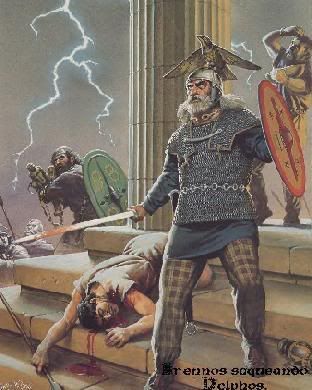
Brennus was covered here once before briefly ('Brennus of the 4th century BC'), and the question remains; should Brennus be thought of as our own noble ancestor who stood up against Roman oppressors, or as a foreign invader who only destroyed and plundered? I think the answer is somewhere in the middle.
I recall years ago of reading a Padanian website in English, where Brenno was mentioned as a northern hero. I distinctly remember reading at the end of that particular writing, something like "now Brenno is coming back!" A reference of his Gaulish spirit coming back.
To find the truth, we must recognize two items to begin with. First, Gaul and Cisalpine Gaul were the same culture; and second, the Romans had not invaded the heart of Cisalpine Gaul as of yet. While Brennus was from northern Gaul, there were strong cultural links, For example, part of the northern Gaulish tribe called the Cenomani, apparently migrated to what is now the area of lower Brescia and Verona. These migrations were common, and had occurred over centuries. Therefore, on one hand Brennus was legitimately a powerful figure to the Cisalpine Gauls; while on the other hand the Romans had not invaded the Gauls as of yet. You cannot "strike back" against someone for something they had not done yet; therefore Brennus was more of a plunderer than a resistance fighter.
The simple truth is that the Romans and the Gauls are both part of our heritage. Most the the north were eventually to be culturally "Romanized Gauls." I've always tried to reason that prior to the rise of Rome, there was Gaulish influence in Tuscany and the south ("southern Cisalpina") and Etruscan influence in Lombardy and the north. Had Rome not risen to power, I think that the two cultures (Etruscan-Umbrian and Gaulish-Alpine) would have merged peacefully together. In fact, they already were. In conclusion, in my opinion--as far as this Etrusco-Gaulish ethnic identity concept is concerned--the invading Romans and the later invasion of Germanic tribes were ethno-cultural admixtures.... "secondary influences" as far as ethnicity. Also of interest is that both the Etruscans and the larger Celtic societies, expanded in relative peace. There existed only marginal "pushing" between Etruscans and Gauls; and while local Celtic tribes battled from time to time, it was hardly a clash of civilizations.

It probably wouldn't be entirely truthful to say that Brennus was to the Cisalpine Gauls, what Vercingetorix was to the northern Gauls. There were Cisalpine Gauls among Brennus' army, but Brennus himself was not from Cisalpine Gaul.
**************************************************
Random fact: I believe that in the movie 'Brennus: Enemy of Rome', Brennus twice made mention of the god "Thor." At one point saying "In the name of Thor!" Thor was a god in the Teutonic pantheon, and not present in Gaulish polytheism. Apparently the filmmakers perceived "the Gauls" as a particular Germanic tribe, instead of an entire culture made up of their own separate tribal groups.
.
Sunday, February 7, 2016
Brennus: Warlord of the Cisalpine Gauls - Part II
Brennus, Enemy of Rome (1963) - Color / 87 mins
Vulture Graffix
An English dubbed, Austrian print of Brennus Enemy of Rome (AKA: Brenno der herr des schreckens, AKA: Brenno il nemico di Roma, AKA: Battle of the Valiant). The film was made in 1963 about the sack of Rome in 387 BC. It was written by Adriano Bolzoni, Arpad DeRiso and Nino Scolaro and was directed by Giacomo Gentilomo. It stars Gordon Mitchell, Ursula Davis, Massimo Serato and Tony Kendall.
The story takes various elements from Livy's history of the Gauls' attack on Rome, plus Plutarch's biography of Camillus, and cleverly remixes them to fashion a ripping yarn. The banishment of the Roman general Camillus, the controversy over the spoils of Veii, the involvement of the Fabius brothers, the flight of the Vestal virgins from Rome, the barbarian who tugs the beard of a Roman elder, the honking of the sacred geese, and even Brennus's scornful "Woe to the vanquished!" as he heaps his sword onto the scales, are all from the historical record.... and all give tale to a fictional re imagining of the sack of Rome in 387 B.C. by Brennus, leading an army of Gauls.
You can visit our facebook page for further movie mayhem;
https://www.facebook.com/VultureArt
**************************************************
Random fact: "Brennus" in Latin became Brenno in Italian. The city of Breno in northern Brescia possibly may have been named after Brennus, who would have been a hero in the Gaulish Alps. Ironically, the Gaulish sacking of early Rome directly led to the Roman invasion of the Alps centuries later.
.
Saturday, February 6, 2016
Brennus: Warlord of the Cisalpine Gauls - Part I
Barbarians - The Primitive Celts
docufans1
So you think you know everything about the Romans? They gave us sophisticated road systems, chariots and the modern-day calendar. And of course they had to contend with barbarian hordes who continually threatened the peace, safety and prosperity of their Empire. Didn't they? Terry Jones' Barbarians takes a completely fresh approach to Roman history. Not only does it offer us the chance to see the Romans from a non-Roman perspective, it also reveals that most of the people written off by the Romans as uncivilized, savage and barbaric were in fact organized, motivated and intelligent groups of people, with no intentions of overthrowing Rome and plundering its Empire.
**************************************************
Random fact: Contrary to long held popular perception, the Vikings did not wear horned helmets. However, the Gauls did.
.
Sunday, January 31, 2016
Mount Sibillini National Park
Nationalpark Monti Sibillini - Italien
TheWorldOfTravel DE
Sibillini Mountains
The Sibillini Mountains, or Sibylline Mountains (Italian: Monti Sibillini) are a mountain group in Italy, part of the central Apennines. Situated between eastern Umbria and the Marche, they are mostly composed of limestone rocks, formed in the Mesozoic and Cenozoic (100 to 50 million years ago) on the bottom of an extinct sea. The land emerged 20 million years ago. Most of the peaks are over 2,000 m (6,600 ft); the highest altitude is reached by Monte Vettore at 2,476 m (8,123 ft).
.
Friday, January 29, 2016
Subscribe to:
Posts (Atom)