Friday, May 31, 2013

Gallo-Italic languages

After the Romans conquered the Gallo-Alpine tribes, the slow process of linguistic Romanization of the languages began. Ancient family and village names were either translated or an Italian suffix was added on to the end (ini, oni, ucci, etti, etc.). In this way, a translated Sicilian name could be the same as a translated Piedmontese name. Still, after the fall of Rome, language shifted back to the natives languages and dialects. What we had in 1860 were the hybrid languages of Roman-Latin and the various Cisalpine dialects. Had cultural and linguistic Romanization not taken place, the Italian peninsula would be just like the Balkans today in terms of constituting entirely different languages and cultures.

If you look at the "linguistic map of Italy," and then look at the nations of 1860 (or any map between the fall of Rome and the Risorgimento, or even the regions today), it always closely matches! There is always the "northern nations," the "Roman state," and the "southern nations." All separated by different languages with local dialects. As Americans, we have a hard time comprehending the way Europe was socio-geographically over the centuries. I could move to Montana, a thousand miles away, tomorrow and instantly become a Montanan. That's what we're used to. I could move From the Bay Area to Maine, and probably fit in better than I do here, even though I have no knowledge of the state. That would be like going from Ireland to Belarus. The cultural-geographical scale, up until very recently, was entirely different.


Within many Italian provinces, there exists even different native dialects (ex. Brescia). Sometimes there are even two different language families, and in parts of the Tri-Veneto area there are three different deep-rooted languages spoken (Italian, Venetian, and Ladin), and it was once four when the German-Cimbrian language was alive. [I would consider the South Tyrol to be a different dynamic since it was wrongly acquired after World War II.]


Gallo-Italic languages (Wikipedia)

The Gallo-Italian or Gallo-Italic languages constitute the majority of northern Italian languages. Among them are are Piedmontese, Lombard, Emiliano-Romagnolo and Ligurian, although there is some doubt about the position of the latter due to its retention of final /o/.

The Gallo-Italian languages have characteristics both of the Gallo-Romance languages to the northwest (including French and Occitan) and the Italo-Romance languages to the south (including standard Italian). Examples of the former are the loss of all final vowels other than -a; the occurrence of lenition; the development of original /kt/ to /jt/ (and often later to /tʃ/); and the development of front-rounded vowels (e.g. the change of /u/ to /y/). Examples of the latter are the use of vowel changes to indicate plurals, in place of /s/; the widespread occurrence of metaphony of stressed vowels, triggered by original final /i/; and the development in some areas of /tʃ/ instead of /ts/ as the result of palatalization of original /k/ before e and i. As a result, there is some debate over the proper grouping of the Gallo-Italian languages. Most commonly, they are grouped with the Gallo-Romance languages, but some Italian linguists prefer to group them with the Italo-Romance languages.


Geographic distribution

Traditionally spoken in Northern Italy, Southern Switzerland, San Marino and Monaco, most Gallo-Italian languages have given way in everyday use to Standardized Italian. The vast majority of current speakers are bilingual with Italian. These languages are still spoken by immigrants in countries with Italian immigrant communities. Ligurian is formalised in Monaco as Monegasque.

The Venetian language is usually considered to belong to a different dialect community, while some publications place it among the Gallo-Italian languages.


.

Monday, April 29, 2013

'Il Trovatore' and 'La Traviata' by Giuseppe Verdi in Bay Area

Il Trovatore

Hear some of Verdi’s most melodious music including his exciting Anvil Chorus sung by Spanish gypsies.  It is full of dramatically powerful scenes: tales of flames at the stake, kidnapping and revenge master-minded by Azucena, the conniving gypsy woman; a mysterious troubadour and Leonora who loses her heart to him; the drama of war waged on a castle fortress; and two brothers separated at birth who unknowingly become mortal enemies. Set in Spain in the early 15th century, the story is told by three separate, intertwining sub-plots, rich with colorful history.

Check periodically for next showing


La Traviata

Experience the effervescent music and the heart-wrenching drama of La Traviata. A time of excess and excitement, of living for the moment and flaunting newfound freedoms creates the mood.  Verdi’s eternally popular opera, spins the tale of a conflicted courtesan, her devoted lover and his disapproving father.  Violetta dares to break society’s rules by allowing herself to love and be loved.

Coming in June

.

Sunday, March 17, 2013

'Rachel the Wicked' (an original new poem)


'Rachel the Wicked'

So many thought of you in a negative light,
As you so often did act without care.
Still for me, I chose to look deeper,
And saw a castle in the air.

I'll never forget the tall brown-eyed Tuscan beauty,
Who left many a passerby in a momentary stun.
And whose long hair seemed to magically change color,
Dark in the dim, and blondish in the sun.

For me, I'll always know in my heart and mind,
No matter if I'm the only one who will believe.
That you possessed some sacred values and ethics,
Of which some of your critics lacked the character to even conceive.

My dream of you this week was entirely unexpected,
Including our mystical happy ending.
I know that it won't happen in this life,
But it was still precious, even in pretending.

In what vein should I remember you,
Now that its been a good many years since you decided to leave this world?
I proclaim here and now, as neither devil nor angel,
But rather as a matron spirit of fire and aspired dreams, waiting to be unfurled.


--Camunlynx


.

Friday, March 15, 2013

Celtic warriors - Italian Bagpipes - Cornamuse Italiane (Arriva la Piva)


The above video, and title, was from YouTube channel fabiovetro. Bagpipes may have been introduced by ancient Phoenician traders, but I have no information about "Italian bagpipes." Apparently there is some evidence of Celtic music having a similar sound in both the British Isles and in continental Europe.

When the ancient Germanic tribes came into Europe, they merged with ancient Alpine natives from Scotland to Asia Minor to produce the "Celtic cultures." The Italic tribes would have been one grouping of the "Alpines," at a time when much of Europe was covered in ice during the last glacial movement. Some of the imagery from this video is based on the Celtic Gaels and Britons, but some of it is based on the continental Celts (Gauls, Celtiberians, Hallstatts, Belgae, Cisalpines, etc.).

.

Thursday, March 14, 2013

First non-European Pope is of Cisalpine descent


Pope Francis (Wikipedia)

Pope Francis (Latin: Franciscus Ecclesiastical Latin: [franˈtʃiskus]; born Jorge Mario Bergoglio; 17 December 1936) is the 266th and current pope of the Catholic Church, elected on 13 March 2013. As such, he is both head of the Church and Sovereign of the Vatican City State.

A native of Buenos Aires, Argentina, he was ordained as a priest in 1969. In 1998 he became the Archbishop of Buenos Aires, and in 2001 a cardinal. Following the resignation of his predecessor, Pope Benedict XVI, on 28 February 2013, the conclave elected Bergoglio, who chose the papal name Francis in honour of Saint Francis of Assisi. He is both the first Jesuit pope and the first pope from the Americas. He is also the first pope from outside Europe since Pope Gregory III in the 8th century.


Early life

Jorge Mario Bergoglio was born in Buenos Aires, one of the five children of Mario José Bergoglio, a railway worker born in Portacomaro (Asti) in Italy's Piedmont region, and his wife Regina María Sivori, a housewife born in Buenos Aires to a family of northern Italian (Piedmontese-Genovese) origin. He graduated from a technical secondary school as a chemical technician and then, at the age of 21, decided to become a priest.


.

Wednesday, February 27, 2013

Cisalpine IQ and human accomplishment: Part 1

Cassini-Huygens Mission to Saturn and Titan
An intelligence quotient, or IQ, is a score derived from one of several standardized tests designed to assess intelligence. 

Some can agree with it, disagree with it, but it remains as the current scientific method for accessing what's between our ears. Obviously someone could be immoral, amoral, evil, violent, twisted, perverted, a political zealot, an ideologue, a relative conformist, or just totally opposed to something normal or good.... and still have a high IQ.

I think, like anything else, it should be questioned. What is "intelligence?" Someone, for example, could attain advanced degrees due to having great memorizational ability; but they could be severely lacking in creative ability, problem solving skills, and sometimes even common "cause and effect" logic. Political figures are a good example of this. Still, IQ does tell us a lot. I wouldn't totally hang my hat on it, but it can be compared to global demographics, sources of technologies, and other factors; and it can at least be determined that IQ tells us much.

Quite frankly, the IQ of native Cisalpines is about 110... the highest in the world. Even then, that doesn't mean that every individual is up to that standard; nor does is mean that a Cisalpine society will always be the best. One good example of "a self-propelled milieu of ideas" (as opposed to an intercultural crossroads of ideas) is the early automobile industry; whereby urban industrial centers in north Italy, Germany, and Japan in particular were able to develop entrepreneurial-technological environments for development.

Germany--which has a slightly lower average IQ (about 105) than true Cisalpines--still maintains a higher standard of living, a slightly higher inherent technological ingenuity, and better infrastructure. What is interesting is that the German-speaking countries, which are of Alpine and Germanic stock; and the Cisalpine regions, which are of true-Mediterranean and Alpine stock with Germanic admixture.... have gotten the best technological results in Europe. Again, this does not guarantee a better society or even a higher standard of living.

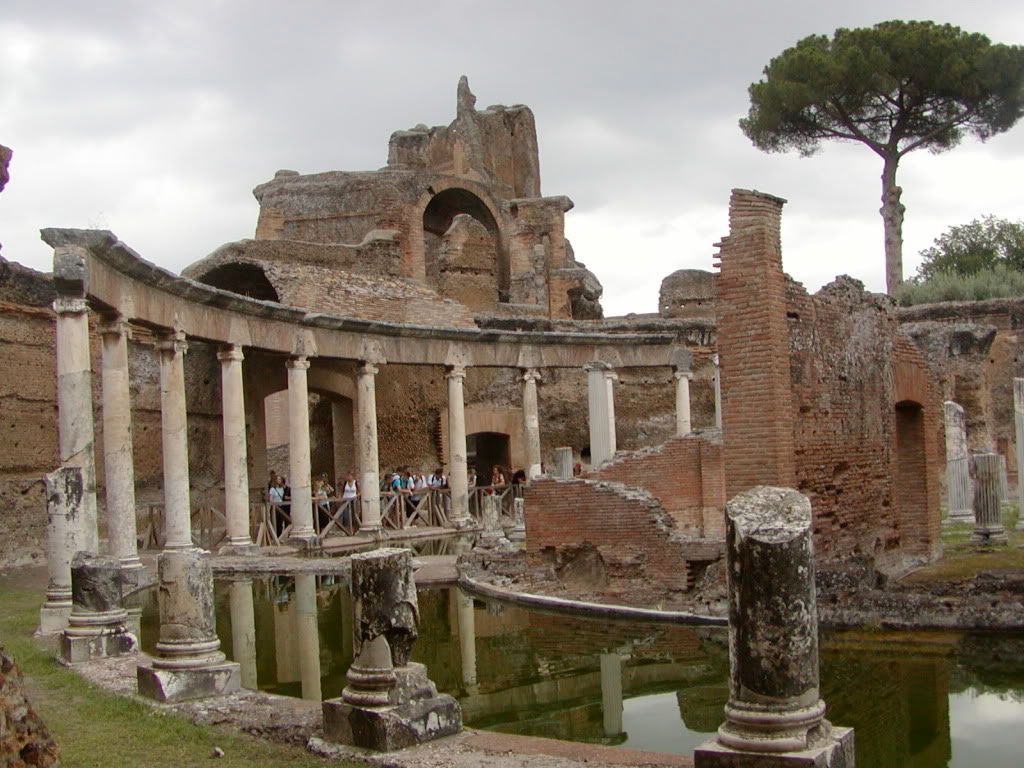
Etruscan ruins
Still, this south-central European ingenuity and IQ is higher than the more Teutonic or Norse countries; or anywhere else in Europe for that matter. It seems to shatter the idea of a Mediterranean or Teutonic basis for human accomplishment. The ancient true-Mediterraneans led the world in every area of human endeavor; yet in recent centuries the more advanced societies have become much more oriented toward generally northern/western Europe or their colonies. However, despite these realities, this Transalpine/Cisalpine creativity and ingenuity--at least in the area of science and technology--remains a driving force in the world.

There are endless theories and quagmires regarding the comparing of collective or demographic IQs, so I think I will just avoid that part of it mainly due to the endless complexities and layers of bias. Suffice to say, IQ tells us a lot, but not everything. I think that an individual could have a high IQ and not be nearly as successful as a cunning person with an average IQ. I like to think that creativity and logic carry a little more weight than cold intelligence and ruthless cunning. Actually, it's all mixed together; but it's helpful to assess ourselves.


.