Monday, August 26, 2013

California Wine 2013

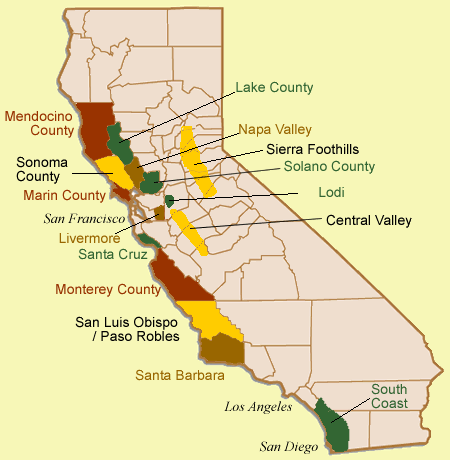
Yesterday, the San Francisco Chronicle published its annual 'California Wine' section. It was subtitled 'Sunny days - Now's the best time in years to enjoy the state's bounty.' In it were numerous articles about regional wines, corresponding foods, fall events, wine tasting, and different grapes. Unfortunately, this group of articles isn't available as a separate section online; but here is the link to their "wine" homepage.

No aspect of regional northern California culture brings out more the long standing local Cisalpine heritage than the wine industry. Not just the older wineries, but newer ones; as well as Cisalpines who came here in later times like Robert Mondavi. One of the wineries featured is the Fanucchi Vineyards in Fresno County.


In one of the articles entitled 'A toast to California wines', it states "California wine is booming as never before. You can see it clearly in the numbers. As we'll relate in the following pages, the state's wine industry remains on a nearly two-decde surge of popularity, accounting for more than $34 billion in sales last year."

In another article from the section entitled 'California wine enjoys a long boom', a sub-section shows the following facts:
*California's wine economy
-$61.5 billion in overall economic impact in the state
-330,000 jobs generated
-$12.3 billion in wages
-$14.7 billion generated in state and federal taxes


I often like to try foreign wines, and it's easy for for locals to forget that we live in very likely the best wine producing region in the world. One interesting development in recent years has been the growth of wine in Sonoma County; although I don't really know if it actually comes close to challenging the famous Napa County wine region in sales. Another interesting aspect of this industry is that there are big growers who don't even have a label of their own, and find it profitable enough in the farming end of the business.

The wine community of Lodi in the Central Valley--a city named after Lodi, Lombardy--had a full page ad to promote their wines, with their website LodiWine.com. If you're near a Chronicle distributor, you could just walk in and purchase the Sunday paper of August 26; especially if you wanted to attend some of the late Summer and Fall events. I find sfgate.com to be hard to search and navigate. Lastly, St. Helena is the heart of the wine industry in North America. It truly is a great place to visit. Our people were predominant in making this industry from it's inception.


.

Friday, August 23, 2013

Caffe D'Melanio: Restaurent Review

Being keenly interested in Argentina, I took notice recently while driving down Ocean Avenue in San Francisco when I saw the sign "Caffe D'Melanio - Argentinean Italian Cuisine." I dined there this past week, and wanted to review it. A quick glance at yelp.com showed inconsistent reviews, but mostly very positive. The establishment is both a coffee shop and deli during the day, and a restaurant and bar in the evening. It was named after the Argentine-expatriate owner Melanio Duarte, who passed away a couple of years ago, and seemed to live a very interesting life. I don't know if there is any Italian heritage connection or not; a person doesn't have to be Italian to serve Italian food, and certainly it is a very prominent culture in Argentina.

I noticed while quickly scanning the reviews, and from my own experience there, that's it's a difficult place to "review." It comes down to personal preference. I went on a weeknight at 5:30 PM, and we were the only ones there except for a person to two at the bar. It's a spacious place with a high ceiling, and well maintained, with a mixture of modern equipment and rustic art on the walls that reminded me of what I at least perceived to be South American. There was a type of monitor near one side playing oldies with the volume low at this time, with trivia, etc. I got the impression that they had been busy with coffee all day, and were making the transition to the restaurant part of the business. There was a bar near the entrance with big coffee blenders. They seem to cater to college students during the day, and there is a Wifi available.

I'm not familiar with "Italian-Argentinian cuisine," so I wasn't certain what items may have been Argentinian; but to me it looked like Italian and eclectic items (ex. Greek salad). Wine was available and they brought bread. I ordered the Chicken Pesto Ravioli and the other person ordered the salmon. My order was $11, but they have a nightly special which was about $6. I thought the homemade pomodoro sauce was very good, and the ravioli's were large and tasty. If you have a big appetite, then you probably should get an appetizer as well. It was pretty adequate food, although not a big menu.

Being a "politicophobe," I didn't care for the political statement(s) on the wall though. Then I had remembered when I scanned the article above, that the founder was a political activist who had fled to Brazil, then fled there apparently. Personally, I can't see a dime's worth of difference between far-right dictatorships and far-left dictatorships in Latin America. Anyway, what's the rule-of-thumb with strangers? "No religion and no politics." If this establishment was closer to places that I frequent more often, I would be more interested. I would like to go back to try their coffee. Basically, I liked it and its casual atmosphere. It looks like what you would think a cafe would appear like in Buenos Aires. It is like a little touch of the cone of South America.

.

Monday, August 19, 2013

'Le Nozze Di Figaro' ("Opera Song" from the 'Shawshank Redemption')


'Le Nozze Di Figaro', or 'The Marriage of Figaro', was the "Opera Song" featured in the movie 'The Shawshank Redemption'.

From Wikipedia: Le nozze di Figaro, ossia la folle giornata (The Marriage of Figaro, or The Day of Madness), K. 492, is an opera buffa (comic opera) in four acts composed in 1786 by Wolfgang Amadeus Mozart, with an Italian libretto written by Lorenzo Da Ponte based on a stage comedy by Pierre Beaumarchais, La folle journée, ou le Mariage de Figaro (1784).

Quote from the movie: I have no idea to this day what those two Italian ladies were singin about. Truth is I dont wanna know. Id like to think they were singin about something so beautiful it can't be expressed in words and makes your heart ache because of it. I tell you those voices soared higher and farther than anybody in a gray place dares to dream. It was like some beautiful bird flapped into our drab little cage and made those walls dissolve away and for the briefest of moments every last man in Shawshank felt free.

.

Tuesday, August 6, 2013

Ben-Hur (movie review)

Last evening on TCM, I watched 'Ben-Hur' for the first time in a very long time, and I wanted to review it. It is considered one of the epic movies of all time. One aspect of the film which I overlooked when I had watched it as a boy, was the Christian element to it; as it was subtitled 'A Tale of the Christ'. "Ben-Hur" was apparently not based on a real historical figure, but the film was based on an very popular 1880 fictional novel by Govenor/General Lew Wallace of the same title and subtitle.

There had been a 1907 film and a 1925 film based on the novel, and with the same title and subtitle as well. With the upcoming remake, there will be four different film adaptations of the novel, as well as television and many stage adaptations going back over a century. This is one of those movies where a film buff could have a field day researching, including documentaries about it and of how it was made.

The movie opens just as Christ is born. It doesn't actually show it, but it implies it with powerful symbolism, including the Star of Bethlehem moving in the sky and illuminating the spot where he is born. Ben-Hur seems to be the same age as Jesus, and his life runs parallel to his in many ways. Then the film shoots forward twenty-six years as "XXVI" is then shown on the screen with Jerusalem in the background. At this point, the nation of Judea has been conquered by the Roman Empire.

Judah Ben-Hur, played by Charlton Heston, is a wealthy prince and merchant in Jerusalem. At this point his childhood friend Messala, who had joined up with the Romans, has just returned to Judea to rule it as Roman colonial governor. Initially, they are overjoyed to see each other again, and speak of old times... as they are from the same cultural background. However, this soon changes when they begin to speak of Roman colonization. Messala wants to use Ben-Hur to help him crush the rebellions. The heated conversations they have, in my opinion, are the same arguments that people have had from the dawn of mankind to the present day: "Is it okay to betray your people?" Obviously most people have answered "yes" to this question... sometimes even while wrapped up in a flag.

Both have become important young men now. Messala insists that "it's a Roman world now!," while Ben-Hur believes that the Judean nation should go back to being free and sovereign. Messala wants to crush the resistance, while Ben-Hur calls them "patriots." Although it would be much more practical and easy to join up with Messala, Ben-Hur will not give in as he stated that he believes in both the past and future of HIS people.

Eventually Messala finds a reason to lock up Ben-Hur, and he becomes a galley slave, rowing oars on Roman ships. I won't give the movie away, but just as there are parallels with Jesus and Ben-Hur, there is a long battle between Ben-Hur and Messala that takes many dramatic twists and turns. At one point, while being marched across the desert as a slave, the Roman guards will not allow him to drink. While face down on the sand, Jesus gives him water... and he connects with Jesus in a very dramatic way at the end, but I don't want to give it away.

The one scene which the film is best known for is "the chariot race scene," a dramatic sporting competition in Judea, of chariot riders from different Roman colonies; and of which Messala rides for Rome, while Ben-Hur competes for Judea. I wish I could give thoughts about the entire movie, but I won't... but I highly recommend it for anyone who has not seen it yet. Through much suffering, the ending is... to say the least.. special. The movie, espeically the ending, says a lot about love, character, faith, family, culture, and nation.

I thought some of the scenes from Rome, and even some from Jerusalem--especially at night with backgrounds--reminded me of how I perceive what ancient Etruria was like. Even some of the architecture seemed more Etruscan than Greek or Roman. Some of the grand movies of that time, which were based upon the ancient world, were starting to effectively use background imagery.. which I saw some of in 'Ben-Hur.' Also, for the naval battles, believable-looking miniature models were used. A lot of these and other artifacts are available for public viewing.

Ben-Hur is known for its cinematography, which included tremendous Roman pageantry... of which they retained for applicable scenes... without overdoing it. This was a movie with many dramatic ups and downs. There are a lot of dark scenes. The ending scene from Ben-Hur could be metaphorically tied to the scene in the 'Shawshank Redemption' where Andy Dufresne finally emerges from the sanitation pipe... except even better. There was a great cast, as well as many other remarkable aspects to the film, which you can see some of in the below link:


Ben-Hur (1959 film) [Wikipedia]

Ben-Hur is a 1959 American epic historical drama film set in ancient Rome, directed by William Wyler, produced by Sam Zimbalist and starring Charlton Heston, Stephen Boyd, Jack Hawkins, Hugh Griffith and Haya Harareet. It won a record 11 Academy Awards, including Best Picture, an accomplishment that was not equaled until Titanic in 1997 and then again by The Lord of the Rings: The Return of the King in 2003.

A remake of the 1925 silent film with the same name, Ben-Hur was adapted from Lew Wallace's 1880 novel Ben-Hur: A Tale of the Christ. The screenplay is credited to Karl Tunberg but includes contributions from Maxwell Anderson, S. N. Behrman, Gore Vidal, and Christopher Fry. Ben-Hur had the largest budget and the largest sets built for any film produced. The nine-minute chariot race has become one of cinema's most famous sequences. The score composed by Miklós Rózsa was highly influential on cinema for more than 15 years, and is the longest ever composed for a film.


.

Tuesday, July 30, 2013

Paul the Deacon

Monte Cassino

Paul the Deacon was born in Friûl, in the Langbard state of Austria (Lombardy/Trento/Tri-Veneto), in the Early Middle Ages. Although of Langobard ancestry, he later became a Catholic monk at Monte Cassino. He is famous for authoring a history of the Langobards, entitled 'Historia Langobardorum'. This history covers about four centuries of Langobard history, from their origin in southern Sweden to their duchy at Benevento. He passed away before he could complete it. We are indebted to his work.

Being a dedicated Benedictine, his subtle dismissal of the Heathen spiritual tradition of the earlier Langobards was evident in his works. The book was translated into English in 1907 by William Dudley Foulke, and of course, is available. Remember, the headquarters of the Langbard Kingdom was Lombardy; but more specifically, their capitol was Pavia... very close to Liguria and Genoa.

A 1907 quote from a letter from President Theodore Roosevelt to Willian Dudley Foulke:

The translation of Paul the Deacon has just come, and I have already begun to read it. It is such a pleasure to have friends who do such things as you do! What a delightful old boy the Deacon was; and what an interesting maxture of fact and fable he wrote!


Paul the Deacon (c. 720s – 13 April probably 799), also known as Paulus Diaconus, Warnefred, Barnefridus and Cassinensis (i.e. "of Monte Cassino"), was a Benedictine monk and historian of the Lombards.


Life

An ancestor named Leupichis entered Italy in the train of Alboin and received lands at or near Forum Julii (Cividale del Friuli). During an invasion the Avars swept off the five sons of this warrior into Pannonia, but one, his namesake, returned to Italy and restored the ruined fortunes of his house. The grandson of the younger Leupichis was Warnefrid, who by his wife Theodelinda became the father of Paul.

Born between 720 and 735 in Friuli in Italy to this possibly noble Lombard family, Paul received an exceptionally good education, probably at the court of the Lombard king Ratchis in Pavia, learning from a teacher named Flavian the rudiments of Greek. It is probable that he was secretary to the Lombard king Desiderius, a successor of Ratchis; it is certain that this king's daughter Adelperga was his pupil. After Adelperga had married Arichis II, duke of Benevento, Paul at her request wrote his continuation of Eutropius.

It is certain that he lived at the court of Benevento, possibly taking refuge when Pavia was taken by Charlemagne in 774; but his residence there may be much more probably dated to several years before that event. Soon he entered a monastery on Lake Como, and before 782 he had become a resident at the great Benedictine house of Monte Cassino, where he made the acquaintance of Charlemagne. About 776 his brother Arichis had been carried as a prisoner to Francia, and when five years later the Frankish king visited Rome, Paul successfully wrote to him on behalf of the captive.

His literary achievements attracted the notice of Charlemagne, and Paul became a potent factor in the Carolingian Renaissance. In 787 he returned to Italy and to Monte Cassino, where he died on April 13 in one of the years between 796 and 799. His surname Diaconus, shows that he took orders as a deacon; and some think he was a monk before the fall of the Lombard kingdom.


Works

The chief work of Paul is his Historia Langobardorum. This incomplete history in six books was written after 787 and at any rate no later than 795/96, maybe at Montecassino. It covers the story of the Lombards from their legendary origins in the north in 'Scadinavia' and their subsequent migrations, notably to Italy in 568/9 to the death of King Liutprand in 744, and contains much information about the Byzantine empire, the Franks, and others. The story is told from the point of view of a Lombard and is especially valuable for the relations between the Franks and the Lombards. It begins:

The region of the north, in proportion as it is removed from the heat of the sun and is chilled with snow and frost, is so much the more healthful to the bodies of men and fitted for the propagation of nations, just as, on the other hand, every southern region, the nearer it is to the heat of the sun, the more it abounds in diseases and is less fitted for the bringing up of the human race.

Among his sources, Paul used the document called the Origo gentis Langobardorum, the Liber pontificalis, the lost history of Secundus of Trent, and the lost annals of Benevento; he made a free use of Bede, Gregory of Tours and Isidore of Seville.

Cognate with this work is Paul's Historia Romana, a continuation of the Breviarium of Eutropius. This was compiled between 766 and 771, at Benevento. The story runs that Paul advised Adelperga to read Eutropius. She did so, but complained that this Pagan writer said nothing about ecclesiastical affairs and stopped with the accession of the emperor Valens in 364; consequently Paul interwove extracts from the Scriptures, from the ecclesiastical historians and from other sources with Eutropius, and added six books, thus bringing the history down to 553. This work has value for its early historical presentation of the end of the Roman Empire in the West, although it was very popular during the Middle Ages. It has been edited by H Droysen and published in the Monumenta Germaniae Historica. Auctores antiquissimi, Band ii. (1879) as well as by A. Crivellucci, in Fonti per la storia d' Italia, n. 51 (1914).

Paul wrote at the request of Angilram, bishop of Metz (d. 791), a history of the bishops of Metz to 766, the first work of its kind north of the Alps. This Liber de episcopis Mettensibus has been recently edited and translated into English by Damien Kempf (Leuven, 2013). He also wrote many letters, verses and epitaphs, including those of Duke/Prince Arichis II of Benevento and of many members of the Carolingian family. Some of the letters are published with the Historia Langobardorum in the Monumenta; the poems and epitaphs edited by Ernst Dümmler will be found in the Poetae latini aevi carolini, Band i. (Berlin, 188f). Fresh material having come to light, a new edition of the poems (Die Gedichte des Paulus Diaconus) has been edited by Karl Neff (Munich, 1908), who denies, however, the attribution to Paul of the most famous poem in the collection, the Ut queant laxis, a hymn to St. John the Baptist, which Guido d'Arezzo fitted to a melody which had previously been used for Horace's Ode 4.11. From the initial syllables of the first verses of the resultant setting he then took the names of the first notes of the musical scale. Paul also wrote an epitome, which has survived, of Sextus Pompeius Festus' De significatu verborum. It was dedicated to Charlemagne.

While in Francia, Paul was requested by Charlemagne to compile a collection of homilies. He executed this after his return to Monte Cassino, and it was largely used in the Frankish churches. A life of Pope Gregory the Great has also been attributed to him, and he is credited with a Latin translation of the Greek Life of Saint Mary the Egyptian.

.

Sunday, June 23, 2013

Temple of Diana: Midsummer


Summer Solstice
http://en.wikipedia.org/wiki/Summer_solstice
The summer solstice occurs when the tilt of a planet's semi-axis, in either the northern or the southern hemisphere, is most inclined toward the star (sun) that it orbits. Earth's maximum axial tilt toward the sun is 23° 26'. This happens twice each year, at which times the sun reaches its highest position in the sky as seen from the north or the south pole.


Midsummer
http://en.wikipedia.org/wiki/Midsummer
Midsummer is the period of time centered upon the summer solstice, and more specifically the European celebrations that accompany the actual solstice or take place on a day between June 21 and June 25 and the preceding evening. The exact dates vary between different cultures.


Diana (mythology)
http://en.wikipedia.org/wiki/Diana_%28mythology%29 
In Roman mythology, Diana (lt. "heavenly" or "divine") was the goddess of the hunt, the moon and birthing, being associated with wild animals and woodland, and having the power to talk to and control animals. She was equated with the Greek goddess Artemis, though she had an independent origin in Italy. Diana was worshipped in ancient Roman religion and is revered in Roman Neopaganism and Stregheria. Dianic Wicca, a largely feminist form of the practice, is named for her. Diana was known to be the virgin goddess of childbirth and women. She was one of the three maiden goddesses, Diana, Minerva and Vesta, who swore never to marry.

Oak groves were especially sacred to her. According to mythology, Diana was born with her twin brother Apollo on the island of Delos, daughter of Jupiter and Latona. Diana made up a triad with two other Roman deities: Egeria the water nymph, her servant and assistant midwife; and Virbius, the woodland god.


Janus
http://en.wikipedia.org/wiki/Janus
In ancient Roman religion and myth, Janus (Latin: Ianus) is the god of beginnings and transitions, thence also of gates, doors, passages, endings and time. He is usually depicted as having two faces, since he looks to the future and to the past. The Romans named the month of January (Ianuarius) in his honor.


Note
The stag or horned solar god, as well as the moon goddess, go clear back into the ancient world to proto-European peoples. Later manifestations (Etruscan, Greek, Roman, Norse, Celtic/Gaulish, Slavic, etc.) all merged, co-opted, or co-existed with this earlier culture.


[Music: Song #1: 'Ready to Fly' by Verman Williams; Song #2: Unknown]

.